The CoRoT satellite discovered a massive object orbiting its star closely. The object is so exotic that scientists do not know if it is a planet or a failed star.
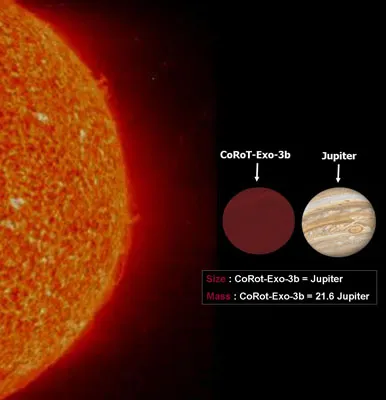
The object, called COROT-exo-3b, is the size of Jupiter, but 21.6 times denser. It takes only 4 days and 6 hours to orbit its star, which is a little larger than our Sun.
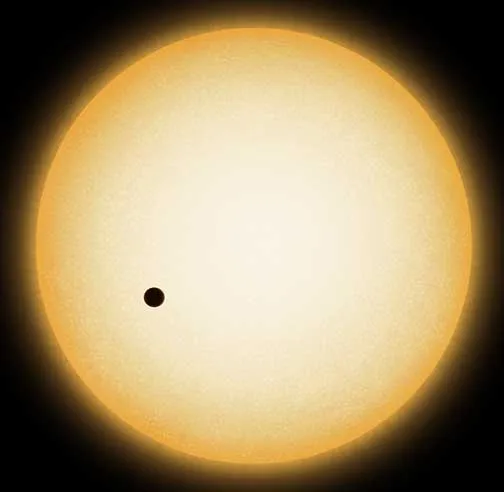
The object was found by detecting a drop in the star's brightness every time the object passed in front of it. "We were taken by surprise to find this massive object orbiting so close to its parent star," says Dr. Magali Deleuil of the Laboratoire d'Astrophysique de Marseille (LAM), leader of the discovery team.
The search for planets with orbital periods of less than 10 days orbiting close to their parent star has been going on for almost 15 years. During this time, scientists have found planets with masses 12 times that of Jupiter and stars 70 times more massive than the gas giant, but nothing in between. That is why the new object, 21.6 times more massive than Jupiter, is a surprise.
The rare find fits neither in the planet category nor in the brown dwarf category. A brown dwarf is a "failed star," a sub-stellar mass object, between 13 and 80 Jovian masses, incapable of sustaining continuous nuclear fusion reactions of hydrogen in its core.
COROT-exo-3b could, therefore, be a member of a new family of massive planets orbiting stars more massive than the Sun, as expressed by Dr. Francois Bouchy of the Institut d'Astrophysique de Paris (IAP).
Dr. Hans Deeg, of the Instituto de Astrofísica de Canarias (IAC), explains why this new object is an important discovery for planet hunters: "It has puzzled us; we are not sure where to draw the boundary between planets and brown dwarfs."
As a planet, COROT-exo-3b would be the most massive and the densest found to date, more than twice as dense as the previous record. Studying the object will result in a better understanding of how to categorize these objects. The team also wants to understand how such a massive object formed so close to its star.
Sources and related links
- ESA: COROT discovery stirs exoplanet classification rethink
- Transiting exoplanets from the CoRoT space mission.VI. CoRoT-Exo-3b: the first secure inhabitant of the brown-dwarf desert
M. Deleuil, H. Deeg, R. Alonso, F. Bouchy, D. Rouan, and T. Guillot et al.
Accepted for publication in Astronomy & Astrophysics
DOI:10.1051/0004-6361:200810625 - CoRoT
- CoRoT: Spanish Participation
About the images
Credit: OAMP