When Comet Holmes erupted unexpectedly in 2007, astronomers turned their telescopes toward the spectacular event. Their quest was to know why the comet exploded.
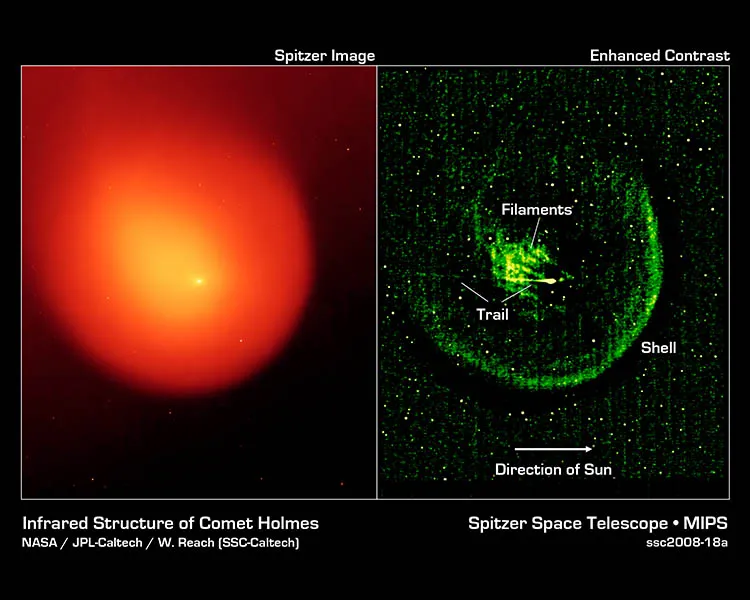
Observations taken after the explosion by the Spitzer Space Telescope deepened the mystery, showing strange behavior in the dust shell around the comet's nucleus. The data also offered a rare glimpse of the material released from the nucleus and confirmed previous findings from NASA's Stardust and Deep Impact missions.
"The data we obtained with Spitzer did not resemble anything we commonly see when observing comets," says Bill Reach of the Spitzer Science Center at the California Institute of Technology. "The comet Holmes explosion gave us a rare look inside the comet's nucleus." The findings were presented at the 40th Meeting of the Division for Planetary Sciences in Ithaca, New York.
Every six years, comet 17P/Holmes speeds away from Jupiter and heads toward the Sun. However, twice in the last 116 years, in November 1892 and October 2007, the comet exploded as it approached the asteroid belt and shone like never before in the night skies (It increased its brightness significantly, by about a million times!).
In an attempt to understand these rare occurrences, astronomers pointed the Spitzer Telescope at the comet in November 2007 and March 2008. By using the infrared spectrograph, Reach was able to gain valuable insight into the composition of the object's interior. Like a prism that spreads visible light into a rainbow, the spectrograph reveals the components of infrared light in various chemical elements.
In November 2007, Reach noticed a bunch of silicate dust or crystallized grains. This observation is similar to that obtained in other comets where the grains underwent violent episodes, including the Deep Impact mission, which impacted a projectile into comet Tempel 1, and the Stardust mission to comet Wild 2, and the outburst of comet Hale-Bopp in 1995.
"Comet dust is very sensitive, meaning the grains are more easily destroyed. We think the fine silicates are produced in these violent episodes by the destruction of larger particles that originate within the comet's nucleus," explains Reach.
When Spitzer observed the same portion of the comet in March 2008, the fine silicate dust was no longer there and only larger particles were found. "The March observation tells us there is a very small window for studying the composition of the dust after a violent event like the comet Holmes outburst," the scientist stated.
The comet not only has unusual dust components, but it does not look like a typical comet. According to Jeremie Vaubaillon, Reach's colleague at Caltech, images taken from the ground shortly after the outburst revealed filaments (streamers) in the dust shell around the comet. Scientists suspect they were produced after the explosion by fragments escaping from the nucleus.
In November 2007, the filaments pointed away from the Sun, which seems natural since scientists believe the star's radiation pushed these fragments backward. However, when Spitzer observed the same filaments in March 2008, they were surprised to find that they continued pointing in the same direction as five months earlier, even though the comet had moved and sunlight was coming from a different place. "We never saw anything like this in a comet before. The extended shape still needs to be understood," adds Vaubaillon.
The scientist notes that the shell around the comet also acts peculiarly. The shape of the shell did not change as expected from November 2007 to March 2008. Vaubaillon says this is because the dust grains seen in March 2008 are relatively larger, about a millimeter in size, and thus, are harder to move.
"If the shell were composed of smaller dust grains, it would have changed as the sun's orientation varied over time. The Spitzer image is very special. No other telescope has seen comet Holmes in such detail, five months after the explosion," adds Vaubaillon.
Reach adds that "Just like people, all comets are a little different. We have been studying comets for hundreds of years -116 years in the case of comet Holmes- but we still don't really understand them. However, with Spitzer's observations and data from other telescopes, we are getting closer."
Sources and related links
- NASA's Spitzer Gets Sneak Peak Inside Comet Holmes
About the images
The Spitzer telescope took the image on the left, of comet Holmes, in February 2008, four months after the sudden eruption. The image contrast was enhanced on the right to show the comet's anatomy.
The image on the left reveals fine dust particles that make up the outer shell or coma of the comet. The comet's nucleus is inside the brightest white dot in the center, and the yellow area shows solid particles that were ejected from the comet in the explosion. The comet is moving away from the Sun, which lies beyond the right-hand side of the image.
The contrast-enhanced image on the right shows the outer shell and rare filaments (streamers) of dust. The filaments and the shell are other mysteries of comet Holmes. Scientists initially suspected that the filaments were small dust particles ejected from fragments of the nucleus during the October 2007 explosion. If that were the case, the filaments and the shell would have changed their orientation as the comet continued its orbit around the Sun. The pressure of solar radiation would have swept the material backward, but images taken later show that the filaments and the shell are in the same configuration. The observations left astronomers perplexed.
The horizontal line in the image is a trail of debris traveling with the comet in its orbit.
Credit: NASA/JPL-Caltech/XMM/NTT/MPIA