A new experiment by the European Space Agency (ESA) shows that traces of life in a Martian meteorite could survive the violent conditions of entry into Earth's atmosphere.
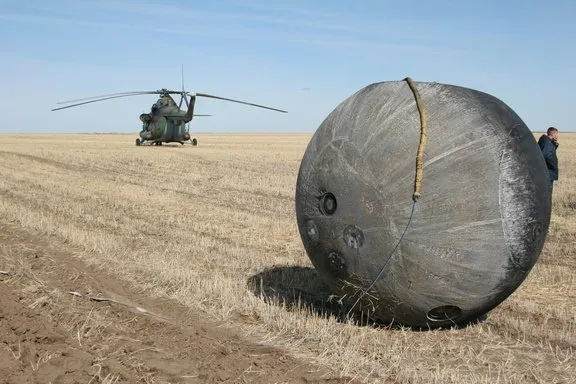
The experiment called STONE-6 was mounted on the FOTON M3 capsule which was launched in September 2007. Two samples of sedimentary rock and one control sample of basalt were placed on the capsule's protective shield. It reentered the atmosphere on September 26, after 12 days in orbit. The basalt was lost during reentry. However, a sample of sedimentary rock from Pilbara, Australia, 3.5 billion years old with microfossils and the rock sample from the Orkney Islands that contained chemical traces of past organisms, survived.
On one face of both rocks a bacterium called Chroococcidiopsis was placed, it is one of the most primitive cyanobacteria we know. Its ability to survive in a wide range of extreme conditions.
The idea was to know if these samples could survive the harsh conditions to which they would be exposed during reentry into our planet's atmosphere, where the temperature reaches 1700ºC.

After descent, the samples were transported to a laboratory at the European Space Research and Technology Centre (ESTEC) to examine the samples. The results were presented by Dr. Frances Westfall at the European Planetary Science Congress, in Münster, Germany, on September 25.
In 1999, ESA created the first experiment of this type, which it called STONE-1. Since then, more experiments were conducted on different types of rock and with different biological traces.
Recent missions have collected evidence of water and sediments on primitive Mars. Potential traces of Martian life are more likely to be found in sediments. However, although about 39 meteorites from Mars have been identified, all are basaltic rocks and no sedimentary rocks have been found to date.
Dr. Westall says that, "The STONE-6 experiment shows that sedimentary Martian meteorites could reach Earth. The fact that we have not found any to date could mean we must change the way we search for meteorites. Most meteorites have been found in Antarctica, where their black crust shows clearly against the white snow. In this experiment we found that sedimentary rocks develop a white crust or none. This means we must expand our search".
In the analysis of the samples it was found that the Pilbara one formed a crust half a millimeter thick, creamy white in color, beneath which the microfossils survived. Approximately 30% of the other sediment also survived as did its biomolecules.
The Chroococcidiopsis, on the other hand, did not have the same luck, it was carbonized.
According to the scientist, the experiment suggests that "if sedimentary Martian meteorites carry traces of past life, these can be transported to Earth. However, the results are more problematic to be applied to Panspermia, a theory that proposes that living cells could be transported between planets. STONE-6 showed that at least two centimeters of rock are not enough to protect organisms during reentry".
That is, Martian meteorites could tell us if there was life on that planet, for example, fundamentally if we found meteorites of sedimentary rocks. However, for those meteorites to serve as transport for living organisms that could arrive and thus be the germs of life on another planet, as proposed by the theory of Panspermia, it would not be possible with rocks of at least two centimeters, according to this experiment.
Sources and related links
- ScientificBlogging:STONE-6 Experiment Proves Martian Meteorite Could Carry Traces Of Life
- EPSC2008-A-00407; Room: S9
Westall, F.; Demets, R.; Brandstätter, F.; Edwards, H.G.M; Cockell, C.S.; Parnell, J.; Foucher, F.; Kurat, G.; Brack, A.
STONE 6: Sedimentary meteors from Mars
PDF - COSMOS:Meteorite tests deal blow to panspermia
About the images
The Foton-M3 capsule after descent. The STONE-6 rocks were fixed in the circular positions on the left side of the capsule.
http://meetings.copernicus.org/epsc2008/