The Rosetta spacecraft is preparing for a flyby of asteroid 2867 Steins. Furthermore, it renewed its own 2.0 space.
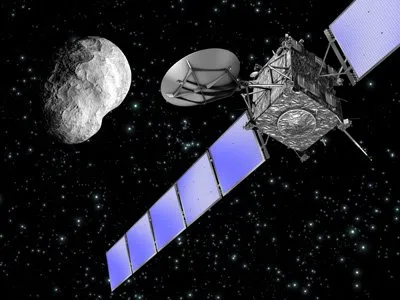
At the moment of closest approach, Rosetta will be 800 km from the asteroid, as planned, at a speed of 8.6 km/s relative to Steins. Both, the spacecraft and the asteroid, will be illuminated by the Sun, so it will be an excellent opportunity for scientific observations.
Near its closest approach to the asteroid, Rosetta is at 2.41 Astronomical Units, or 360 million kilometers from Earth. The radio signals sent and received will have a 20-minute journey between the satellite and our planet.
The Cebreros antenna in Spain will be used for communications with the satellite in the two days prior to the closest approach and other stations will also provide communications support.
Rosetta's closest approach to 2867 Steins is scheduled for September 5, 2008. For Saturday, September 6, a press conference with the first results and images is expected at the Operations Center in Germany.
To better inform about the activities, ESA created a renewed blog for Rosetta at:
http://webservices.esa.int/blog/blog/5
And why is it called Rosetta?
For the famous "Rosetta Stone". That basalt stone that is now in the British Museum in London, which was key in the translation of Egyptian hieroglyphs. French soldiers discovered it in 1799 near the village of Rashid (Rosetta) in Egypt. The inscriptions carved in the stone included a text written in Greek and in hieroglyphs. By comparing the inscriptions, historians were able to decipher the mysterious Egyptian writings. Thomas Young and Jean François Champollion were the pioneers in that work which allowed a better understanding of the fabulous Egyptian civilization.
Just as that Rosetta Stone was key to understanding the Egyptians, the Rosetta spacecraft of the European Space Agency will attempt to unveil the mysteries of the oldest building blocks of our Solar System: comets. As if it were a successor to Champollion, Rosetta will allow scientists to look back 4,600 million years to a time when planets did not exist and only a vast swarm of asteroids and comets surrounded the Sun.
The mission
The objective is for the spacecraft to enter the orbit of comet 67P/Churyumov-Gerasimenko in 2014 and perform a small landing on its icy nucleus and then spend two years orbiting the comet as it approaches the Sun. On its way, Rosetta received gravitational assistance from Earth and Mars and will fly past the main asteroid belt.
For 2009, a third gravitational boost from Earth is expected. In 2010 it will fly by Lutetia and in 2014 it will reach its cometary target. The mission would end in December 2015.
The spacecraft has a large number of instruments, among which OSIRIS, the imaging system, and ALICE, an ultraviolet spectrometer, stand out.
The spacecraft was launched on March 2, 2004 by an Ariane-5G rocket from Kourou, French Guiana.
Sources and related links
- Rosetta Blog now live
- Rosetta Steins fly-by timeline
- Technical Information and more material on Rosetta
About the images
Credit:ESA, image by AOES Medialab