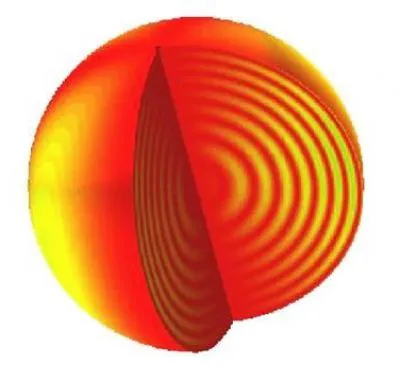
Subtle variations in the cosmic microwave background radiation left by the Big Bang could finally reveal the distant Oort Cloud.
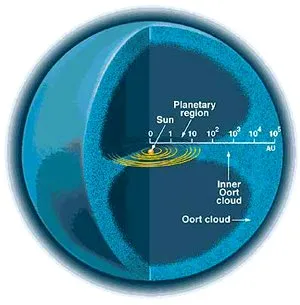
Since 1930 astronomers have theorized that a spherical bubble of icy objects surrounds the Solar System, 100,000 times farther from the Sun than Earth.
In 1932, astronomer Ernst Öpik postulated that long-period comets originated in a cloud orbiting the outer reaches of the Solar System. Later, the Dutch astronomer Jan Oort postulated the theory independently. Thus it is sometimes called the Öpik-Oort Cloud or Oort Cloud.
These debris, it is said, are the source of the so-called long-period comets, which take millions of years to orbit the Sun.
However, the existence of this cloud is hypothetical, as it has never been observed, given that the objects are too far away and too small to see.
Now, astrophysicists Daniel Babich and Avi Loeb from the Harvard-Smithsonian Center say they might be able to detect the cloud by studying the cosmic microwave background (CMB): the radiation that uniformly bathes space left by "the Big Bang".
Discovering the Oort Cloud would help astronomers understand the early solar system. Among other things, its shape could help understand how the outer planets formed and how large they originally were.
Although comets are icy, they are still warmer than the CMB. Thus, their thermal emission should show up against the CMB radiation, according to the researchers.
"Basically we take a random star from the observed distribution in the local neighborhood around the Sun. Then we calculate how the star would influence the Oort Cloud," Babich told Cosmos Online magazine.
The researchers then measured the effect the star would have on the CMB and on the warmer objects in the Cloud and repeated the calculations for 1,000 stars.
High-resolution CMB maps should be able to determine the areas of the cloud affected by the stars. So far no such map has been made, but surveys like those to be completed by the Planck telescope, planned for launch next year, could do the job.
Other methods for detecting the cloud, such as observing how objects passing in front of stars cause their light to dim, could provide evidence of large debris, but the CMB method is the best technique for finding smaller objects, the scientists explain.
Geraint Lewis, an astrophysicist at the University of Sydney, has some reservations. "If the Oort Cloud is effectively spherical, there would be no recognizable distortions in the CMB," he explains. But he adds that "We have this large population of cold, dark objects at the edge of the Solar System. There must be some kind of reservoir there, but we don't know where it begins, where it ends, or the composition of the objects."
Other hypotheses
It has been speculated that a star, perhaps a small star, somewhat larger than a planet like Jupiter, that is, a brown dwarf, could orbit near where the aforementioned Cloud is thought to be. That is, the Sun would have a small companion and it would be responsible for bombarding Earth with comets as it periodically passes through the cloud. This supposed star has not been detected so far.
Sources and related links
- "Big bang illuminates distant nursery of comets", by Heather Catchpole
- Imprint of distortions in the Oort Cloud on the CMB anisotropies
Daniel Babich, Abraham Loeb
DOI:10.1016/j.newast.2008.07.005
New Astronomy Volume 14, Number 2, Pages 166-179 (February 2009)
About the images
The image describes the distance of the Oort Cloud from the Solar System, using a logarithmic scale
Credit: NASA