Probing the Sun through a technique similar to seismology has opened a new era for understanding the interior of our star. The Corot satellite has now applied this technique to three stars, directly investigating their interiors, for the first time.
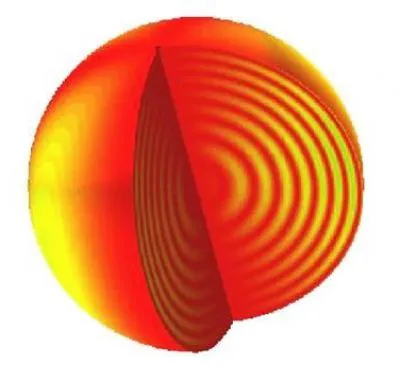
When the global oscillations of the Sun were discovered, scientists realized they opened a new window to the Sun's interior. Like the propagation of seismic waves on Earth, which provide information about the interior of our planet, sound waves travel through the Sun carrying information about what is happening beneath the surface.
These oscillations can also be observed in other stars. They can be detected through the variation in the light emitted by the star as the surface oscillates: the technique used by the Corot satellite. This reveals the star's internal structure and the way energy is transported from the core to the surface.
"Other techniques for estimating stellar oscillations have been used from the ground, but they are limited in what they can do," reports Malcolm Fridlund, a Corot scientist at the ESA ESTEC Research Centre, and co-author of the results.
"Adverse weather conditions and the fact that you cannot observe stars during the day force astronomers on the ground to interrupt their observations. Now, the key to detecting those small stellar oscillations from great distances is not only the sensitivity of an instrument but also the opportunity to observe the star without interruptions: any interruption produces noise in the data that can completely cover a signal. So, to be sure, we must address the issue with the right instruments and from space," adds the scientist.
The three stars investigated by Corot - known as HD499933, HD181420 and HD181906 – are similar to our Sun and are located between 100 and 200 light-years away.
Dr. Eric Michel of the Paris Observatory and a large group of colleagues from Europe and Brazil analyzed the data to determine that the three nearby stars, all significantly hotter than our Sun, also have larger vibrations and a finer surface texture or granulation. With these data, the researchers show that the oscillations of these stars are about 1.5 times more vigorous than in our Sun and their granulation is about three times finer.
These results represent the first time researchers have been able to accurately measure the oscillation amplitudes and granulation of stars beyond the Solar System.
The initial discovery of oscillations in our Sun, in the late 1970s, led to the creation of asteroseismology, which has since been used to measure the motion and heat transport around the Sun. Progress in understanding the internal structure of the star that lights us daily, however, ran up against the need to obtain precise data from uninterrupted observations. This makes study from the ground impossible. Hence, these observations made from space, without interruptions, with the Corot satellite, for 60 days, help refine our understanding of stars and our Sun.
"Although the Sun's energy is more or less constant over our lifetime, every small variation can have important effects," notes Brooks Hanson, physics editor of the journal Science in which the results were published. "Understanding that small variability is crucial for, for example, predicting solar storms and space weather and understanding the causes of changes in Earth's climate," he added.
The pulsation of stars depends on their age, size and chemical composition. (In the BBC note it is possible to hear these sound waves!)
According to Michel, the pulsations of the three stars studied are close, but not equal to what was expected, so scientists will have to ask themselves if it is not necessary to rethink the models accepted until now.
Sources and related links
- ESA:COROT directly sees ‘Sun-quakes’ in other stars for the first time
- CoRoT Measures Solar-Like Oscillations and Granulation in Stars Hotter Than the Sun
E. Michel et al.
Science 24 October 2008:Vol. 322. no. 5901, pp. 558 - 560
DOI: 10.1126/science.1163004 - BBC:Team records 'music' from stars
- Discovery:Distant Stars Send Good Vibes
About the images
Illustration of the global oscillations of a star shaking the entire interior and thus transporting information. The yellow color refers to maximum temperature variations, due to the oscillations.
Credit:Aarhus University/S. Frandsen