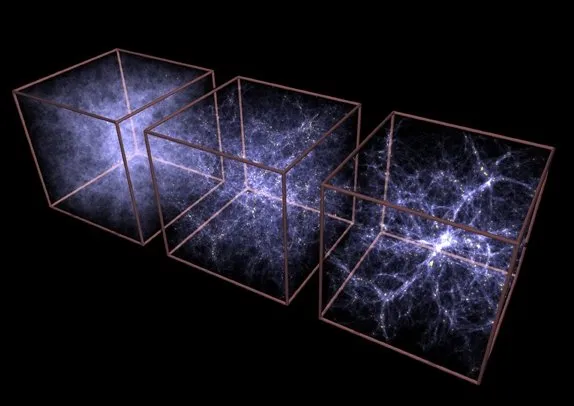
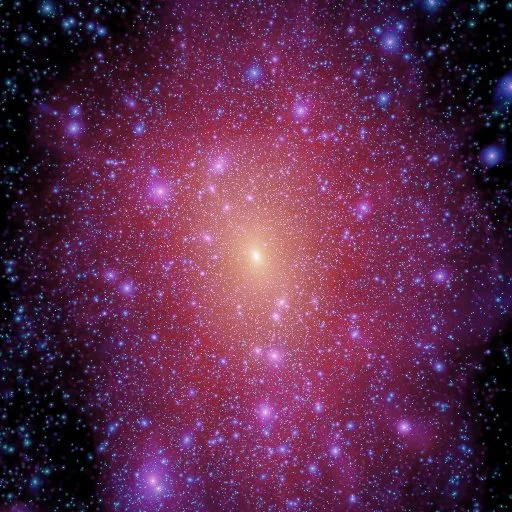
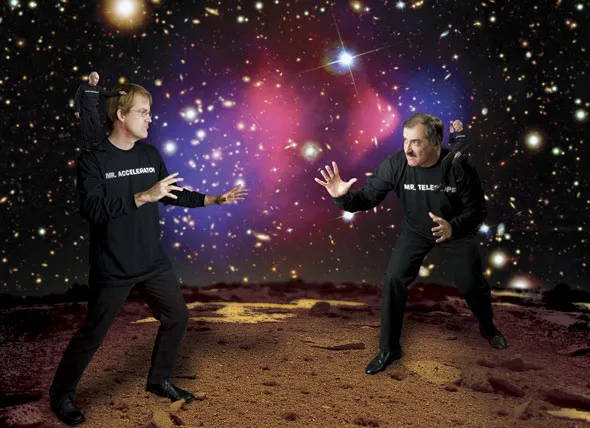
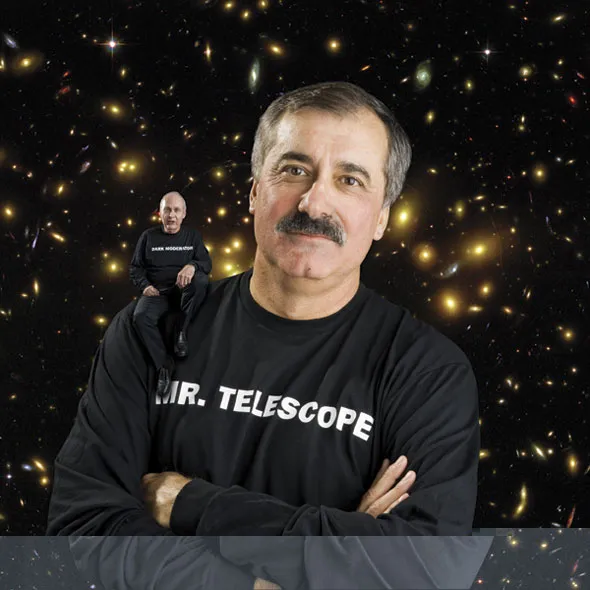
Who will be the first to prove the existence of dark energy and dark matter? A particle physicist (Mr. Accelerator) and an astrophysicist (Mr. Telescope) debate face to face.
Researchers understand only 4% of the universe, made of atoms, compared to the remaining 96% which they think is composed of dark energy and dark matter.
(See "The Dark Side of the Universe"). Scientists found evidence of dark matter and dark energy, but nobody knows what they really are. Researchers, from many disciplines, are looking for the answers in space, in ground observatories and try to create these particles in accelerators. The question is: Who will be first?
Joe Lykken, a particle physicist at Fermilab and the astrophysicist Rocky Kolb faced the topic in a public debate on September 24, moderated by Michael Turner (an astrophysicist from Chicago).
Lykken argued that particle physicists will be the first to find evidence of dark matter and dark energy, using accelerators and detectors. Kolb indicated that astrophysicists would be first with the help of satellites, telescopes and the same detectors underground.
They spoke before an audience of almost 400 people at the Smithsonian Museum in Washington. Michael Turner, who coined the term "dark energy" moderated the talk.
Turner's introduction went to a key point. "Why should the taxpayer invest in this? Why should the man or woman on the street be interested in answers to questions about the dark side?"
Lykken responded by pointing to quantum mechanics -the study of the interaction of particles at the smallest level- which at first seemed purely an intellectual exercise with no practical application. But it led to the invention of electronics, including the computer. The same with the connection between magnetism and electricity that led to today's power plant technology.
United by the search in the darkness
Scientists found evidence of dark matter in 1935. They theorized that clusters of dark matter formed the foundations of galaxies, holding them together.
A decade ago, scientists discovered that an opposing force was pulling the universe apart, causing an accelerated expansion.
The search for understanding dark matter and dark energy generated a common goal for scientists who previously operated independently, admitted Lykken.
"Until recently," added Kolb, "particle physicists considered astronomers like Rocky as insomniacs who spent all night taking pictures that didn't matter to us".
Lykken added that particle physicists realized that their theory of supersymmetry predicted the existence of something similar to the dark matter that astrophysicists were detecting. Supersymmetry holds that all known particles have a corresponding particle that behaves differently. This theory could help fill the missing pieces about how the building blocks of matter and the forces of nature work to create objects. The lightest particle, the neutralino, is a prime candidate for dark matter, which is thought to have existed since the early universe, when it helped matter clump together to form galaxies.
"Supersymmetry has explained both how the subatomic world holds together and how galaxies hold together. It's the connection of inner-space, outer-space," explained Lykken.
"So you weren't interested in dark matter. But then you noticed it was important and remembered you had predicted it," added Turner.
"Well, it also seems we predicted dark energy," added Lykken. Physicists call it "vacuum energy" and Albert Einstein called it "cosmological constant" and they share the basic idea that empty space is not completely empty.
Illuminating dark matter

Particle physicists hope to find dark matter in one of two ways: either by producing it in a particle accelerator or by identifying it with ultrasensitive detectors underground. Many believe the reason accelerators haven't found dark matter yet is that it would take an enormous amount of energy to create it -a level that could now be reached with the Large Hadron Collider.
"I think the LHC will find something that is really going to shake fundamental knowledge of physics," stated Lykken, who is working on the LHC's CMS experiment, and even said that perhaps it could be discovered within three years.
Kolb went further by declaring that astrophysicists would discover it with astronomy in two and a half years.
Two clues have led astronomers to suspect the existence of dark matter: First, when they measured the masses of the stars and planets that make up galaxies, they discovered that the gravity of those objects would not be enough to hold them together. Something they couldn't see must be contributing the missing mass (as well as the gravitational pull).
Second, they could see distortions of light in space, normally caused by large masses, in places that seemed to be empty. They called it the invisible presence of dark matter.
"Are you sure dark matter is there?" asked Turner.
"I'd bet your life," replied Kolb.
Detecting dark energy

The researchers were not so confident of success in the search for dark energy, a mysterious form of energy that would push the universe to expand at an accelerated rate. Both said that the best possible development would be that, contrary to Turner's prediction, dark energy does not exist. This would give them a blank check to start over, with new theories.
"Just for the record, it was a Tuesday in 1964 when I made a mistake. There was a time when I made a mistake. It's not impossible" joked Turner.
Astronomers came up with the idea of dark energy after measuring the rate at which the universe was expanding long ago, compared to the more recent acceleration.
They found their basis for comparison by looking at distant objects in space: supernovae. By measuring how brightly these explosions shine as seen from Earth, scientists can tell how far away they are. Since light takes time to travel to our planet, the distance of the supernovae allows astronomers to look back in time.
When scientists look at very distant objects, they are seeing how they were in the past.
"That's why, when I look at the audience here, the people in the back look younger to me," joked Kolb.
Astronomers had expected the expansion to slow down over time, since gravity attracts objects. To their surprise, they discovered that the expansion is accelerating, the supernovae were moving away more quickly. As if a force were pushing those objects—and everything else in the universe.
While Turner believes the best explanation is the repulsive gravity of dark energy, he admitted there could be another explanation for these surprising observations. "Hit me with your craziest ideas," he asked the two scientists. "Make it really crazy, the Paris Hilton kind of crazy."
Kolb said that dark energy could be "the ether of the 21st century." Earlier theorists thought this hypothetical substance filled the universe and allowed light to travel through what would otherwise be empty space. After finding that the speed of light was the same in all directions of space, experimenters refuted the concept of ether.
"We think dark energy is there, but perhaps something even stranger is happening, something even more surprising. One possibility I've been working on is that the universe is so inhomogeneous that, in some unknown way, this changes the expansion of the universe and makes us think dark energy exists. If the idea were correct, the way we've been doing the basic equations of cosmology since 1922 would change," said Kolb.
Lykken said that the idea of dark energy could be explained by a flaw in our understanding of gravity. "One reason is that we might be doing gravity in the wrong number of dimensions," he added. String theorists predict the existence of at least six additional dimensions beyond the four space-time dimensions we perceive.
Coming up
Turner asked his colleagues to predict where science will be in a century.
A hundred years ago, said Kolb, astronomers believed the Milky Way was the entire universe. "I think that in 100 years we will understand the fact that what we call the universe today will be only a small part of something we might call a multiverse or megaverse."
Lykken, for his part, thinks that "the history of particle physics is finding a new force of nature out there. New forms of matter we didn't suspect were there. Within 100 years we will have found at least one new force of nature."
"If this didn't make you interested in science, then give up."
Sources and related links
- Symmetry:The dark universe debate, by Kathryn Grim
- Mr. Accelerator “vs.” Mr. Telescope
About the images
Joe Lykken, Fermilab vs. Rocky Kolb; and moderator Michael Turner.
Photos: Reidar Hahn, Fermilab
Illustration: Sandbox Studio
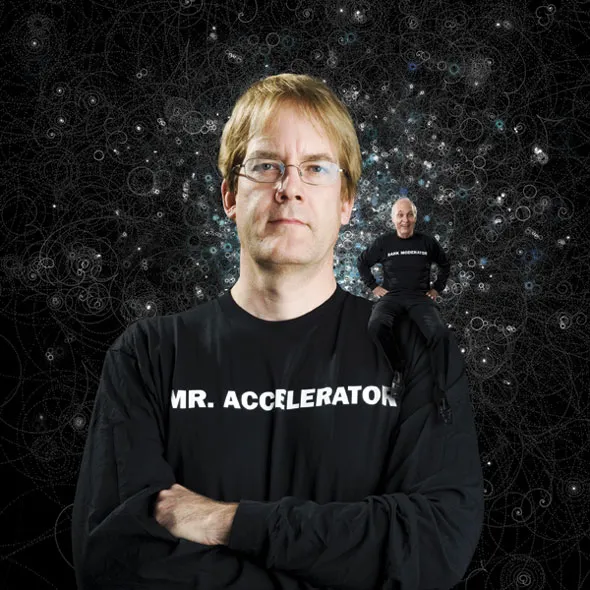
"Mr. Accelerator"
Photos: Reidar Hahn, Fermilab
Illustration: Sandbox Studio
Background image: Bubble Chamber “Strange Event” algorithm, Jared Tarbell 2004
"Mr. Telescope"
Photos: Reidar Hahn, Fermilab
Illustration: Sandbox Studio
Background image: NASA and STScI