A composite infrared image of the center of the Milky Way reveals a new population of massive stars and new details in complex structures in the hot ionized gas around the central 300 light-years.
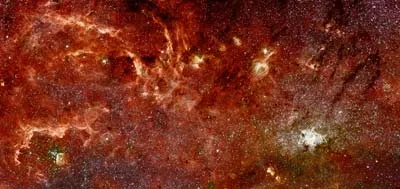
This panorama is the sharpest infrared image of the galactic nucleus. It is a nearby "laboratory" that allows astronomers to understand how massive stars form and influence their environment in the usually violent regions of other galaxies. This view combines the power of Hubble's Near Infrared Camera with a previous survey by Spitzer with its IRAC camera.
The galactic nucleus is dark in visible light due to the dust clouds that block the view, although infrared light can penetrate that dust to reveal these details. The Hubble images were taken between February 22 and June 5, 2008.
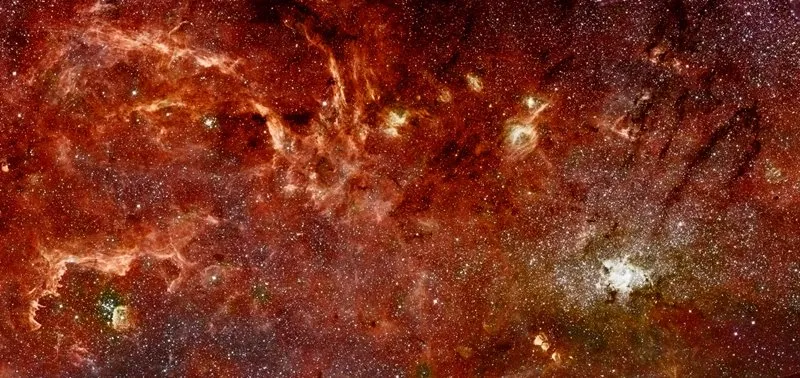
One finding is that astronomers can now see that massive stars are not confined to the three known clusters of this type of star in the galactic center, known as the Galactic Cluster, the Arches Cluster, and the Quintuplet Cluster. These groupings are easily seen as tight concentrations of bright massive stars in the image. The distributed stars could have formed in isolation or could have originated in clusters, later altered by powerful gravitational forces. The winds and radiation from these stars form complex structures seen in the nucleus and in some cases could be triggering the generation of new stars. In the upper left, long arcs of ionized gas are seen as sets of filaments, indicating, perhaps, the critical role of the influence of powerful local magnetic fields.
The lower left region shows pillars of gas sculpted by the winds from the massive stars of the Quintuplet Cluster. In the center of the image, the ionized gas surrounding the supermassive black hole at the center of the galaxy.
Sources and related links
- Hubble Views Galactic Core in Unprecedented New Detail
- A Panoramic Hubble Space Telescope View of the Galactic center in Paschen-alpha Emission
Q. Daniel Wang
213th AAS Meeting — Long Beach, CA
About the images
Hubble image credits: NASA, ESA, and Q.D. Wang (University of Massachusetts, Amherst)
Spitzer image credits: NASA, Jet Propulsion Laboratory, and S. Stolovy (Spitzer Science Center/Caltech)