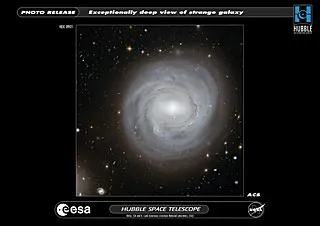
A spectacular new image of an unusual spiral galaxy in the Coma Galaxy Cluster was created with data from the Advanced Camera for Surveys on the Hubble Space Telescope. It reveals fine details of the galaxy NGC 4921.
The Coma Cluster is one of the closest collections of galaxies. Also known as Abell 1656, it lies 320 million light-years from Earth and contains over a thousand members.
Galaxies in rich clusters produce many interactions and mergers that tend to turn spirals into elliptical systems without much active star formation. As a result, there are many more ellipticals and fewer spiral galaxies in this cluster.
NGC 4921 is one of the rare galaxies in Coma. It is an example of an "anemic spiral", where the normally vigorous star formation that creates the familiar spiral arms is less intense, so there are only delicate spirals in a ring around the galaxy, accompanied by some bright young blue stars. The pale structure in the outer regions of the galaxy is unusually smooth and gives the galaxy the ghostly appearance of a jellyfish.
The long exposure time and Hubble's quality allowed not only the detailed observation of NGC 4921, but also much farther, into the distant universe. All around, even through the galaxy itself, thousands of much more remote galaxies are visible, of all sizes, shapes, and colors.
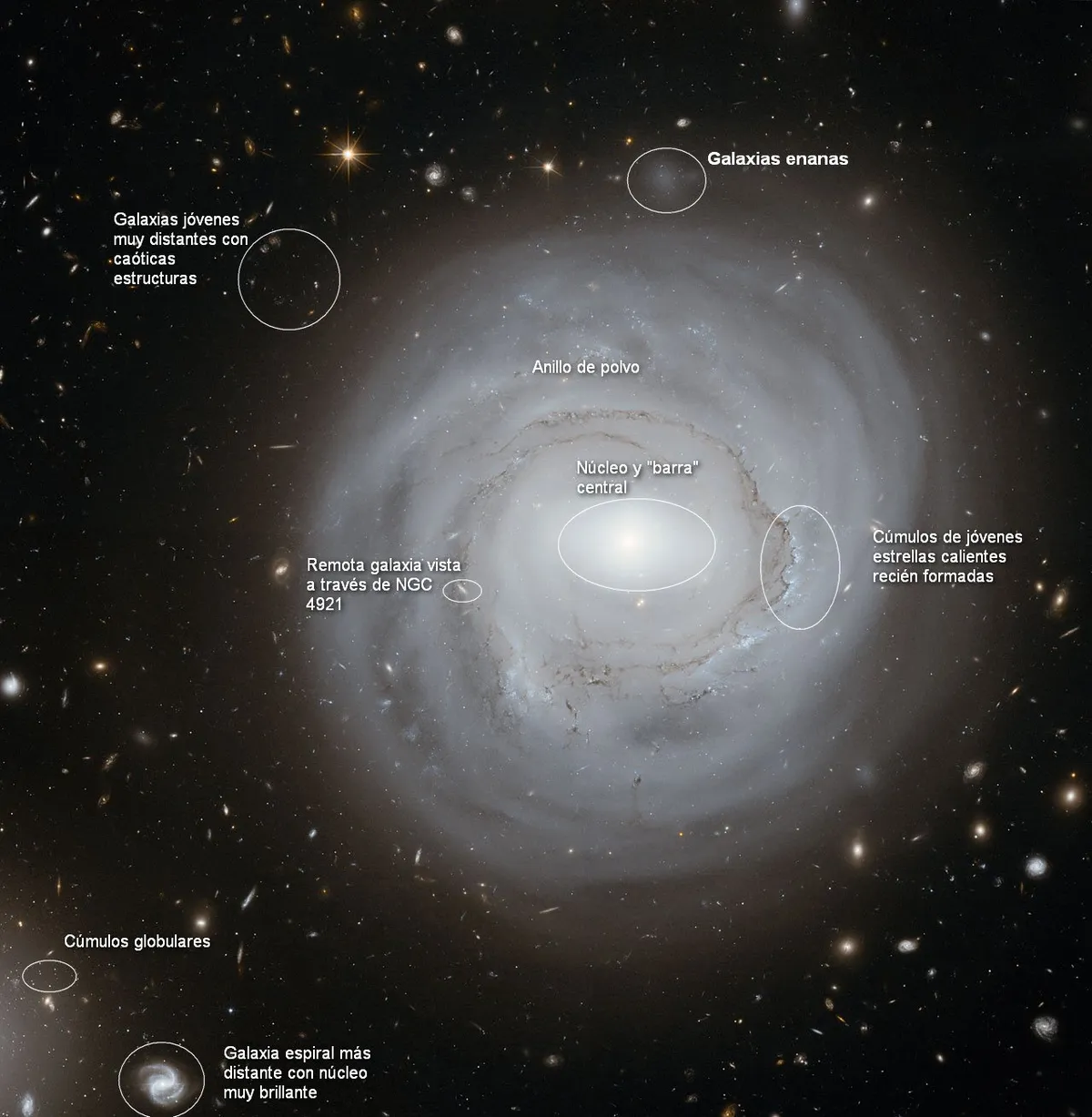
The Hubble images used to create this picture were originally obtained by a team led by Kem Cook (Lawrence Livermore National Laboratory, California).
His team was using Hubble to search for Cepheid variable stars in NGC 4921 that could be used to measure the distance to the cluster and, thus, the expansion rate of the universe.
Unfortunately, the failure of the Advanced Camera for Surveys in early 2007 meant they had insufficient data to complete their program, although they hope to continue after the next servicing mission.
The image was created from 50 separate exposures through a yellow filter and another 30 exposures through a near-infrared filter. The total exposure time was approximately 17 and 10 hours respectively.
Sources and related links
- SpaceTelescope:Exceptionally deep view of strange galaxy
The site contains many more images in different sizes, videos, and other resources.
About the images
Credit:NASA, ESA and K. Cook (Lawrence Livermore National Laboratory, USA)