Astronomers unveiled regions of intense star formation in the nearby galaxy NGC 253. The center of this galaxy appears to host a supermassive black hole.
Astronomers from the Instituto de Astrofísica de Canarias, Spain, used the NACO instrument on the Very Large Telescope to study in detail the galaxy NGC 253, one of the brightest and dustiest spiral galaxies in the sky. The instrument allows observations to be made with the technique called Adaptive Optics (AO) which corrects the blurry effect introduced by the planet's atmosphere. This turbulence makes stars twinkle in a way that delights poets, but frustrates astronomers by blurring the images. With AO action, the telescope produces images as sharp as possible, as if the telescope were in space.
The observations provide scientists with such detail that, for the first time, they can compare them with the best radio maps of that galaxy, maps that have existed for more than a decade, explained Juan Antonio Fernández-Ontiveros, lead author of the results report.
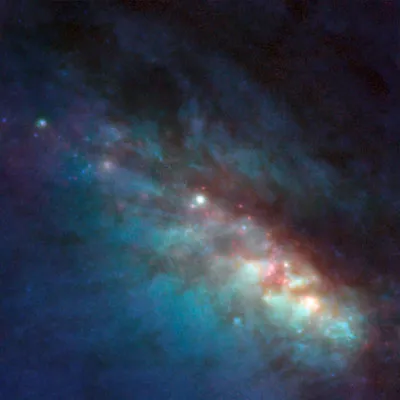
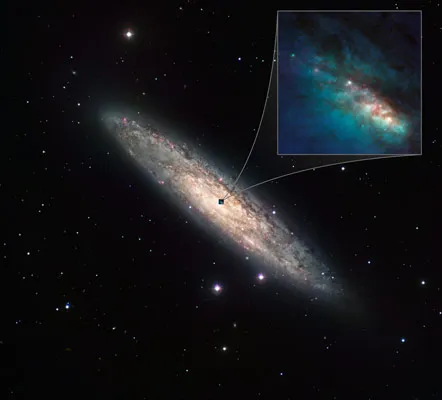
NACO revealed features in the galaxy of only 11 light-years in diameter. Astronomers identified 37 bright regions, a threefold increase over previous results, packed into a small region in the galaxy's nucleus, comprising only one percent of the galaxy's total size. The researchers combined their images with data from the VISIR instrument, images from the Hubble Space Telescope and radio observations from the VLA and VLBA. By combining these observations, taken at different wavelengths, they obtained a clue to the nature of these regions.
"We think they are probably very active nurseries containing many stars bursting out of their dusty cocoons," said José Antonio Acosta-Pulido, a team member. NGC 253 is known as a "starburst" galaxy, galaxies with intense star formation. Each bright region could contain 100,000 young massive stars.
These data allow astronomers to think that the center of NGC 253 hosts a larger version of Sagittarius A*, the bright radio source that lies at the nucleus of the Milky Way and is thought to host a massive black hole. "We have thus discovered what could be a twin of our Galactic Center," added co-author Almudena Prieto.
Sources and related links
- Frantic activity revealed in dusty stellar factories
- The nucleus of NGC 253 and its massive stellar clusters at parsec scales
Juan Antonio Fernández-Ontiveros, M. Almudena Prieto, Jose Antonio Acosta-Pulido (Instituto de Astrofísica de Canarias)
arXiv:0810.3250v1
Accepted for publication in MNRAS (Letters)
DOI: 10.1111/j.1745-3933.2008.00575.x
About the images
ESO PR Photo 02a/09
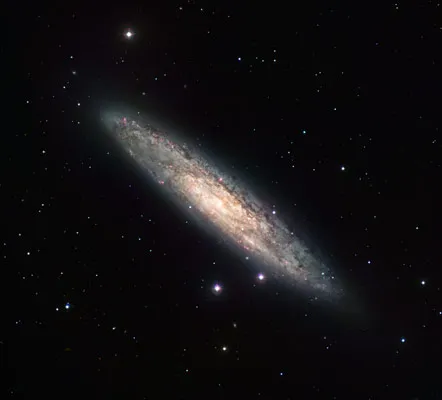
The starburst galaxy NGC 253
Credit:ESO
The entire galaxy observed by the WFI instrument is shown. The inset shows a close-up of the central parts observed by NACO.
ESO PR Photo 02b/09
Close-up of the central regions of galaxy NGC 253.
Credit:ESO
ESO PR Photo 02c/09
With a diameter of 70,000 light-years and at a distance of 13 million light-years, the spiral galaxy NGC 253 is revealed here in an image taken at the La Silla Observatory.
Credit:ESO