Could there be other planets in the solar system, still undiscovered? Is it feasible that the much-talked-about planet X exists?
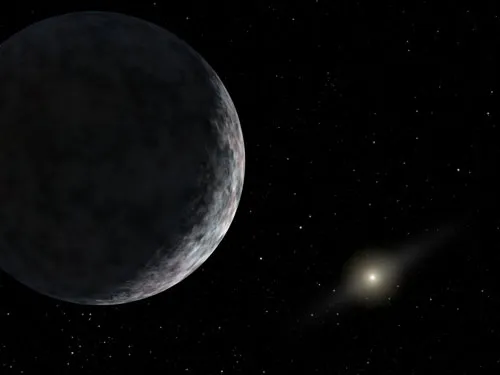
When the International Astronomical Union voted to demote Pluto to the dwarf planet category in 2006, they established three criteria to define what a planet is: it must orbit the Sun, its gravity must be sufficient to shape it into a quasi-spherical form; and it must be massive enough to have its orbit cleared. Pluto did not meet the third criterion. It is one of the many objects in the Kuiper Belt, icy debris beyond Neptune's orbit.
Some objects in the belt travel in extremely elongated orbits around the Sun. Others have steep orbits. "These could be signs of perturbation from a distant massive object," indicates Robert Jedicke, a scientist at the University of Hawaii.
Of course, his assessment does not have general consensus. An early migration of the giant planets (See "How the Solar System Was Created") could also explain these strange orbits.
Over the last 20 years, large regions of the sky have been covered in the search for objects and more than 1000 Kuiper Belt objects have been found. But these large-area surveys can only detect large and bright objects. The surveys that can find smaller objects cover only small areas of the sky. An object the size of Mars, at a distance of, say, 100 AU, would be as faint as it is difficult to observe.
This could change soon. In December 2008, the first prototype of Pan-STARRS was seen. Soon, four telescopes - equipped with the world's largest digital cameras - will scan the sky for anything that twinkles or moves. Their main purpose is to search for asteroids dangerous to Earth, but the inhabitants of the outer solar system will not escape their observations.
Jedicke and his team are developing software to detect objects automatically with Pan-STARRS. The discovery of a more distant planet would be exciting. Its presence could be explained by the merging of large objects and their subsequent ejection by the gravity of the giant planets.
Could planet X be a brown dwarf?
This possibility is hard to believe. A brown dwarf is smaller than a star and larger than a planet. These are objects whose mass is less than that needed to sustain fusion. These objects are born hot, since they form - like stars - from a collapsing cloud of gas and dust. The process generates so much heat that even a brown dwarf can have fusion in its core. At least for a while. But they cannot maintain that fusion and they shut down.
A mature brown dwarf shines in infrared. It has a temperature between 1000 and 2500 degrees Celsius, so it emits very little visible light. Gliese 229b is an example of a brown dwarf. It eluded detection until 1995. It shines with a magnitude 25 in visible light.
Gliese 229b is located 18 light-years away. A planet X that was similar to this brown dwarf, but located in our solar system, would be much, much brighter, with a magnitude 2.
It is said that planet X is in an orbit that brings it close to the Sun every 3600 years. With knowledge of the laws of gravity it is possible to calculate its distance at any given time. The well-known astronomer Phil Plait took the trouble to do the calculations: In May 2002, the supposed planet X would have had to be at a distance similar to Earth's from Saturn and as bright as the gas giant.
Planet X or Nibiru as it is also called, is a fantasy. The forecast that it would pass near Earth in 2003 evidently did not come true, because such a planet does not exist.
Is it possible that there is some planet in the solar system that has not yet been discovered?
Yes, it is possible. A small body, beyond Neptune, is difficult to observe. An object beyond Pluto, for example, if it is small in size, could have escaped detection.
Why is it then ruled out that planet X exists?
The claims about planet X arise from the book "The 12th Planet", by Zecharia Sitchin. The author says he studied the Sumerians. Taking their stories of gods and other myths as facts, he determined that they were in contact with an alien civilization that lives on a 12th planet (the eight current planets, plus Pluto, the Sun and the Moon) in our solar system that passes through the inner solar system every 3600 years.
The myth of planet X includes "pole shift" and "Stoppage of Earth's rotation".
Since the book, the number of followers who believe that it is indeed a reality, rather than fiction, has been increasing.
If it existed, as their claims say, a planet 23 times larger than Earth and passed through the inner solar system every 3600 years, we would have already detected it.
Is there a conspiracy against planet X?
On the contrary, there is a conspiracy in favor of the supposed planet. Any planetary scientist would love to find a new planet in the solar system. But he does it through observations and in accordance with firmly established knowledge. This is why, given the characteristics that the invisible planet is said to have, researchers took care to verify their accuracy. The arguments usually given in favor of this planet X were dismissed by scientists and it is there that the argument of "worldwide conspiracy" is appealed to. In the absence of evidence, a conspiracy comes to lend a hand, to continue maintaining the myth.
Sources and related links
- New Scientist:Is there a Planet X?, by Govert Schilling
- The Planet X Saga: Introduction
- A look at the Science behind Planet X
About the images
Artistic conception of the dwarf planet Eris, also known as 2003UB313.
Credit: R Hurt (SSC/Caltech) / JPL-Caltech / NASA
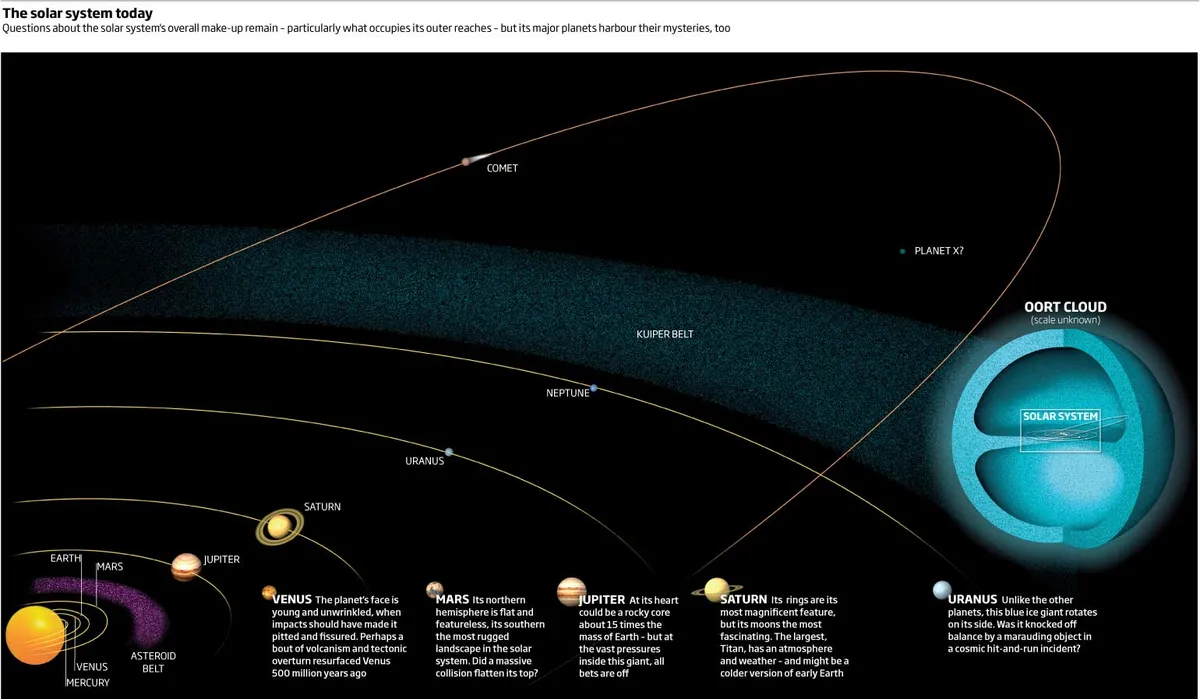
Graphic: The solar system today
Credit: NewScientist