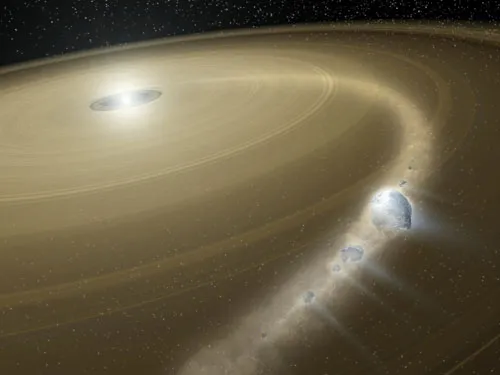
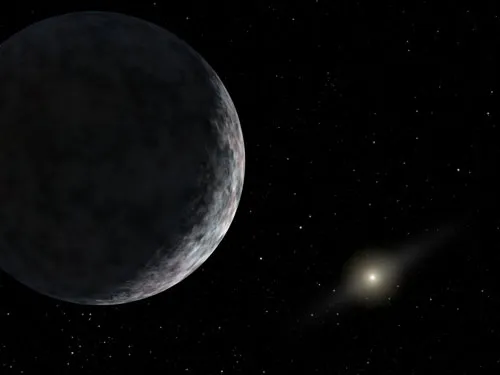
Looking at the planets of the solar system, one might think that if they belong to the same family it is by adoption, rather than by kinship. But no. The story of their birth reveals that they were created from the same molecular cloud that collapsed to form the Sun.
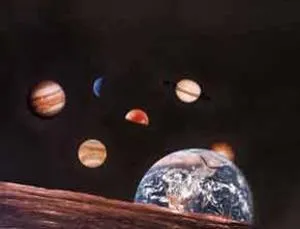
When our Sun formed, it swallowed almost all the surrounding debris cloud. The rest was sculpted by gravity into a disk of gas and dust around the newborn star. The dust grains orbiting the Sun collided and progressively formed larger bodies. In the innermost part of the disk, the combustion of hydrogen in the Sun made things very hot, so only metals and silicon minerals with high melting points were present in solid form. The bodies in this region could only reach a certain size, producing the four rocky planets of the inner solar system: Mercury, Venus, Earth and Mars.
Beyond this zone, without these rigorous limitations, methane and water could also be present as solids. Here, the developing planets could grow larger and be big enough to begin accreting gas molecules -mainly hydrogen- before the Sun's energy broke them apart. Thus, finally, that is how the gas giants Jupiter and Saturn were created and further out in even colder climates, the ice giants Uranus and Neptune.
So far, everything seems very simple. But when one begins to detail the process, the accretion model is quite weak, says Alessandro Morbidelli of the Observatoire Côte d'Azur, France. To begin with, no one knows exactly how small rocks manage to form much larger bodies. Small objects would have received pressure from the gas around them and would have sent them toward the Sun before they could form larger bodies. A recent proposal is the possibility that regions of turbulence in the gas produced low-pressure vortices in which rocks could have gathered and merged.
A similar problem affects the gas giants, whose solid cores must have merged in the presence of gas that they would later accrete. The risk of these planets being pushed toward the Sun is illustrated by the "hot Jupiters" seen in other planetary systems. These are planets of size similar to Jupiter but orbiting their stars at a distance like that of Earth or closer.
How to create a solar system
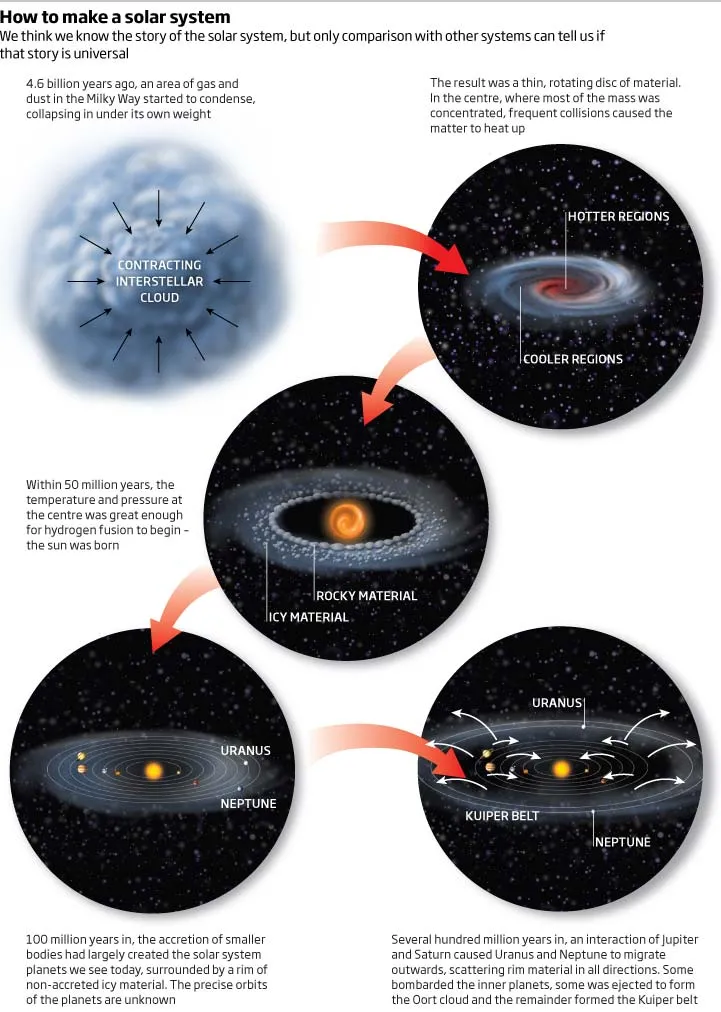
4.5 billion years ago, an area of gas and dust in the Milky Way began to condense, collapsing under its own weight.
The result was a thin disk of rotating material. In the center, where most of the mass concentrated, frequent collisions caused the matter to heat up.
Within 50 million years, the temperature and pressure in the center were great enough for hydrogen fusion to begin: the Sun was born.
At 100 million years, the accretion of minor bodies largely created the planets we know, surrounded by a ring of icy material. The precise orbits of the planets are unknown.
Several hundred million years: an interaction of Jupiter with Saturn caused Uranus and Neptune to migrate outward, scattering material from the ring in all directions. Some bodies bombarded the inner planets, others were ejected to form the Oort Cloud and the remainder formed the Kuiper Belt.
According to a theory by Morbidelli and colleagues, the solar system had a reconfiguration.
It is generally accepted that the planet formation process, which began 4.6 billion years ago, would not have taken more than 10 million years. But the lunar rock samples brought by the Apollo missions indicate that the rocks formed at the same time, hundreds of millions of years after the birth of the planets.
The conventional explanation is that after the solar system calmed down, it had a brief but violent epoch, sometimes called the "lunar cataclysm" or "late heavy bombardment". About 700 million years after the formation of the planets, the moon and the inner planets were hit by waves that destroyed their surfaces.
Why would this bombardment have occurred?
Many hypotheses were proposed but, until recently, no one explained the origin of the event in detail and according to observations, such as the shape of the orbits of the giant planets or the trajectories of objects beyond Neptune.
A step toward the answer was taken in 1993 when at the University of Arizona, Renu Malhotra studied the possibility of planetary migration. Malhotra used computer models of the solar system to argue that Uranus and Neptune could have formed in orbits much closer to the Sun and that their subsequent migration could explain Pluto's strange orbit. (See "Uranus and Neptune may have swapped places"). Later, other researchers began to wonder if those migrations could have generated the late heavy bombardment.
The early solar system
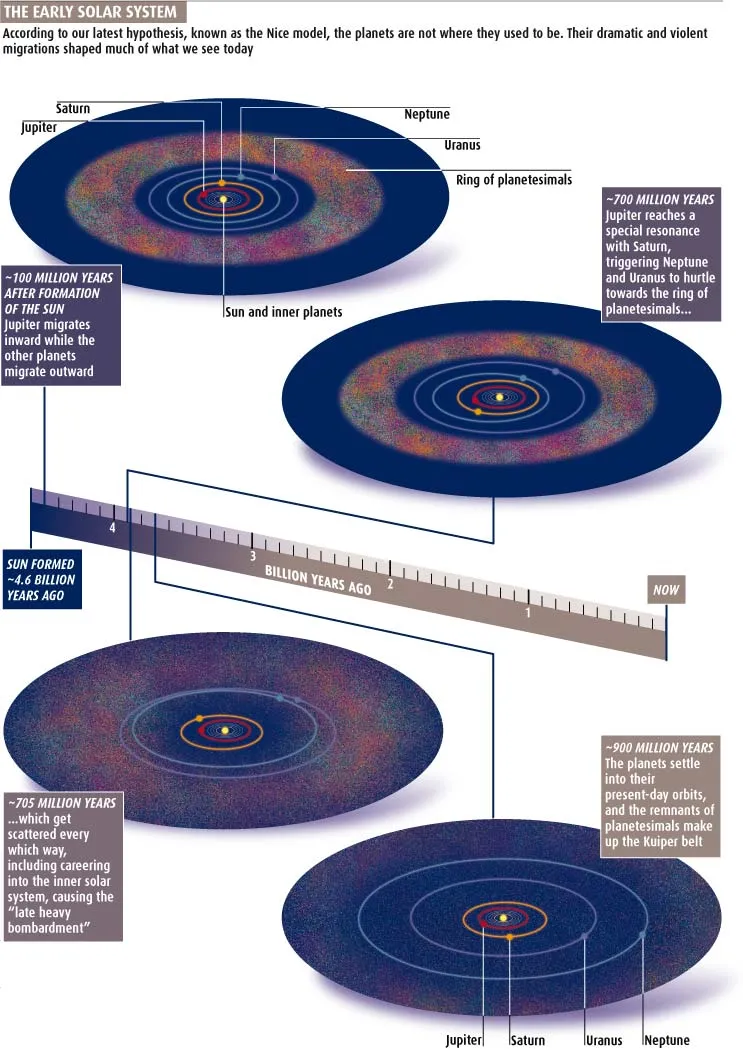
- Timeline in billions of years
- The Sun formed approx. 4.6 billion years ago
- Approx. 100 million years after the Sun's formation
Jupiter migrates inward while the other planets migrate outward. - Approx. 700 million years :Jupiter reaches a special resonance with Saturn, sending Neptune and Uranus into the planetesimal ring...
- Approx. 705 million years:
...which are scattered in all directions, including the inner solar system, causing the "late heavy bombardment" - Approx. 900 million years
The planets settle into their current orbits and the remnants of the planetesimals form the Kuiper Belt.
In 2002 Morbidelli and colleagues formed a group that would produce what is known as the "Nice Model". The group performed detailed simulations of the first few hundred million years of the solar system, taking as a starting point newly formed planets around a ring of debris.
In the simulations, the two largest planets, Jupiter and Saturn, pulled a little on each other every time their orbits came close, but overall, these gravitational pulls canceled each other out. However, when Jupiter orbited the sun exactly twice for every one of Saturn's orbits—a two-to-one "resonance"—the closest approach occurred at the same point in each of their orbits and, instead of canceling, these pulls worked in the same direction, forming elongated elliptical orbits. This, in turn, altered the orbits of Uranus and Neptune.
Resonances are common in planetary dynamics. Like a child on a swing receiving a gentle push at the right point to go higher and higher, this particular resonance gave a push to the orbits of Uranus and Neptune every time they were near the giant planets. Little by little, the simulations showed their orbits becoming longer and more elliptical. This led them into the swarm of planetesimals which, in turn, due to the gravity of the giants, were either ejected or drawn toward the sun. In the process, the planetesimals bombarded the inner planets and their moons.
For the timing to match, the group found it crucial to place the debris ring between the orbits of Saturn and Neptune and thus, correct the size of the initial disk.
The model, in this way, would agree with the current configuration of the system, including the asteroids known as Trojans.
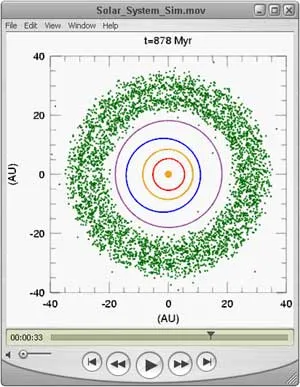
However, many scientists are not convinced by the model, mainly due to its size. The Nice model, to work, must have a debris disk of about 30 astronomical units to match current observations.
Disks have been observed around many young stars—like Beta Pictoris—and their size does not match.
"We see disks of 100, 200, 300 astronomical units. We rarely see disks of 30 AU," notes Scott Kenyon of the Harvard-Smithsonian Center.
The Nice model, however, allows us to explain many of the features of the current solar system, including the Kuiper Belt and the unusual shapes of the orbits of Jupiter and Saturn. Undoubtedly, the model, although it may need to be corrected, has set a new standard that can be improved and expanded in future research.
Sources and related links
- New Scientist: Unknown solar system 1: How was the solar system built?, by Richard Webb
- New Scientist: The solar system, but not as we know it, by David L Chandler
- Sky and Telescope: Chaos in the Early Solar System
Includes a video (mov) illustrating how the millions of planetesimals modified the orbits of the outer planets. - Origin of the orbital architecture of the giant planets of the Solar System
Tsiganis, K.; Gomes, R.; Morbidelli, A.; Levison, H. F.
Nature, Volume 435, Issue 7041, pp. 459-461 (2005).
DOI: 10.1038/nature03539 - Chaotic capture of Jupiter's Trojan asteroids in the early Solar System
A. Morbidelli, H. F. Levison, K. Tsiganis and R. Gomes
Nature, Volume 435, Issue 7041,p462
doi: 10.1038/nature03540 - Origin of the cataclysmic Late Heavy Bombardment period of the terrestrial planets
R. Gomes, H. F. Levison, K. Tsiganis and A. Morbidelli
Nature, Volume 435, Issue 7041,p466
doi: 10.1038/nature03676
About the images
Top image: Illustration of the solar system
Graphic: How to create a solar system
Graphic: The early solar system
Credit: New Scientist
Video Capture: Sky and Telescope. R. Gomes et al.