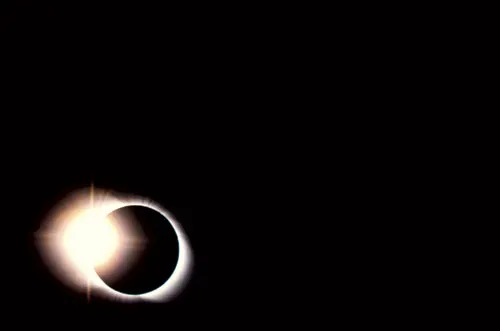
It is one of the most glorious pieces of natural theater. Assuming you spend your life in the same part of the Earth's surface, you would observe it once or -if you live long enough- perhaps twice. But it is worth waiting for a total solar eclipse. At its peak, the Sun and the Moon coincide so perfectly, creating the "diamond ring" effect.
Everything is an incredible coincidence. The Sun is about 400 times wider than the Moon, but also 400 times farther away. Thus, they appear the same size in the sky, in a unique event among the eight planets and 166 known moons. Earth is also the only planet in the system that hosts life. Pure coincidence?
Our moon is different. The many moons of the large outer planets -Jupiter, Saturn, Uranus and Neptune-, it is thought, would have originated in one of two processes: from the accretion of a disk of material in the planet's gravitational field, or through the gravitational capture of small bodies. The second possibility is also suggested for the two natural satellites of Mars, Phobos and Deimos, the other moons in the inner solar system.
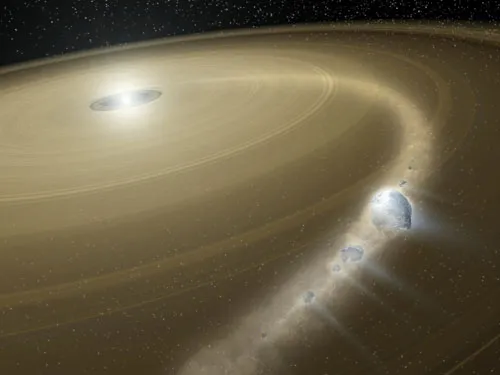
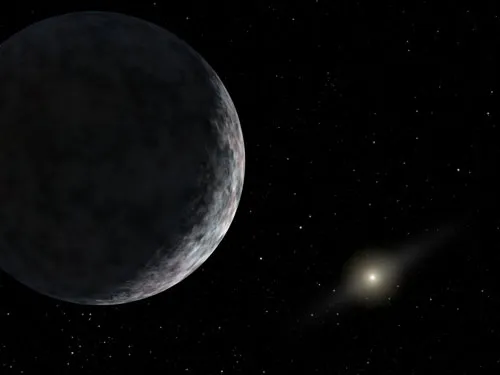
But our Moon is relatively too large for the size of Earth to have formed simply by either of those two processes. Planetary scientists believe there can be only one explanation: in the first 100 million years of the solar system, an object the size of Mars collided with Earth. The impact radically reshaped our planet, ejecting an enormous amount of debris that eventually fused into our oversized moon.
And the best part: The Moon has collaborated with the development of life on Earth. Our planet rotates on its own axis and has a natural tendency to "wobble", due to the varying pull of other bodies like the Sun. The invisible hand of lunar gravity gently "damps" that wobble, preventing rotational instabilities that, otherwise, would have caused dramatic changes in Earth's climate zones over time. Those instabilities would have complicated the emergence of life on the planet.
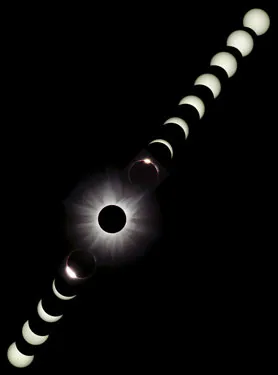
Earth's position in the "habitable zone" around the Sun, where liquid water is abundant, is, without a doubt, the most important factor in its fertility. But the presence of a large moon would have also been crucial. If so, this would have important consequences for the search for life on other planets.
Since its creation, the Moon has been moving away from us, currently about 3.8 centimeters per year. Dinosaurs did not see eclipses like the ones we can see: the Moon was closer 200 million years ago, close enough to entirely block the Sun's light. In the same way, the future occupants of the planet in a couple of hundred million years will not see eclipses since the moon will appear too small.
Our luck seems to result from two coincidences of timing: the recession of the impact-formed moon and the evolution of intelligent life. If you are fortunate enough to see a total eclipse in your lifetime, consider this intriguing possibility: that large moon could be the reason you are there.
Sources and related links
- New Scientist:Why are the sun and moon the same size in the sky?, by Marcus Chown
About the images
The "diamond ring" effect is seen towards the end of the total solar eclipse. This eclipse was photographed in Bolivia on November 3, 1994. Credit: Reverend Ronald Royer / SPL
The different stages of the solar eclipse seen in 2001 in Sambia, Russia.
Credit: Martin Rietze / WestEnd61 / Rex