Few cosmic appearances have inspired as much respect and fear as comets. The particularly striking Halley's Comet, whose last appearance in the inner solar system was in 1986, appears in the Talmud "as a star that appears once every seventy years". In 1066, the appearance of the comet was seen as a portent of doom before the Battle of Hastings.
Modern science adopts a more measured view. Comets like Halley's are agglomerations of ice and dust that orbit the Sun in highly elliptical orbits, acquiring their spectacular tails in the wind of charged particles coming from the Sun. Their source is even known: they are objects from the Kuiper Belt, towed from their orbits by Neptune and Uranus.
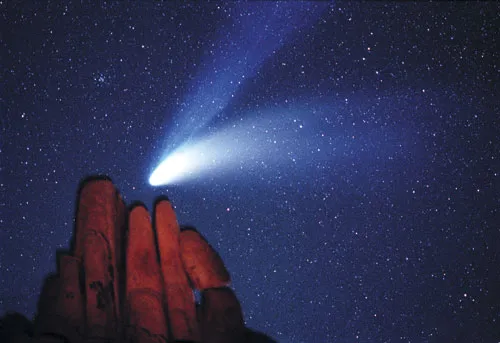
But there is a problem. Certain comets, like Hale-Bopp, which passed through our neighborhood in 1997, appear very infrequently in our sky. Their orbits must be very long, too long to originate in the Kuiper Belt. Astronomers believe the solar system is surrounded in all directions by a tenuous halo of icy bodies, expelled from the immediate vicinity of the sun billions of years ago by the gravity of the giant planets.
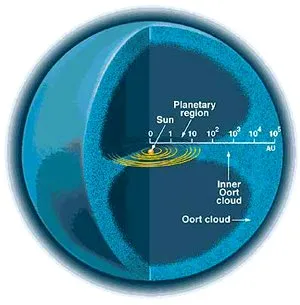
This "cosmic Siberia" is known as the Oort Cloud, in honor of the Dutch astronomer Jan Oort, who proposed its existence in 1950. This diffuse sphere of material has never been seen. And if searching for Planet X is difficult, the search for the Oort Cloud is a nightmare. It would be very far away, very diffuse, and its pieces too small to be seen by telescopes.
So far, the only information comes from the lost comets and the larger objects of the Belt, which should have a similar composition. "It's like trying to know what a whale is like by looking at its blowhole and the tip of a fin," notes Hal Levison, a planetary scientist at the Southwest Research Institute.
However, mapping the rest of the whale could be achieved in a few decades. Oort Cloud objects should dim and alter the light of distant stars. These occultations last only fractions of a second, but astronomers can use them to measure the size and distance of the intervening body. From the surface of our planet, atmospheric turbulence makes these subtle detections impossible, but future space surveys should be able to detect them in large numbers.
Recently, astrophysicists Daniel Babich and Avi Loeb from the Harvard-Smithsonian Center say they might be able to detect the cloud by studying the cosmic microwave background radiation: the radiation that bathes space uniformly left by "the Big Bang". See the detailed article "In Search of the Oort Cloud".
Other mysteries remain. The number and trajectories of the long-period comets seen so far suggest that the Cloud would contain trillions of objects one kilometer in diameter or larger, with a combined mass several times that of Earth. This is more material than current ideas about the formation of the solar system can explain, which means our models should be revised, according to Levison.
Sources and related links
- New Scientist:Where do comets come from?, by Rachel Courtland
- Astrogea: The Oort Cloud
About the images
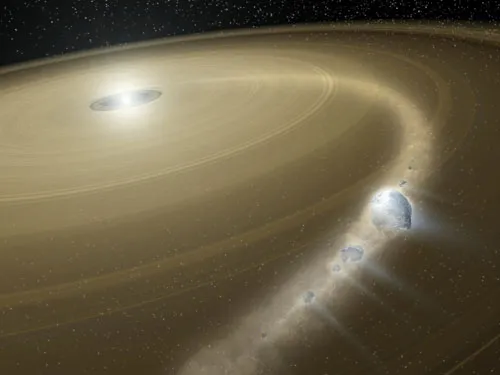
Artistic conception illustrating a planet being shredded around the white dwarf star called G29-38. The Spitzer Space Telescope observed a dust cloud around this star that could have been generated by this type of event.
Credit: T Pyle (SSC) / JPL-Caltech / NASA
Hale-Bopp seen from Joshua Tree Park in California.
Image: Walter Pacholka, Astropics / SPL
The image describes the distance of the Oort Cloud from the Solar System, using a logarithmic scale
Credit: NASA