A new study reveals NGC 604, the largest star-forming region in the nearby galaxy M33, in its first high-resolution view in X-rays. This image composite with data from the Chandra X-ray Observatory (in blue), combined with optical data from the Hubble Space Telescope (red and green), shows a divided neighborhood where about 200 hot, young, and massive stars reside.
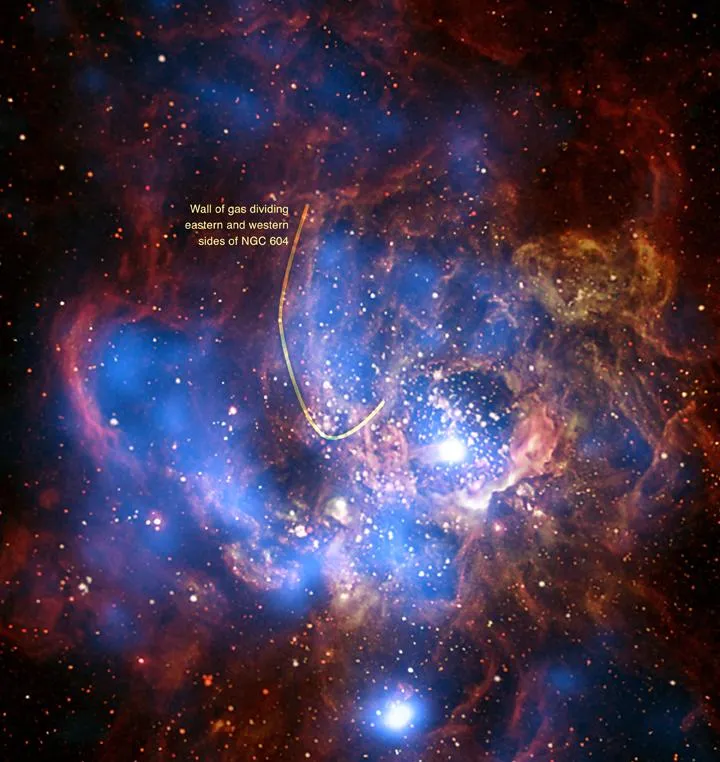
Across the "cosmic metropolis," giant bubbles in the cold dust are filled with very hot gas that emits X-rays. Scientists think these bubbles are generated and heated by the powerful stellar winds from young massive stars that collide and sweep up the surrounding gas and dust. Thus, the empty areas are repopulated with the hottest material seen by Chandra.
However, there is a difference between the two sides of this bifurcated stellar city. On the west side (right), the amount of hot gas found in the bubbles corresponds to 4,300 times the mass of the Sun. This value and the brightness of the gas in X-rays imply that the western part of NGC 604 is entirely powered by the winds from the 200 massive stars.
The result is interesting because previous models of other bubbles usually predicted they would be fainter than observed, so additional heat from supernova remnants is required. The implication is that in this area of NGC 604, none or very few of the massive stars would have exploded as supernovae.
The situation is different on the east side (left). The X-ray gases contain 1,750 times the mass of the Sun and the winds from young stars cannot explain the brightness of the emission. The bubbles on this side appear to be older and were probably generated by young stars and supernovae in the past.
A similar separation between east and west is seen in the optical results. This implies that a massive wall of gas covers the quieted eastern region from the active star formation in the west.
The study was led by Ralph Tuellmann of the Harvard-Smithsonian Center and was part of a long 16-day observation of M33, called "Chandra ACIS Survey of M33", or ChASeM33.
Sources and related links
About the images
X-ray: NASA/CXC/CfA/R. Tuellmann et al.; Optical: NASA/AURA/STScI