Just as a photographer in visible light can choose to take a photograph in black and white instead of color, astronomers using the Spitzer Space Telescope have their options about which colors to use or not in their compositions, as shown in an image of the star-forming region RCW 49 released today.
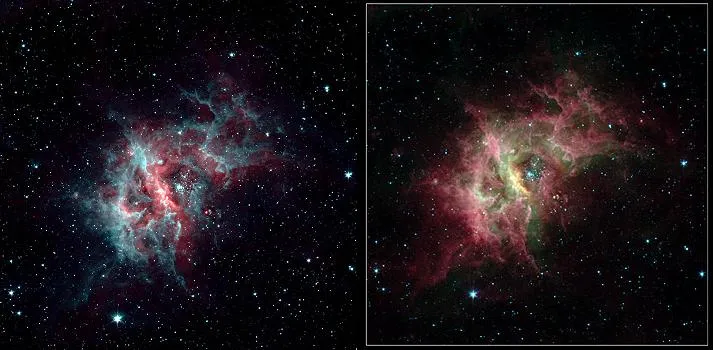
The new composition is an alternative image of a dusty stellar nursery located 13,700 light-years away in the constellation Centaurus. The original version was released in 2004 and combined information from four different infrared wavelengths, but the new image uses only two.
The typical human eye perceives three different colors of visible light - red, green, and blue - through the cones of the retina. All the colors we see are a combination of those three colors. Each color of light has a different wavelength and many wavelengths go beyond the visible spectrum. Infrared light is basically wavelengths of light that vibrate in colors below the red part of the spectrum, colors we cannot see.
Spitzer's cameras can "see" seven distinct wavelengths or channels of infrared light. That would be equivalent to our eyes being sensitive to seven colors, instead of three. The scientists' challenge is to present those different channels using colors we can see. When astronomers select the channels to include in their false-color compositions, each wavelength is assigned a different visible color. Thus, the same observations can be used to create different images. This is particularly important because the colors of the images "speak," they generate different sensations. For example, when looking at the two images of RCW 49, does one seem "hotter" than the other?
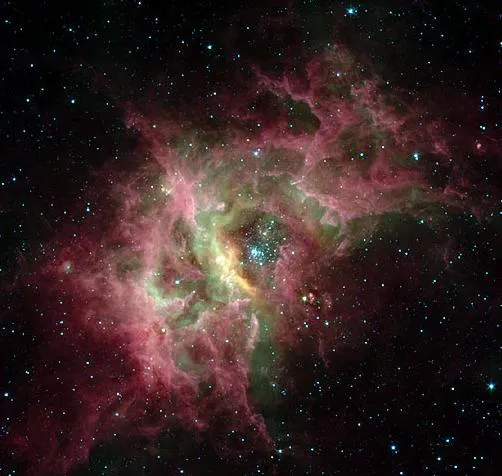
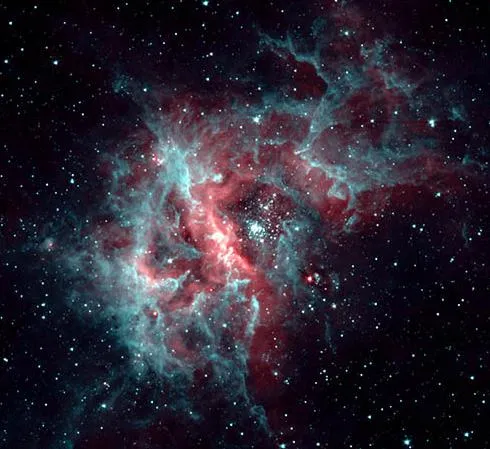
Spitzer's shorter wavelengths (3.6 and 4.5 microns) were mapped as cyan and red respectively for the new image. At 4.5 microns, hot hydrogen gas glows like neon lights. The two-channel image emphasizes the hot hydrogen gas, which appears as red regions, in addition to the more than 2,200 stars and organic molecules visible in both images (the original and the new one).
Besides allowing new scientific discoveries, two-channel images like this one are particularly interesting for scientists who want to understand how the observatory will function after its helium coolant runs out in 2009. At that point, the telescope will be too warm to observe at longer wavelengths, but will continue operating in these channels.
Sources and related links
- New Image Shows the Power of Visual Remix
About the images
Credit: NASA/JPL-Caltech/E. Churchwell (University of Wisconsin)