A new image from the Spitzer Space Telescope offers a rare glimpse of an imminent collision between the nuclei of two merging galaxies.
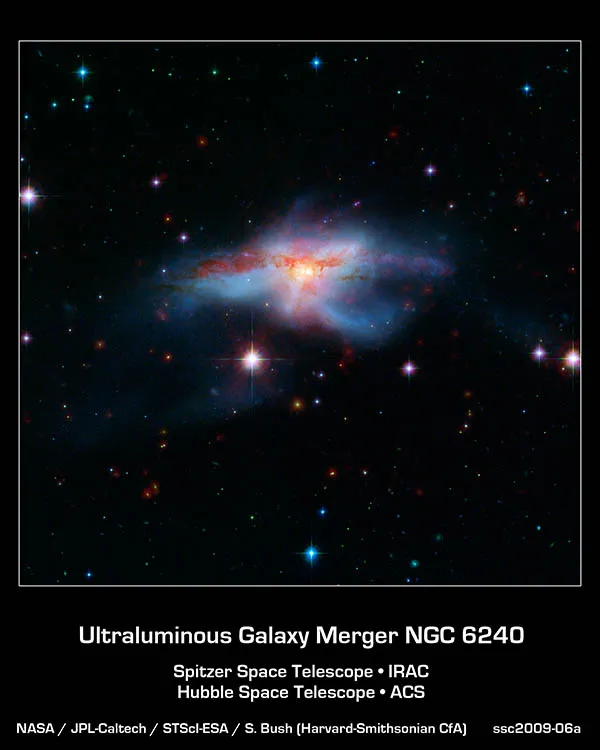
The galactic nuclei belong to galaxy NGC 6240, 400 million light-years away in the constellation Ophiuchus. Millions of years ago, each nucleus was the dense center of its own galaxy before they collided and tore each other apart. Now, those nuclei are approaching at tremendous speeds and preparing for the final collision, in a few million years.
The spectacular image combines visible light from the Hubble Space Telescope and infrared light from Spitzer.
"One of the most exciting things about this image is that the object is unique. The merger is a fast process, especially when the collision is happening. There aren't many galactic mergers at that stage in the nearby universe," notes Stephanie Bush of the Harvard-Smithsonian Center, lead author of the report describing the observation to appear in Astrophysical Journal.
NGC 6240 is emitting large amounts of infrared light, an indication that a great deal of star formation is occurring. At the center, the two black holes in the nuclei are preparing for a frenzy of radiation as they head toward each other, transforming the galaxy into a monster known as an ultra-luminous infrared galaxy, thousands of times brighter in infrared than the Milky Way.
Another fascinating aspect of this rare object is that mergers are always different, because their progenitor galaxies are distinct. Spitzer's infrared light shows (in red) the cold dust and radiation from star formation and Hubble's visible light (in blue and green) shows the hot gas and stars.
Sources and related links
- Spitzer: Hearts of Galaxies Close in for Cosmic Train Wreck
- The Structure of Active Merger Remnant NGC 6240 from IRAC Observations
Stephanie J. Bush et al 2008 ApJ 688 875-884
DOI:10.1086/592180
About the images
Credit: NASA/JPL-Caltech/STScI-ESA
A higher resolution image at JPL Caltech:
http://www.nasa.gov/mission_pages/spitzer/multimedia/spitzer-20090316.html