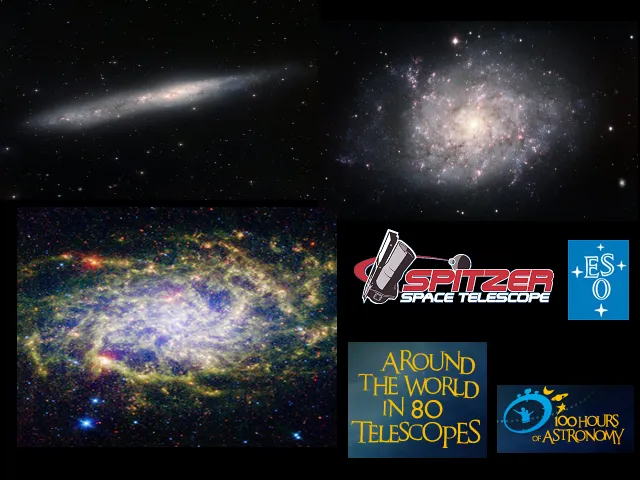
To celebrate the 100 Hours of Astronomy event, ESO is sharing two incredible images of galaxies obtained by the La Silla and Paranal observatories, and the Spitzer Space Telescope reveals to us the splendor of a neighboring galaxy.
The event Around the World in 80 Telescopes, which is part of 100 Hours of Astronomy, an event framed within the International Year of Astronomy 2009, was a 24-hour live webcast. It was a virtual guide to the world's most advanced observatories, which committed to releasing images to celebrate the event. In this sense, ESO gives us images of two incredible galaxies.
The first is the irregular galaxy NGC 55, a member of the Sculptor group of galaxies in the constellation of that name. The galaxy is about 70,000 light-years in diameter, a little smaller than our Milky Way, and similar to our neighbor the Large Magellanic Cloud, although the latter is seen face-on, while NGC is edge-on.
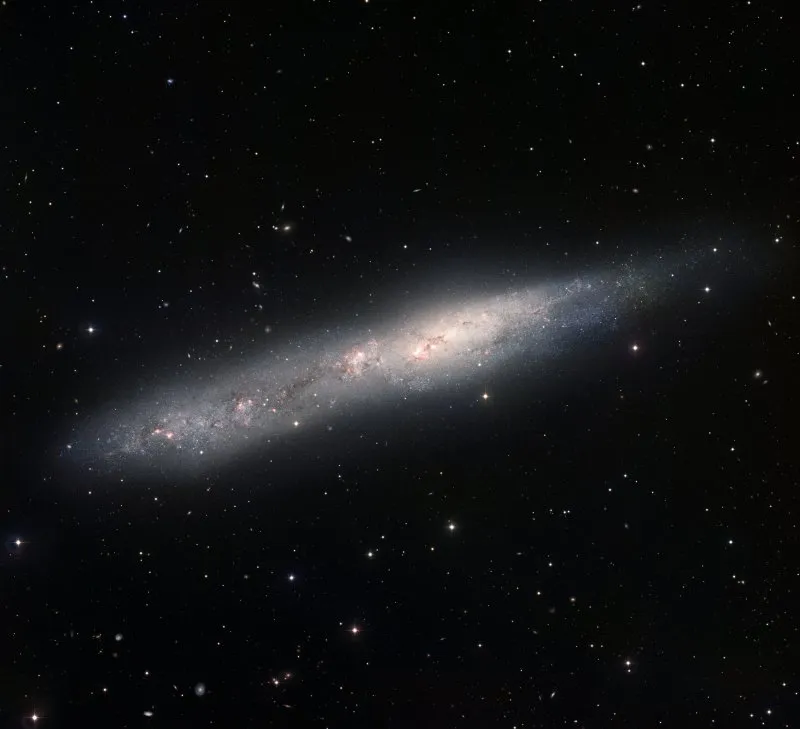
By studying about 20 planetary nebulae in this image, a team of astronomers found that NGC 55 is located 7.5 million light-years away. They also discovered that the galaxy would be forming a pair with the dazzling spiral galaxy NGC 300.
The image of NGC 55, obtained with the Wide Field Imager on the MPG/ESO 2.2-meter telescope at La Silla, contains reddish nebulae, created by young and hot massive stars. Some of the most extensive ones are not different from those seen in the Large Magellanic Cloud, like the Tarantula Nebula. The image quality is clearly demonstrated by the remarkable number of background galaxies seen, as well as the number of individual stars that can be counted in NGC 55.
The second image shows another galaxy belonging to the same group. It is NGC 7793, which has a chaotic spiral structure. The image shows how difficult it is to identify any spiral arm in this intricate structure. The galaxy is located a little farther than the previous one, about 12.5 million light-years away, and is half the size of NGC 55.
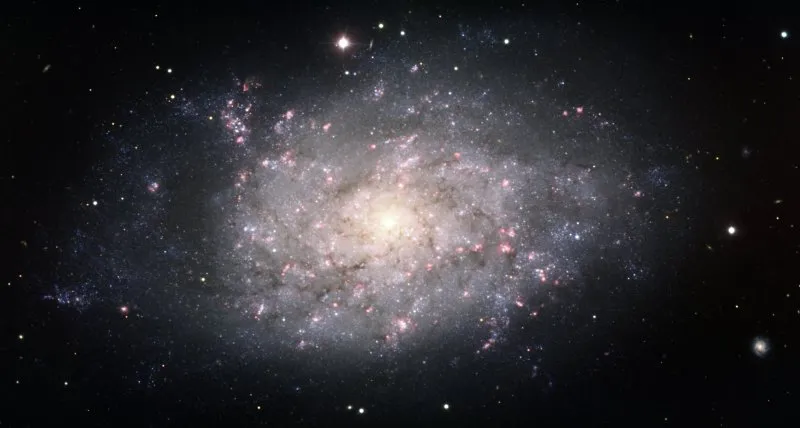
NGC 7793 was observed by the FORS instrument, on the Very Large Telescope of the Paranal Observatory.
For its part, the Spitzer Space Telescope reveals to us the splendor of M33, a close neighbor.
M33, also known as the Triangulum Galaxy, is a member of the Local Group of Galaxies. Along with the Milky Way, these galaxies travel together in the universe, as they are gravitationally related. In fact, M33 is one of the few galaxies moving towards the Milky Way, despite the fact that space itself is expanding.
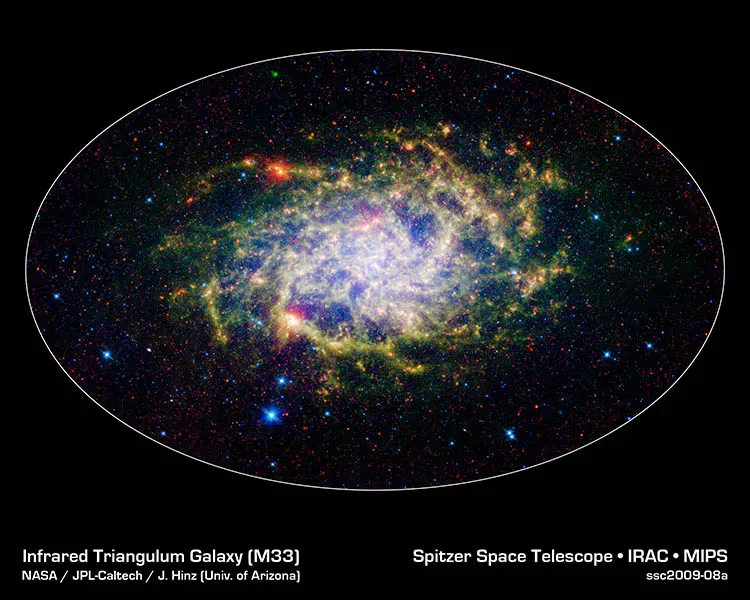
Seen by Spitzer's infrared vision, this elegant spiral galaxy shines in color and detail. The stars appear as blue gems (several of which are actually background stars from our own galaxy), while dust rich in organic molecules glows green. The diffuse orange-reddish areas indicate star-forming regions, and the red specks outside the spiral disk are probably distant background galaxies.
M33 is located 2.9 million light-years away in the constellation Triangulum. This is a three-color composite image showing infrared observations from Spitzer's instruments.
The webcast is ending, but 100 Hours of Astronomy continues until tomorrow, and the International Year of Astronomy 2009 is just beginning, to our delight.
The webcast can be viewed via Upstream, at:
http://www.ustream.tv/channel/100-hours-of-astronomy
Update: Hubble gives us the Arp 274 Triplet
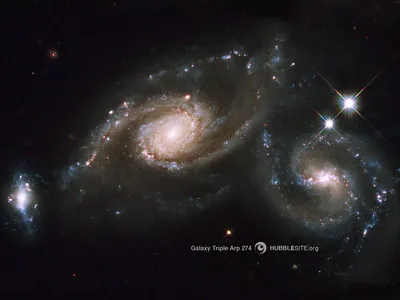
The Space Telescope Science Institute had proposed deciding Hubble's next target. Between April 1 and 2, these galaxies, which were the winners of that vote, were photographed.
Arp 274, also known as NGC 5679, is a system of three galaxies, which although they appear together, are at different distances. The galaxy on the left, more compact than the other two, shows evidence of star formation.
The largest component, in the middle, is a spiral galaxy and the entire system resides about 400 million light-years away, in the constellation Virgo.
Wallpapers of Arp 274 on HubbleSite.
To download larger images and videos of each of the galaxies mentioned here, from ESO, Spitzer and Hubble, follow the links to the original sites, in "Sources and related links".
Sources and related links
- Two Galaxies for a Unique Event
- M33: A Close Neighbor Reveals its True Size and Splendor
- Hubble Celebrates the International Year of Astronomy with the Galaxy Triplet Arp 274
About the images
Credits:NGC 55 and NGC 7793:ESO
M33:NASA/JPL-Caltech/Univ. of Ariz.
Arp 274:NASA, ESA, M. Livio and the Hubble Heritage Team (STScI/AURA)