Sometimes, objects in the sky that appear strange or different from the norm have a story to tell that can be scientifically valuable.
This was the idea behind Halton Arp's catalog of Peculiar Galaxies that appeared in the 1960s. One of the rare objects listed is Arp 261, which has now been photographed in greater detail than ever before using the FORS2 instrument on ESO's Very Large Telescope. The image contains several surprises.
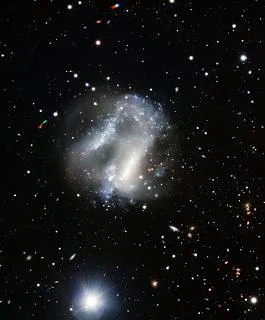
Arp 261 lies 70 million light-years away in the constellation of Libra. Its chaotic and very unusual structure is created by the interaction of two galaxies. Although individual stars very rarely collide in this event, as they are very far apart, the huge clouds of gas and dust certainly collide at high speed, triggering new clusters of hot stars. The orbits of existing stars are dramatically altered, creating the swirls that extend to the top left and bottom right of the image. Both galaxies were probably dwarfs, not very different from the Magellanic Clouds that orbit our galaxy.
The photographs used to create this image were not taken to study the interaction of these galaxies, but to investigate the properties of the object located to the right of the brightest part of Arp 261 and near the center of the image. It is an unusual supernova, SN 1995N, the result of the collapse of a massive star. It is unusual because it has faded very slowly and is still clearly visible in the lower image, more than seven years after the explosion! It is also one of the few supernovae observed that emit X-rays. These unusual characteristics are thought to be the result of the explosion of a star in a dense region of space.
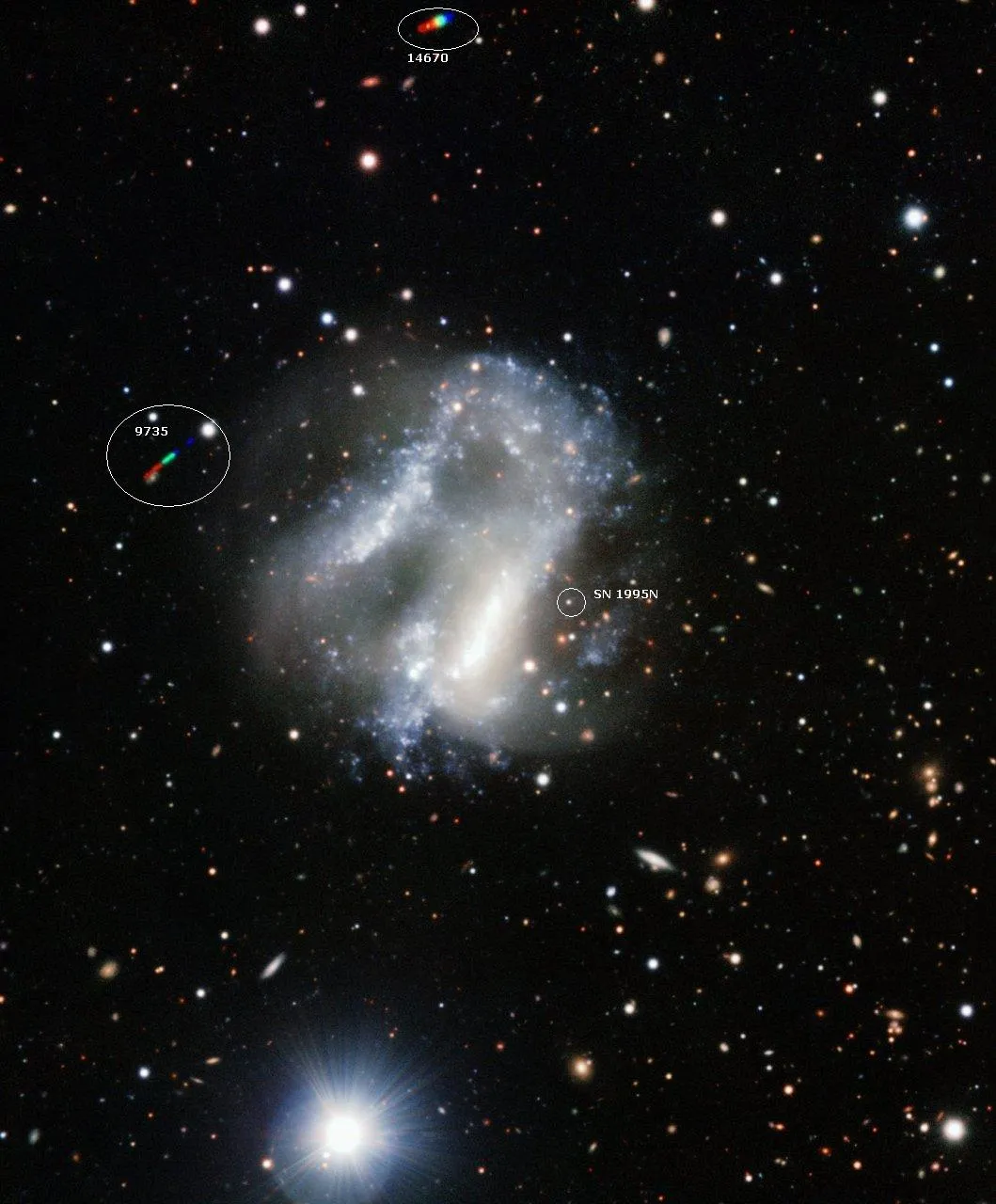
The image also contains other objects at very different distances from us. Starting close to home, two small asteroids, in our solar system, between the orbits of Mars and Jupiter, crossed during the taking of the images and are shown as red-green-blue trails to the left and top of the image. These trails appear because the objects are moving during the exposures and also between exposures through different color filters. The asteroid at the top is number 14670 and the one on the left is 9735. They are probably less than 5 km in diameter.
The next object is probably the apparent bright star at the bottom. It may seem bright but it is a hundred times fainter than what can be seen with the naked eye. It is thought to be a star like our Sun, 500 light-years away, 20 million times farther than the asteroids. Arp 261, and the supernova, are 140,000 times farther than this star, although it is still what astronomers call our cosmic neighborhood. Much more distant, perhaps 50 to 100 times farther than Arp 261, lies the cluster of galaxies visible to the right of the image. Undoubtedly, besides those mentioned, there are many other remote and unrecognizable background objects in this wonderful image.
Sources and related links
- ESO: A Curious Pair of Galaxies
- A fabulous collection of galaxies
About the images
Image credit: ESO
More image and animation formats and sizes are available in the ESO press release, cited above.