On the British television show "Quite Interesting", a quiz program that emphasizes humor rather than knowledge, a question was asked about how many moons our planet has. The show's panel is made up of comedians who aim to earn points for their hilarious answers. One of the participants answered that there is only one. The host of the show, Stephen Fry, however, told him it was incorrect. The correct answer, according to the show, is that Earth has TWO moons. The reaction of the rest of the panel is comical and that's the goal of the program. But the answer is clear: Earth has only ONE moon.
The video of the show in question can be viewed on YouTube, although it's in English, of course: YouTube:How many moons does earth have? - Qi - BBC
The panelist Alan Davies, who is a very well-known comedian in the United Kingdom, answered the question by saying our planet has only one moon and that it's made of cheese, trying to be funny, although at some point there were people who really thought the Moon was like a Gruyère cheese. Anyway, up to that point, all good, very funny (very?). But, the alarm sounded. The answer is incorrect.
"Please, is it THE moon?", the comedian tried to defend himself. However, the host corrected the panelist:
But the answer is that there are two moons. One is the one we know, the one we call "the moon". The other is called "Cruithne", it is 3 miles in diameter and orbits the world every 770 years.
As there is always someone caught off guard, let's make some healthy clarifications.
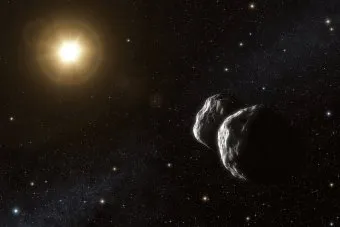
The Moon is Earth's only natural satellite. The object they refer to on the show, called (3753) Cruithne, is an asteroid that orbits the Sun, not Earth. What is striking about this and some other similar bodies is that their orbit is similar to that of our planet. They are co-orbital asteroids.
It was discovered in 1986 but only in 1997, Paul Wiegert and colleagues used computer simulations to understand its behavior and reported it to Nature.
It is indeed 5 kilometers in diameter, but it takes 770 years to complete its horseshoe-shaped orbit around the Sun. Every 385 years it achieves its closest approach to Earth, at 15 million kilometers. The last time was in 1990 and the next will be in 2285 (we won't be here by then, right?).
Although the asteroid, initially designated 3753 (1986TO), was discovered in 1986, no one had tracked its orbit enough to detect its peculiarity. At first, Wiegert couldn't believe his calculations and thought it was a computer error. After repeating them several times he ended up convincing himself.
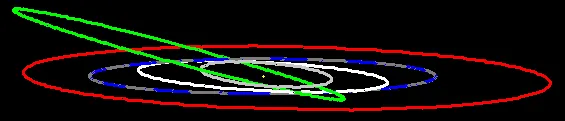
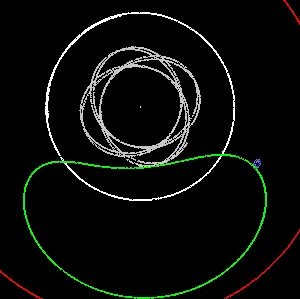
In the year 2277, the asteroid's orbit will meet Earth's. Earth's gravity raises Cruithne's orbit a little. It will return to this point 752 years later, in 3029.
Although Cruithne's orbit is not stable in the long term, Wiegert's calculations show it will be synchronized with Earth's for a long time. Of course there is NO risk of collision, at least for the next few million years. The orbits do not cross and the asteroid's orbital plane is inclined relative to ours by almost 20º. To be seen, Cruithne would require a very, very large telescope, as at opposition its magnitude is 15.8, fainter than Pluto.
The number 3753 is given by its official designation in the catalog of known asteroids. The name Cruithne was given by its discoverers and refers to a Celtic tribal group.
It was officially discovered on October 10, 1986 by Duncan Waldron, working with R. McNaught, M. Hartley and M. Hawkins at the Siding Spring Observatory in Australia. Later, C. Bardwell noted that the asteroid had been observed three years earlier at ESO, Chile, by G. de Sanctis and R. West. However, the "discovery" traditionally goes to the person or group that observes the asteroid over a long enough time to allow a good orbit to be calculated.
Waldron also discovered asteroid 5577 Priestley and since 1995, when he learned Paint Shop Pro, he has dedicated himself to image manipulation to create kaleidoscopes.
Other examples of asteroids with orbits like Cruithne's are Janus and Epimetheus, satellites of Saturn. On our planet, there are several near-Earth asteroids (NEAs), also called NEA by its English acronym, such as 54509 YORP, (85770) 1998 UP1, 2002 AA29, and 2009BD.
The horseshoe orbit
What allows this object to have this rare orbit is that it passes near three Lagrange points.
The research of Joseph-Louis Lagrange, an 18th-century French mathematician, allowed the determination of the position of five gravitational equilibrium points related to our planet. These are the Lagrange points.
L1 is located on a line from the Sun to Earth, 1.5 million km from our planet; L2 is on the same line, but on the other side of Earth; the same as L3, which is on the other side of the Sun; meanwhile, L4 and L5 are at the vertex of two equilateral triangles, whose base is the Earth-Sun line.
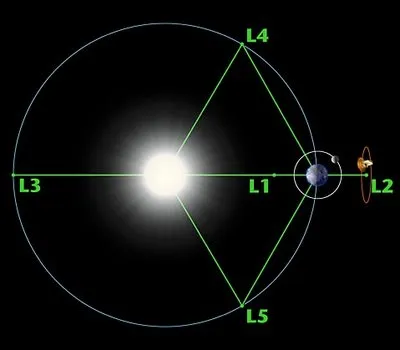
Lagrange himself demonstrated that any object placed at L4 or L5 can easily remain there, receiving the name Trojan. The described geometry is also applicable to the other planets, and thus Jupiter has hundreds of Trojan asteroids, while Mars has at least two.
The Trojans orbit simultaneously around the Lagrange points L4 and L5, following a very curious trajectory. But even more curious is the trajectory of asteroids whose orbit passes around L2, L4, and L5 simultaneously, drawing a kind of horseshoe in the sky. Cruithne is one of these objects.
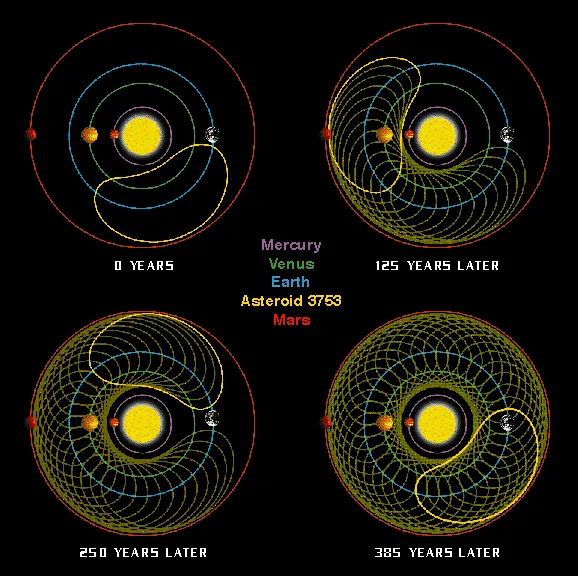
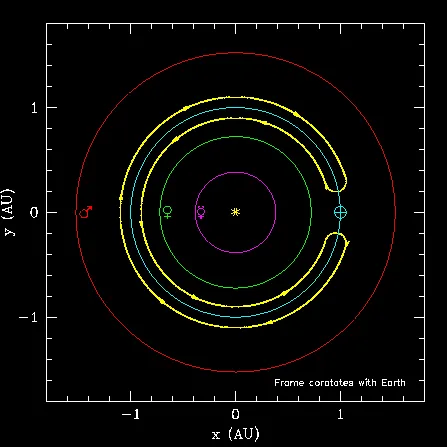
It is not a true Trojan. Rather, it occupies one of the two regular solar orbits, one slightly smaller and faster than Earth's and the other slightly larger and slower, periodically alternating when it approaches Earth. With the asteroid's approaches to Earth, from inside Earth's orbit, it takes orbital energy from Earth and moves into a larger, higher-energy orbit. Then Earth catches up to the asteroid (which is in a larger and therefore slower orbit) now it is Earth that takes energy and causes the asteroid to fall into a smaller, faster orbit and in the future it will be the asteroid that catches Earth to start the cycle again. This does not have a notable impact on the length of the year, because Earth's mass is more than 20,000 million times heavier than 3753 Cruithne.
Wiegert, on his page about Cruithne, explains it with an allegory, considering the horseshoe orbit as a circular, three-lane race track. (Something like a space Daytona?). Earth is a large truck moving at constant speed in the central lane and the asteroid is a car. When, in the outer lane, the car is going a little slower than the truck, and the truck is about to pass it. But just as the truck is about to pass, the car changes to the inner lane and accelerates. The car begins to pull away from the truck, but since the track is circular, the car will eventually catch up to the truck from behind. When it gets close, the car changes lanes again to the outer lane and slows down. And the cycle repeats. This is what happens in the horseshoe orbit. Both "vehicles" share the same route, but in a coordinated way to avoid collision.
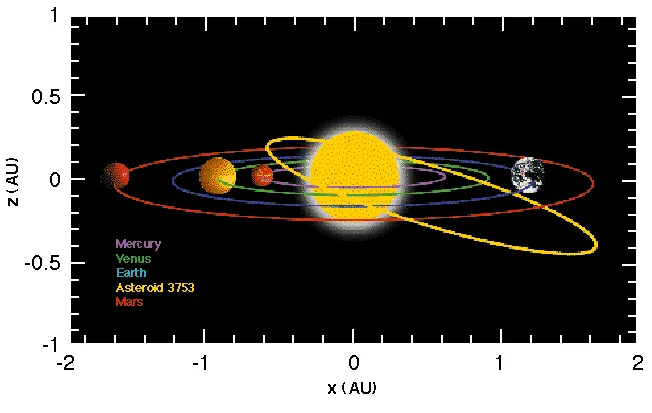
When the asteroid approaches Earth, it begins to move away again. Why doesn't the planet's gravity capture it?
An orbit is a balance between two competing forces: gravity that brings things closer and the velocity of the objects, which with the right direction, tends to move them away. Like artificial satellites, which if they didn't move, would fall. But their speed keeps them in orbit. This interaction of forces (with its consequent conservation of energy and angular momentum) allows Earth's gravity to modify the asteroid's velocity in such a way that its orbit begins to move away.
From a more technical point of view, it is related to the Restricted three-body problem. After the discovery, some theoretical contributions were made which I cite below:
New coorbital dynamics in the solar system
F. Namouni, A. A. Christou, C. D. Murray http://arxiv.org/abs/astro-ph/9904016
Secular Interactions of Coorbiting Objects
Fathi Namouni
Icarus
Volume 137, Issue 2, February 1, 1999, Pages 293-314 doi:10.1006/icar.1998.6032
The dynamics of tadpole and horseshoe orbits : I. Theory
Stanley F. Dermott and Carl. D. Murray
Icarus
Volume 48, Issue 1, October 1981, Pages 1-11 doi:10.1016/0019-1035(81)90147-0
Sources and related links
- University of York announcement of the discovery
- Fryed astronomy
- ESA:Earth's 'Second Moon' in a 'minage à trois'
- Cruithne orbit simulator
- Near-Earth asteroid 3753 Cruithne
About the images
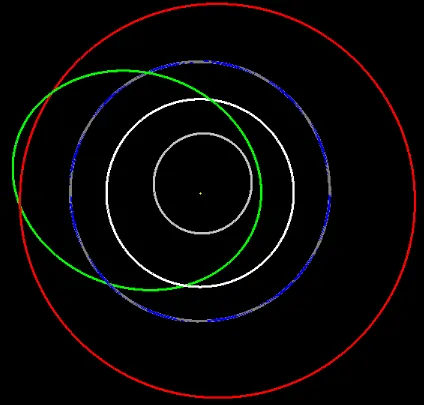
Orbits of Cruithne and Earth, from OrbitSimulator
The site has software to download that allows you to view simulations.
Cruithne's orbit by Wiegert.