A team of astronomers found a sample of massive galaxies with properties that suggest they would have formed recently. This is contrary to the thinking that massive and luminous galaxies began their formation in the early universe.
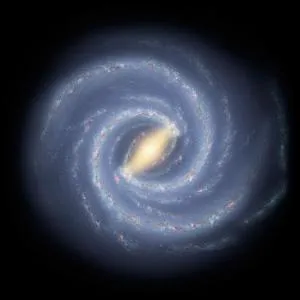
John Salzer, a researcher on the published study, said that the 15 galaxies in the sample exhibit luminosities that indicate they are massive systems, galaxies like our Milky Way. However, these particular galaxies are unusual because they have low abundances of heavy elements (elements heavier than helium), which would imply that the galaxies are cosmologically young and would have formed recently. According to the report published in ApJ Letters, these are objects with a redshift (z) in the range 0.29 - 0.42.
The chemical abundances of these objects, combined with knowledge about stellar evolution and the progress of chemical enrichment in galaxies in general, suggest they would be only 3 to 4 billion years old and that they would have formed 9 to 10 billion years after the big bang. Most theories about galaxy formation predict that massive and luminous systems like these should form much earlier.
If this were really the case, the galaxies could allow astronomers to investigate phases of galaxy formation and the evolutionary process that is difficult to study since they normally occur at early ages of the universe, and therefore, at very large distances from Earth.

"These objects could represent a unique window into the process of galaxy formation, allowing us to study relatively nearby systems that are going through a phase in their evolution that is analogous to the types of events that, for most galaxies, typically occurred much earlier in the history of the universe," explained Salzer.
The discoveries are the result of a survey of more than 2400 galaxies called KISS (Kitt Peak National Observatory International Spectroscopic Survey). The study was designed to collect basic observational data for a large number of extragalactic emission-line sources. Additional follow-up spectroscopy of the sources discovered in the initial survey led to the finding of these 15 luminous systems.
However, it is not the only possible explanation for these objects. One possible explanation is that the galaxies are the result of recent mergers between smaller galaxies. That model could explain the low abundance of heavy elements and their luminosity. To distinguish between the scenario of recent massive galaxy formation and the merger of smaller galaxies, the team intends to request observing time on the Hubble Space Telescope to use high-resolution images with the aim of determining the origin of these particular objects.
Sources and related links
- A POPULATION OF METAL-POOR GALAXIES WITH ~L* LUMINOSITIES AT INTERMEDIATE REDSHIFTS
John J. Salzer et al 2009
ApJ 695 L67-L71
DOI: 10.1088/0004-637X/695/1/L67
arXiv:0903.3948v1 - Physorg:Discovery poses challenge to galaxy formation theories
- IU astronomer’s discovery poses challenge to galaxy formation theories
About the images
Artistic conception of the Milky Way.Credit: NASA/JPL-Caltech)
Astronomer John Salzer. Credit:Indiana University.