Lighting up the universe is a violent business.
When most people look at a dark, clear night, they marvel at how many stars there are. Astronomers have the opposite reaction: they marvel at the incredible scarcity of stars. Considering the total amount of material available in our galaxy for star formation, there should be up to 10 times the current number of stars. Why, then, does the night sky not blaze with starlight?
It's not a bad thing that there are so few stars, quite the contrary. Stars burn gas, mainly hydrogen. All the hydrogen in the universe was formed during the big bang, about 13.8 billion years ago. Every galaxy possesses a finite portion of this primordial fuel, and there is no way to make more of it. If there were more stars, galaxies would run out of their fuel reserves more quickly and shine more briefly before passing into eternal darkness.
Understanding how stars form and why they are so difficult to create is much more than predicting our distant cosmic future. Stellar birth explains where the atoms in our bodies come from and why the universe looks as it does today. As astronomer John Bally of the University of Colorado says: "Star formation is the single most important process for determining the fate and evolution of normal matter in the universe". However, until recently, the details of how stars are born were literally shrouded in mystery. Stars form in dense clouds of gas and dust that block visible light.
Now astronomers are lifting the veil with telescopes that detect infrared light, the kind of light central to terrestrial night vision systems. "Seeing in infrared light is important because the dimming of visible light from inside a dusty cloud can be enormous", says Judy Pipher, a professor of observational and experimental astronomy at the University of Rochester in New York. "This is not a problem when you use an infrared camera because at those longer wavelengths the cloud will be a million times more transparent".
The image of star formation that infrared telescopes give us is one of unexpected violence, and it is this violence that is key to understanding why there are so few stars. The birth of one alters the formation of others nearby, limiting the rate at which hydrogen can be gathered into bright stars.
Efforts to spy on the star birth process received a huge boost with the launch of NASA's Spitzer Space Telescope in 2003. Pipher, considered by many to be the mother of infrared astronomy, worked for 20 years with collaborators William Forrest and Dan Watson to develop the detectors that form the heart of this 900 kg floating observatory.
Spitzer does not orbit Earth but follows us from behind in space, following Earth's orbit around the Sun at a distance of about 90 million kilometers (56 million miles). Spitzer was sent so far away because its delicate infrared-sensitive instruments must remain at a very cold temperature just above absolute zero, and it is easier to maintain that temperature by operating far from the heat radiating from our planet's surface.
Spitzer's new views of stellar nurseries as places of chaos and turbulence contrast with astronomers' old preconceptions. In the absence of direct vision provided by infrared telescopes, scientists spent most of the last century creating beautiful theories of individual gas clouds collapsing elegantly under their own gravity to form individual stars. The basic model of star formation was mapped by British astrophysicist Sir James Jeans just over 100 years ago. Jeans began with a large cloud of interstellar gas whose inward gravitational pull perfectly balanced the outward push of the pressure from its own internal heat. Jeans found this balance to be unstable. With very little—for example the shock wave from a supernova remnant—gravity would win the tug-of-war and the cloud's collapse onto itself would begin. At the center of the cloud, matter would pile up to densities and temperatures that (as scientists later noted) were high enough to allow hydrogen atoms to fuse to form helium. When fusion began, a star was born.
Most of the 20th century was spent filling in the details of Jeans's story. "You start with individual stars because they are simpler", says Héctor Arce, an astrophysicist at Yale University. "They are a kind of theorist's dream". These early models paid little attention to the way infant stars could influence each other. "Before we could understand how neighbors affect individual star formation", explains Arce's former thesis advisor, Alyssa Goodman of the Harvard-Smithsonian Center for Astrophysics, "we had to understand the evolution of isolated stars. That was complicated enough in itself".
During the 1980s and 1990s, Spitzer's less sophisticated predecessors put astronomers on the path to a more holistic model of star formation. From hard-to-acquire infrared images, a much more complex story than Jeans's emerged about the birth of stars and planets. Star formation, as those images indicated, is clearly a family affair, with all the turbulence, chaos, and tumult that implies.
Astronomers realized that rotating disks of gas always form around a new star, feeding it matter and serving as an incubator for the development of planets. The disks form from the natural rotation of the original gas clouds. Just as an ice skater closing her arms will increase her rotation speed, the gas in the collapsing cloud will rotate more rapidly until it naturally forms a rotating disk. If interstellar magnetic fields get tangled with the cloud, they will act as transmission belts, harnessing the enormous energy of the disk's rotation to launch powerful jets of gas along the axis of the disk and back out into space.
These jets have a remarkably long lifespan, extending the star-forming environment to 10 light-years or more. The discovery of these jets or streams of matter emerging from dust-enshrouded protostars at hundreds of kilometers per second was the first clue for astronomers that star formation was a much more chaotic process than they had imagined.
Over the last two decades, an intense effort in both theory and observation allowed astronomers to develop a coherent, consistent picture of how individual stars were born that included gas disks and jets. But researchers knew their story was very incomplete because it did not account for how the formation of one star could affect others. 'The problem is that you need to see the entire cloud where many stars are forming at the same time. But the clouds are dense and spread across large regions of the sky. You need new instruments and you have to be systematic if you really want to understand what's going on,' explains Goodman.
Spitzer was built, in part, to meet these needs. With Spitzer's 85-meter infrared eye, astronomers can see deep into young stellar nurseries where stars are beginning to form. They can see protostellar disks taking shape and expelling their jets of matter into space, and they have worked to integrate the new data with results from optical telescopes and radio telescopes (radio waves, millimeter waves in particular, which can penetrate dust and gas). By combining radio and infrared observations, researchers like Goodman and Arce created high-resolution, multi-wavelength images of entire star-forming clouds. This long-term, multi-institution project, called the Complete Survey, gave astronomers the view they needed to study global formation in a global context. Finally they could map the detailed nature of the interactions between infant stars and their environment and a true portrait of star formation began to emerge.
'You really have to think about star formation in terms of an urban, suburban, and rural context. It matters near whom you were born and it also matters what you mean by 'near',' noted Goodman.
Stellar nurseries come in low-mass and high-mass varieties. In the low-mass class, like the Orion Nebula, which is 1,500 light-years away, stars are packed together like a swarm of bees. (In our galactic neighborhood, the Sun floats alone in a cube about three light-years on a side. In a high-mass star-forming cluster, thousands of stars occupy the same amount of space). More importantly, high-mass clusters produce high-mass stars, bright nuclear furnaces with 10 to 100 times the mass of our Sun. These giants live fast and die young. Our Sun will shine for 10 billion years, but high-mass stars are lucky to last 10 million. 'Massive stars have a huge impact on star formation. They emit powerful winds and a lot of ultraviolet radiation,' added Bally. The winds and UV light push aside the surrounding gas, carving vast 'blisters' that alter the cloud. This agitation can inhibit the formation of other stars or promote birth in other regions.
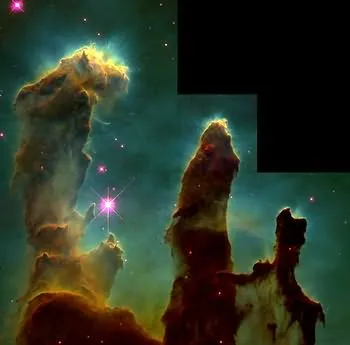
Only in the past decade have astronomers understood how common and significant the feedback between stars and their stellar nurseries can be. 'There's a kind of self-regulation taking place. The stars that form can change their own star-forming environment,' noted Bally. The Pillars of Creation, in the Eagle Nebula (photographed in one of the most famous images from the Hubble Space Telescope) are a clear example of this feedback. Like the steep rocks formed by wind erosion in the desert, the gaseous pillars in the Eagle Nebula have been shaped and compressed by stellar winds and energetic ultraviolet light from the nebula's massive stars. Spitzer images of the nebula show that this compression, in turn, is triggering the formation of new stars within the pillars.
The complex environment in which a star forms affects the creation of planets as well. In fact, the effect of massive stars on disks around infant stars—where planets arise—can be deadly. 'The UV radiation from a massive star will ionize and heat the surrounding gas disks of nearby low-mass stars. The gas in the disks will evaporate into space. It can take 10 million years to form a planet, but the UV radiation from a massive star can burn away the outer part of a disk in just 10,000 years,' said Bally. With its gas depleted, it may be impossible for disks around stars in massive clusters to form giant planets like Jupiter or Saturn. It may still be possible for an Earth-like world to form close to the star where the disk was not disturbed, but the point remains under debate.
Massive stars can also wreak havoc on the cloud when they die. At the end of its life, a massive star inevitably explodes as a supernova. This pours vast amounts of energy into the surroundings: A supernova can briefly shine as brightly as an entire galaxy. Supernovae also create all the elements heavier than iron. With such short lives, massive stars die near where they were born, usually in the same star-forming region where they began.
Some astronomers have argued that the formation of our Sun was triggered by the shock wave from a nearby stellar explosion. 'There is strong evidence that our own solar system was born near a massive star that went supernova. Even if our formation was not sparked by a supernova, the presence of certain radioactive element products points to a supernova perhaps feeding the already formed solar system with enriched elements,' added Bally. This implies that our star was born near the edge of a high-mass cluster, close enough to feel the effects of a supernova, but not so deep inside that our protoplanetary disk was shredded.
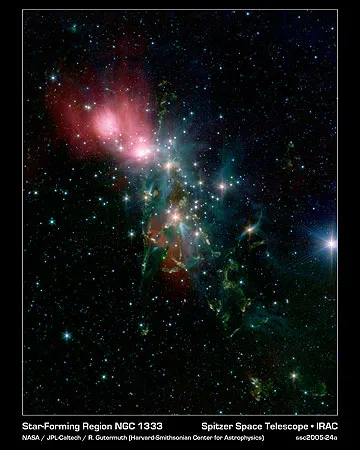
The ravages of star formation feedback are not confined to high-mass clusters. Low-mass clusters like NGC 1333 (a nebula and stellar nursery about 1,000 light-years away) contain only hundreds, instead of thousands, of stars. Although massive stars are not formed in these clusters, the stars there produce protostellar jets from their disks and these can also play a dramatic role in shaping the cluster's fate. Spitzer images of NGC 1333 and other low-mass clusters show them entangled with elegant arcs of material stretching back and forth across these stellar nurseries. In low-mass clusters, feedback from matter jets can play the same disruptive role that winds and UV radiation from massive stars play in high-mass clusters. Unfortunately, we still don't have enough information to say whether most stars in the galaxy formed in high-mass or low-mass clusters. If we knew the answer, we would be closer to estimating how many solar systems like ours exist.
The combined effects of matter jets, winds, radiation, and supernova explosions show that nature can enforce a kind of celestial family planning. Stars can beget other stars, but they can also impede the birth process. "We can see the jets from different stars interacting with each other. Those flows can either trigger the formation of new stars or disperse the gas that would have been part of the formation process," explains Arce.
The impact of this stellar birth control is still highly debated, however. Some astronomers believe these internal processes are not the key players in inhibiting star formation. They say factors external to the cluster, like the forces produced by the galaxy's rotation, alter the cluster more intensely and prevent stars from forming. But Spitzer images have provided incredibly beautiful evidence to support the case for internal processes. Recent computer simulations showed how hundreds of jets can act like hypersonic cocktail stirrers churning a cluster's gas into turbulent motions that inhibit new stars from forming. And new studies added weight to the idea of stellar feedback. "With the Complete Survey we tripled the number of outflows we can see affecting the cloud," notes Goodman.
While astronomers have investigated the feedback mechanisms operating in high- and low-mass clusters, a related mystery remains about the largest potential star-forming regions. Both types of clusters form in larger complexes of gas and dust called giant molecular clouds. Some of these clouds are dominated by high-mass clusters, others by low-mass clusters, and some by both. A typical cluster will span a few light-years. Its parent cloud can stretch across 300 light-years and contain enough matter to create a million stars. But a million stars are not formed. Instead, star formation across the giant molecular cloud is rather an anemic process and relatively few stellar nurseries emerge. Only 10 percent of a cloud's mass, on average, is converted through gravitational collapse into stars. The rest collapses and is eventually dispersed into the tenuous interstellar medium across the galaxy. What is preventing the vast clouds from collapsing under their own weight?
Some astronomers believe the answer lies in the powerful magnetic fields known to envelop the clouds. Others think galactic shock waves prevent most of the gas from collapsing. And others say the feedback that astronomers see operating in high- and low-mass clusters is powerful enough to alter even the molecular clouds.
"You have to ask why only 10 percent of the cloud turns into stars. But we know that star formation adds energy to the system through winds, radiation, and matter jets. Supernova blast waves, of course, just add insult to injury," says Bally.
"If all these stars create turbulence, then that turbulence acts like a kind of heat that keeps the cloud inflated," adds Goodman.
The mechanism that prevents giant molecular clouds from collapsing—whatever it is—has a lot to do with why we exist in the first place. Stars are factories that convert light elements into heavier atoms. These atoms include carbon, oxygen, nitrogen, and all the other elements that are essential for life as we know it. When a star dies, this material is scattered into space. When later generations of stars form, some of that material solidifies into rocky planets like Earth. If galaxies quickly exhausted their fuel reserves, creating many first-generation stars early on, few stars with rocky planets would have been born later. The chances for life would be worse. Earth might very well not exist.
By searching for star-forming nurseries across the galaxy, astronomers have shown us something innate and strangely familiar about the birth of our own star and planet. Psychologists know that in human families the role of siblings can be as important as that of parents. Thanks to the Spitzer Telescope, the same could be said of the heavens.
The Star Formation Game
Astronomer Adam Frank, author of the Discover article translated in this post, helped Discover magazine create a flash game whose goal is to trigger the greatest creation of star formation. This article is part of the material accompanying that game, which we talked about in "Star Formation: The Game".
Note: I avoided using the anglicism "nursery" in the translation, using "guardería" instead, as reader Joaquín in a previous note instructed me. Thanks!
Sources and related links
- The Violent, Mysterious Dynamics of Star Formation by Adam Frank
About the images
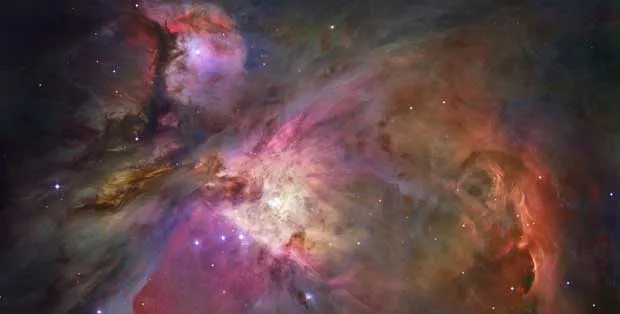
Young stars in the Orion Nebula emerge in this overlay of infrared images from the Spitzer Space Telescope and visible-light images from the Hubble Space Telescope.
Image courtesy of NASA
M16: The Pillars of Creation in the Eagle Nebula
NASA, ESA, STScI, J. Hester and P. Scowen (Arizona State University)
NGC 1333
Credit: NASA/JPL-Caltech/R. A. Gutermuth (Harvard-Smithsonian CfA)