Massive bursts of stars in a galaxy have been compared to cosmic fireworks happening at a movie pace: they are fast and furious for a short time.
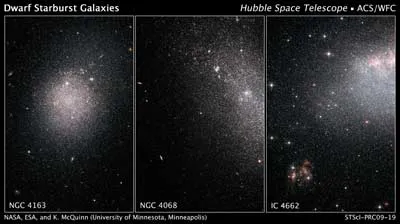
These fleeting starbursts are only pieces of a story, according to astronomers. An analysis of archival images of dwarf galaxies, taken by the Hubble Space Telescope, suggests that these bursts, which are intense regions of star formation, extend across the entire galaxy and last 100 times longer than thought. The longer duration may affect how dwarf galaxies change over time, and thus, could shed light on galactic evolution.
"Our analysis shows that starburst activity in dwarf galaxies occurs on a global scale," explains Kristen McQuinn of the University of Minnesota, leader of the study. "There are pockets of intense star formation that propagate across the galaxy." According to McQuinn, the duration of these events in a dwarf galaxy could last between 200 million and 400 million years.
This is much longer than the 5-10 million years proposed by astronomers who have studied star formation in dwarf galaxies. "They were looking at individual clusters and not at the whole galaxy, so they assumed the starbursts lasted a shorter time," noted McQuinn.
Dwarf galaxies are considered by many astronomers to be the building blocks of the larger galaxies seen today, so the duration of the bursts is important for understanding how galaxies evolve.
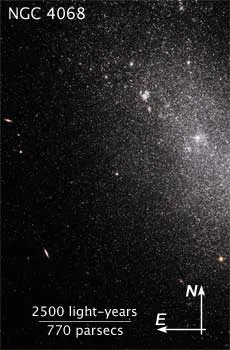
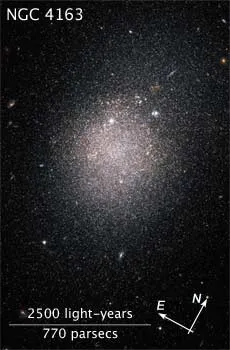
The team analyzed archival data from the Hubble Space Telescope's Advanced Camera for Surveys of three dwarf galaxies: NGC 4163, NGC 4068, and IC 4662. Their distances vary between 8 million and 14 million light-years. The trio is part of a survey of starbursts in 18 nearby dwarf galaxies.
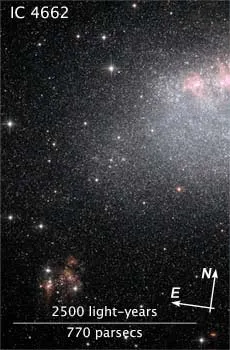
Hubble's vision allowed the scientist to pick out individual stars in the galaxies and measure their brightness and color, two important characteristics that astronomers use to determine stellar ages, and thus, reconstruct the history of the bursts in each galaxy.
Two of the galaxies, NGC 4068 and IC 4662, show active and bright starburst regions in the Hubble images. The most recent burst in the third galaxy, NGC 4163, occurred 200 million years ago and has faded from view.
The team searched in regions of high and low stellar densities to form a picture of the bursts. The galaxies were creating some stars, when something, perhaps an encounter with another galaxy, pushed them to form stars at a higher rate. Instead of forming eight stars every thousand years, the galaxies began to form 40 stars every 100 years, which is a lot for a small galaxy, according to McQuinn. A typical dwarf galaxy is between 10 thousand and 30 years years light in diameter. In comparison, a galaxy like the Milky Way is about 100 thousand light-years in diameter.
About 300/400 million years ago star formation occurred in the outer areas of the galaxies. Then it began to migrate inward, as massive stars exploded and triggered new star formation in adjacent regions. These bursts of new stars are still occurring in the inner parts of NGC 4068 and IC 4662.
The total duration of the activity depends on many factors, including the amount of gas in a galaxy, the distribution and density of the gas, and the event that triggers the bursts. A merger or an interaction with a larger galaxy, for example, could create a larger burst than an interaction with a smaller system.
McQuinn plans to expand her study to a larger sample, of more than 20 galaxies.
"Studying nearby dwarf galaxies, where we can see the stars in great detail, will help us interpret observations of galaxies in the distant universe, where star bursts were much more common because galaxies had more gas with which to create stars," the author of the study, which appears in The Astrophysical Journal, finally explained.
Sources and related links
- Starbursts in Dwarf Galaxies are a Global Affair
- IAC: Star formation bursts
- The True Durations of Starbursts: Hubble Space Telescope Observations of Three Nearby Dwarf Starburst Galaxies
Kristen B. W. McQuinn, Evan D. Skillman, John M. Cannon, Julianne J. Dalcanton, Andrew Dolphin, David Stark, Daniel Weisz
ApJ 695 561-573
DOI: 10.1088/0004-637X/695/1/561
About the images
Credit: NASA, ESA, K. McQuinn (University of Minnesota, Minneapolis), and I. Karachentsev (Special Astrophysical Observatory of the Russian Academy of Sciences, Russia)