The long-awaited servicing mission to Hubble, the fourth and final one, is one month away. The space shuttle Atlantis is scheduled to launch on May 12.
For Massimino it will be his second mission to the space telescope and he has been sharing his enthusiasm through the popular messaging service Twitter. UniverseToday took the opportunity and asked him some questions.
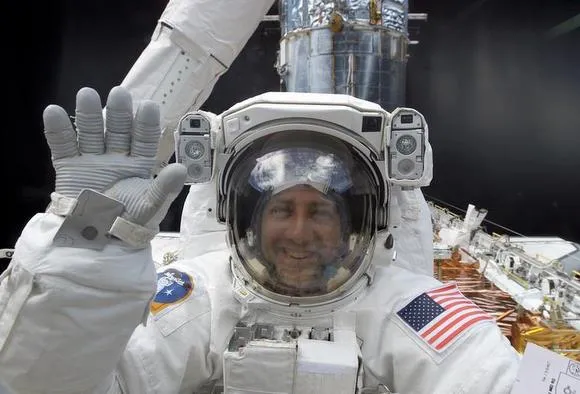
Finally the Hubble servicing mission will happen. How do you feel about it?
I feel great. I'm ready, and I think my crew is ready and looking forward to going to space and seeing Hubble again and seeing Earth from space.
On Twitter, you commented a few days ago: "Seeing Earth from space is the most beautiful place, words cannot describe the experience, I can't wait to have that view again!". And it made me wonder how long you have waited to have that perspective and if you dreamed of this kind of thing as a child.
I dreamed of being an astronaut when I was little. I was 6 years old when Neil Armstrong first walked on the Moon. But the view of Earth...it's so incredible to see Earth from space. There's no way to really prepare for that, we can practice our spacewalks in the floating lab, we can go to simulators, but there's nothing that can prepare you for what your eyes see when it comes to the beauty of space and Earth. I really can't describe it in words, but I can describe what my thoughts were. When I actually had the chance to look, while doing a spacewalk, the first thought that crossed my mind was "If you were in Heaven, you would see this". And then the thought that replaced it was "no, no, it's more beautiful than that. This is how Heaven must look".
You performed two spacewalks servicing the telescope during mission STS-109 in 2002. Since then you worked in Mission Control and gave some classes. Why such a long time between missions?
I flew in 2002, then I hoped to be reassigned to another shuttle flight at some point, but the Columbia accident happened. In the three years following Columbia, we didn't have many flights. I was assigned shortly after STS-121 to the Hubble Space Telescope flight. Then came this series. My crew and I were assigned around Halloween, October 2006...We thought we would be flying in a year and a half. We were two weeks from launch, in October of last year, and we were delayed because something broke on the telescope. It's been good for the safety of the job I think. It gives you more time to be prepared, and they hold you back a little more. (See: "Hubble failure would delay its servicing mission")
Have you noticed any differences between preparing for this mission and preparing for the STS-109 flight?
STS-109 was my first flight. I was trying to understand what I was going to do, not to be on top of everything. I worried about how I would react in space, it was a kind of worry about how I was going to do things. On this flight I am very confident about how I will do it...and I'm a little more worried about how the team will do it. It's...a bit more responsibility. I am the experienced person on our spacewalk team now. It's actually a little nicer because I know what I'm going to do and I'm looking forward to it.
You are on Twitter. Why?
I feel fortunate to have the opportunity to be an astronaut. I think I am extremely fortunate. We can do so many wonderful things; one of my interests has been to try to share that with people as best I can. It seems this Twitter idea was a great way to share our experiences with other people. One of the great things about Twitter is that it doesn't take long. You have 140 characters...I checked this weekend and we were about 35,000 people.
You have about 40,000 now
...I think if there are so many people listening, it's a very good thing. It's incredible to hear the excitement and all the good wishes from people all over the world.
The interview was published by Anne Minard in UniverseToday.
Mike Massimino's Twitter page is http://twitter.com/Astro_Mike
The repairs
Two of the telescope's instruments need repairs. The Advanced Camera for Surveys (ACS) and the spectrograph (STIS). The astronauts plan to repair both, in a commendable challenge, as these repairs are beyond the limits of the service design. Hubble's creators thought astronauts could change components, not perform delicate "surgical" operations during spacewalks.
But before this, the telescope needs maintenance. The computer that sends commands to the telescope's science instruments and formats the newly acquired data for transmission to Earth, called the Science Instrument Command and Data Handling Unit (SIC&DH), malfunctioned 17 days before the planned launch on October 14, 2008. The mission was postponed, as Massimino recounted in the interview. The spare part will be taken to orbit in Atlantis and installed on Hubble on the first EVA day.
In addition, the astronauts will replace batteries that store the energy that powers the telescope during the "night" portion of its orbit, with new and more effective versions.
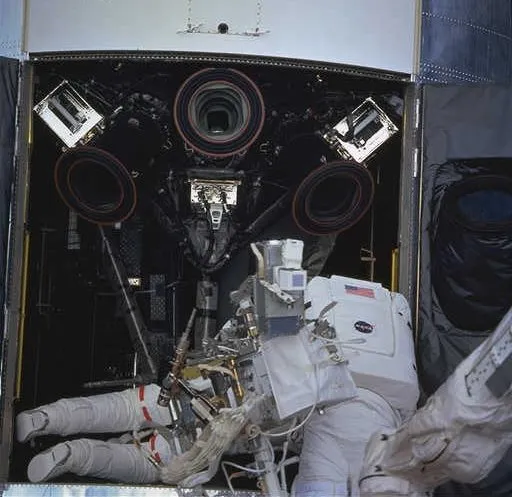
The telescope's six gyroscopes are part of the system that points the observatory. When all 6 gyroscopes are working, three of them are used for pointing and the others are kept in reserve. Time has degraded three of them, which failed. Two are in use and a third is used in case of emergency. The astronauts will install six new gyroscopes.
Hubble's fine guidance sensors, Fine Guidance Sensors (FGS), lock onto guide stars, helping to point the telescope. They can also be used as instruments to measure the position of stars relative to others. A replacement will be made on this mission with a refurbished FGS that had been removed on a previous mission.
In addition, insulation work will be done, in key equipment regions, with a new layer of blankets, the so-called New Outer Blanket Layer (NOBL).
Finally, they will install a new device, which will allow a robotic spacecraft to dock with Hubble someday, once the observatory is at the end of its life.
Sources and related links
- Interview with Astronaut Mike Massimino on the Hubble Servicing Mission, Viewing Earth from Space and … Twitter?
- Hubble Servicing Mission 4
- Mike Massimino biography
About the images
Mike Massimino prepares to practice spacewalks in the pool. Credit: NASA
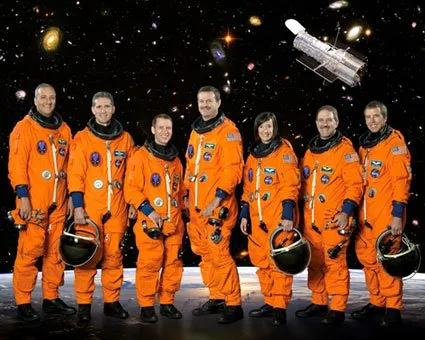
STS-125 crew: From left are astronauts Michael J. Massimino, Michael T. Good, both mission specialists; Gregory C. Johnson, pilot; Scott D. Altman, commander; K. Megan McArthur, John M. Grunsfeld and Andrew J. Feustel. Credit: NASA
Six of Hubble's gyroscopes are located inside three sensor units, in circles. Credit: NASA