How can the cosmos have the entropy we currently observe if the temperature was almost exactly the same everywhere after the big bang? The answer might lie in our "cosmic telephone number", according to Mag Tegmark.
In a talk, called "Finding the entropy challenge", that Tegmark gave at the Massachusetts Institute of Technology, the scientist addressed one of the great questions of current cosmology: What is the entropy, the amount of disorder, of the universe? Why is the entropy so low? And why is it so high?
If we could write an equation on a T-shirt that describes the entire universe, what information would be necessary?
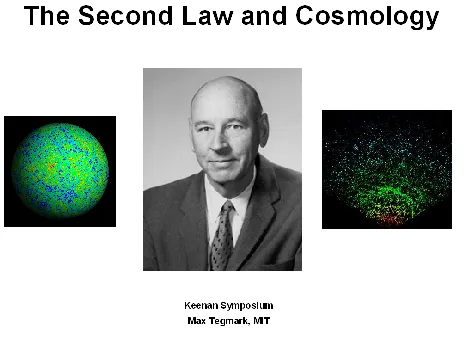
What follows is a transcription of the talk, which can also be seen in the attached video.
Some preliminary clarifications:
The talk is part of a symposium in which there were other talks before Tegmark's that day. That is why Charles Bennett (who gave the talk "The second law and quantum physics") and Dick Bedeaux ("The second law and statistical mechanics") are alluded to.
During the talk, Tegmark used slides, which is why the language of the translation has phrases like "here we see" or similar. The slides used by Tegmark can be downloaded here.
It is perfectly possible, having the video and the transcription translated into Spanish, to directly subtitle the video. However, that would infringe MIT's copyright.
Therefore, I illustrate the post with some images so that it can be read (and understood) directly, although it is feasible to read the text of the post while watching the video.
The talk took place in October 2007, which is why, when alluding to the "previous year", it refers to 2006, specifically when noting the Nobel Prize in Physics for Mather and Smoot.
Finally, the links in the text were added by me, which I think can be helpful to understand some aspects.
The original transcription, in English, was published on Arxiv, with the following summary:
I use examples from cosmology to illustrate that the second law of thermodynamics is not old, but alive and kicking, continuing to stimulate interesting research on the great enigmas. The question "Why is the entropy so low?" (despite the second law) suggests that our observable universe is only a small and almost uniform region in a vastly larger space, stretched by cosmic inflation. The question "Why is the entropy so high?" (compared to the complexity required to describe many candidate "theories of everything") independently suggests that physical reality is much larger than the part we can observe.
[Presentation by Max Tegmark]
[APPLAUSE] Thank you very much. It's a pleasure to be here. The organizers asked me to talk about the second law and cosmology, and a gut reaction to a title like that is: "Wait a minute - the second law of thermodynamics has nothing to do with cosmology!". When I first heard about the second law, I thought it had more to do with Murphy's Laws and the kind of physics that takes place in my kitchen, especially now with two small children in the mornings. You know, eggs break and don't put themselves back together. And this local arrow of time we perceive, what could it have to do with the universe?. However, as we are going to see, it has everything to do with the universe. In fact, Dick Bedeaux and Charles Bennett mentioned that the key to understanding our local arrow of time here is to understand why we started in an unusual state of low entropy. And understanding how we started is, of course, the business of cosmology.
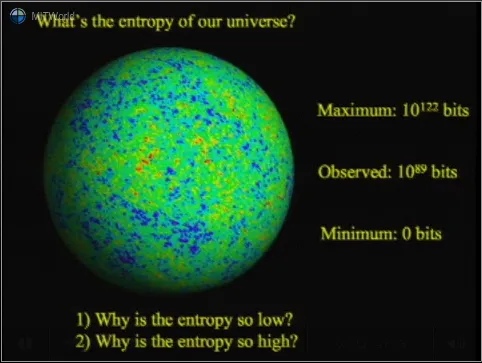
So, a little more quantitatively, with a way of counting, what is the entropy of our observable universe, this sphere in space from which light had time to get here during 13.7 billion years since the big bang? This entropy is around 1089 bits. Roughly speaking, a googol of bits. My talk will have two parts. I will talk about two issues:
1. Why is our entropy so low?
2. Why is our entropy so high?
By the first question, I will mean why is it that the 1089 bits is still much less than thermal equilibrium or what does that mean?. Much less than the 10122 bits that is the Hawking and Bekenstein limit on how much entropy a volume of this size can have.
The second question is why on Earth is this number still much larger than something like zero? Where did all these complexities come from?
Let's start with the first question, "why is the entropy so low?", which, of course, is crucial for understanding our arrow of time. First I must tell you what I mean by entropy. I'm going to stick to the microscopic definition. I will keep measuring in bits, as Charles Bennett did, which you can think of as using units where Boltzmann's constant is equal to 1. Towards the end I am going to take some liberties and use entropy almost non-rigorously to refer to the information algorithm or complexity algorithm. I am going to take these liberties because, frankly, we have severe problems even defining entropy in cosmology, which you are welcome to ask about later. And as John von Neumann once said, nobody really knows what entropy is, so in an argument, you will always have the advantage.
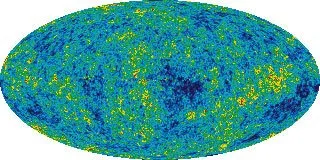
So with these considerations, why is entropy so low in our solar system? And how did our solar system end up so far from thermal equilibrium? The reason we have life here on this planet, the force driving the thermodynamics behind the arrow of time here, is that we have these 6,000 Kelvin of sunlight radiating onto our 300 Kelvin planet, which in turn radiates into a 3 Kelvin universe. This is the number one driver of the thermodynamic process happening here. How could it come to this? If you think about it, it's really striking. We have learned that when the universe was much younger, the temperature was almost exactly the same everywhere. We started 400,000 years after the big bang in a situation where the density was almost perfectly uniform throughout our observable universe, and the temperature was almost exactly the same everywhere to within one part in 10-5. This was the subject of last year's Nobel Prize in Physics for Mather and Smoot. So how can you take something with almost the same temperature everywhere and then make something really hot here and something else really cold?
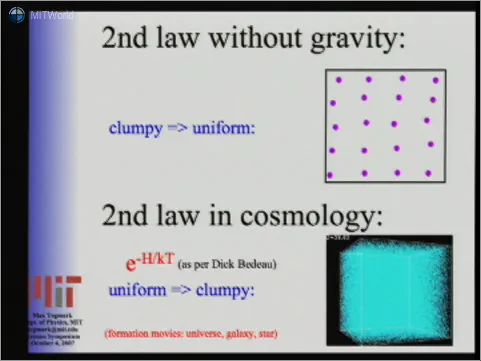
Well, let's look at this animation. We have classical Boltzmann physics where you have a handful of atoms, which are starting to clump together and end up in a more uniform situation. This is the usual way we think of the second law of thermodynamics, taking something clumped and making it more uniform. Well, in cosmology, it tends to be almost exactly the opposite. And the reason is gravity. This happens when there is no gravity, whereas when we have gravity, if we remember what Dick Bedeaux told us, when we look at this usual Boltzmann factor e-H/kT, the Hamiltonian here will contain a gravitational potential energy term, here in the exponent, which can be negative. And it can be arbitrarily negative in classical gravity: if I take two particles and put them arbitrarily close to each other, I can have an almost infinite negative energy. And what that does is give you an intrinsic instability, a thermodynamic instability. And as a result, I'm going to show you now, what has really happened in our universe is that it has gone from being almost uniform to being very, very clumpy.
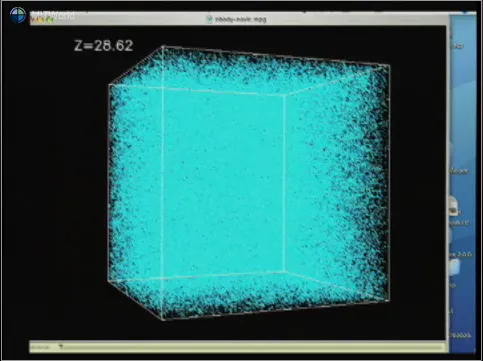
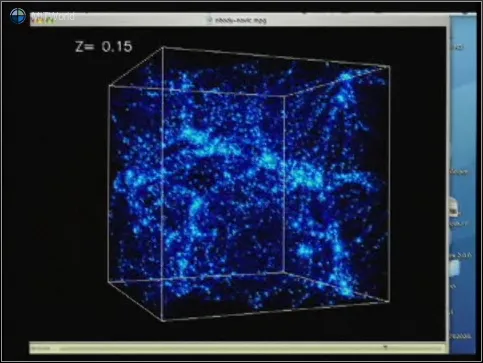
Let me make this a bit more visual by showing you a computer simulation by Ben Moore and his group in Zurich.
What we have here is an enormously large cube, many hundreds of millions of light-years on a side, filled with almost uniform matter and all they put into this supercomputer are the laws of gravity. When we run it and we see an almost uniform distribution becoming clumpier. An intuitive physical way to think about why this is happening is that if you started with something perfectly symmetric and uniform, of course, by symmetry it should stay that way. But if you have a clump here with a bit more stuff than around it, then that clump will gravitationally attract more stuff from its surroundings and become clumpier, which in turn makes it better at stealing stuff from its surroundings. The clump gets bigger and bigger and before you know it these little overdensities of a level of 10-5 have grown to form galaxies, stars, planets, etc. Basically, the rich get richer. That's what gravity is doing here.
So let's zoom in on one of these clumps, which has a size like the dark matter halo in which our Milky Way galaxy lives and see more examples of the second law in action in cosmology. This is a supercomputer simulation now by Mattias Steinmetz and his group in Postdam, Germany, where they put, besides gravity, the basic physics of gases. What you see on the left is a top view of the same thing you see on the right, seen from the side, which is gas gradually becoming denser and denser and forming stars and things are getting more and more disordered. Except, again, compared to the way we usually think of entropy increasing in a gas, making it more uniform, this is not becoming more uniform. It's becoming more and more clumpy and complicated. And if you let this happen for a billion years, you end up with something that looks a lot like the Milky Way galaxy, which is our home.
If we zoom in closer to home now, in the environment of just one of these specks of light here, just one star, we can see the second law again. We have a gas cloud. It contracts due to gravity. It dissipates and radiates much of its energy and settles into a disk, and the contraction and clumping continues in the center of this until the gas becomes so dense that nuclear fusion ignites in the core of this clump and a star is born. And meanwhile, further out clumps took place in the outer parts of this disk and once the newborn star expels the residual gas, we see these clumps that are formed here: planets.
We started by wondering why entropy is so low here in our solar system: why we have very different temperatures from different celestial bodies that allows us to have life here and so on. The good news is that astrophysics has made a lot of progress on this, as the computer simulations illustrate, because no magic was put in here: we just put in Einstein's theory of gravity and the basic physics of gases and ended up with what looks like the universe we observe.
However, deep questions remain. Why then was it that things were so uniform in the beginning? Because, as I have already said, that reality corresponds to the very low entropy in cosmology. Why was it that the gas that fills our observable universe was as uniform as the gas in this room? The air has fluctuations of the order of 10-5 due to the sound waves caused by my talk. Why was it so uniform back then? And, moreover, why is everything so big? Why is space expanding? There is a cluster of questions that have bewitched us for a long time. And then our colleague Alan Guth, here at MIT, came up with an answer that sounded completely crazy for this, called inflation, which has captured us like a wildfire and is now strongly supported by observation. His answer about why the universe started so uniform is that it didn't. Instead, he said that if you have a tiny, tiny region of space, much, much smaller than an atom, which for some reason is very, very uniform and also very, very dense, then this process of inflation can expand space, as Einstein and Friedman showed long ago that space can do, and expand it exponentially, and thus double its size over and over again, perhaps every 10-32 seconds, until this subatomic region of space has become so enormous that you have made all the space in the part of the universe we can see and more. And it makes it all uniform. So in this picture, you can start with something all messy, perhaps close to a kind of thermodynamic equilibrium in a vague sense, but a small part of it could be stretched and become uniform. And since that fills everything we can see, we fool ourselves into thinking that everything was uniform just because we arrogantly like to think that everything we can see is all that exists.
This is an idea that sounds very, very crazy, so why should we believe a word of this? I want to remind you that all of cosmology was viewed with extreme suspicion throughout the sixties and seventies. It was considered a very eccentric subject, on the border between metaphysics and philosophy. And yet, the journal Science wrote this article in 2003, saying that the number one breakthrough of the year is that we can now begin to believe what these cosmologists are saying. And why did they write that? They wrote it because there is data. As Bob Silbey mentioned, we have enjoyed a revolution in measurements, in our ability to quantify things out there in space. And just to give you an example of this, I have already talked a bit about three-dimensional galaxy maps. Another example are these baby pictures of the universe for which George Smoot and John Mather won the Nobel Prize last year.
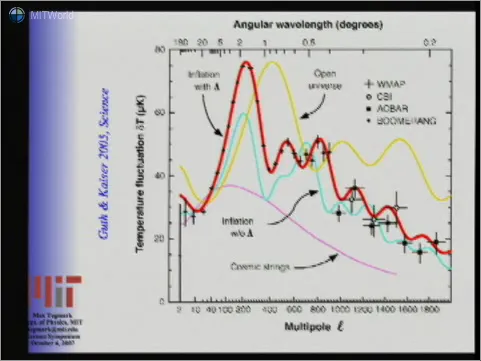
Don't worry about what these axes mean. What is important is that the black crosses here are measurements with one-sigma error bars, and the red curve is a theoretical prediction from inflation. This is very, very far from the sixties when you could speculate about anything because there was no data to prove you were wrong. This is a truly impressive quantitative fit. And it is because of this kind of measurement that more and more people are beginning to think that Alan Guth will also get a free trip to Stockholm at some point. Because this theory is looking very credible.
So we have talked about why entropy is so low. In other words, why, at least the part of space we are in is so far from thermal equilibrium. And let me use my remaining five minutes very briefly to say a few words about why entropy is so high. It is an enormous number, 1089 bits. Now, who ordered that?[1]
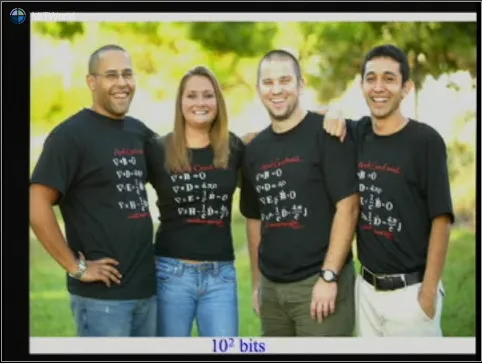
Here at MIT, many people like to walk around with t-shirts with fundamental equations on them. And my colleagues in theoretical physics have their Holy Grail hope that one day they will discover not just some equations, but the equations, for the theory of everything. They will give us a complete description of the universe. And what they particularly hope is that they will be elegant enough for those equations to fit on a t-shirt, right? This may be a vain hope. But let's suppose it is true for a moment. Let's entertain that thought and see where it leads us. Then, how much of this information is really necessary on a t-shirt? Does the t-shirt have to have an equation that has the number eight in it that says we have eight planets? No way. Because we know there are many other planetary systems with three planets, two planets, zero planets, and so on, so the number eight is only telling us something about where we are living, right?
Should that t-shirt specify all the initial conditions for our observable universe? No. It shouldn't, because inflation predicts that space is not just big, but actually infinite. So if you go far enough, by the kind of ergodic arguments we heard this morning, all kinds of initial conditions will be realized somewhere else. So those initial conditions, which create the set of those 1089 bits, are only telling us where we live in space. Those 1089 bits are only telling us our address in space. So they shouldn't go on a t-shirt, because the t-shirt describes all of space, the whole theory, right?
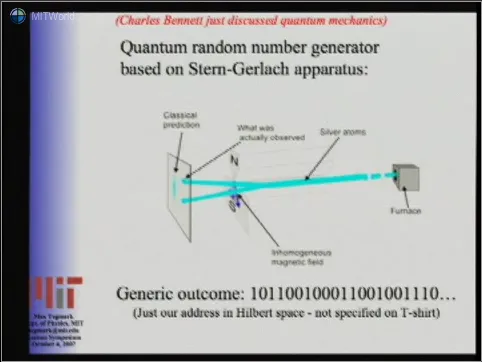
And in the beautiful previous talk by Charles Bennett on quantum physics, suppose you take a quantum random number generator like your Stern-Gerlach apparatus and start producing a whole bunch of quantum random numbers, should those numbers go on the t-shirt as something fundamental about the universe? Well, if you give Charles Bennett enough beer, he will confess to you that he believes quantum physics is unitary and surely, all these bits are also telling us where we are in this great quantum Hilbert space where these different outcomes occur.
So what should go on the T-shirt then? This is from a recent paper I wrote with my colleague Frank Wilczek here and Martin Rees and Anthony Aguirre: you would want to put the 32 dimensionless constants of nature, which we need to calculate everything, from the masses of elementary particles to the strength of the interactions and so on. That could be a good thing to put there. We still don't know where they come from. They are really telling us something about our universe. Or perhaps we put some equations, including the Standard Model Lagrangian. I suspect this T-shirt would not be very financially viable. But perhaps one of you will come up with some more elegant equations from string theory or whatever, of which this is just a special case. But even here there is a bit of a surprise coming from string theory recently, which is that it could well be that in this infinite space even the values of these constants might not be completely constant across all of space. Perhaps they are only constant in the large portion that inflation made. And there could be other values somewhere else, in which case even part of this information is just telling us where we live. The key point I am making is that most of the information we think describes something fundamental about the universe might just be our address, a form of our cosmic telephone number.
So if you ask yourselves 'is everything we observe really all there is?', I would argue that our high entropy, the fact that 1089 is a large number, suggests 'no, there is probably more than we can see'. Or putting it another way, if what we can observe here requires many more bits to describe than a complete mathematical description of the world to put on a T-shirt, then we are in some kind of multiverse or basically a much larger reality than we can observe.
To summarize, I think that not only does the second law of thermodynamics have a lot to do with cosmology, but it gives intriguing clues about future research to follow. Why is entropy so low? Probably because inflation occurred. Why is it so high? I estimate it's because we are in some kind of multiverse. Do we know this? Absolutely not. But my key point is that these are active research questions. And if it sounds too crazy, I think especially for the biologists in the room, we should give credit to Charles Darwin here. He told us that we have developed intuition as human beings for things that had survival value for our ancestors, like classical physics, the parabolic trajectories of rocks in flight thrown at you. That is the kind of thing we expect to have intuition for, nothing else. So it's not surprising that then we look at very small things in the quantum world and they seem counter-intuitive, when we look at very large things, very fast things, black holes, time dilation, it seems counter-intuitive. And I think that if we categorically reject ideas and science just because it feels weird, we will probably also reject the correct theory.
Finally, I would like to return to the anthropic principle that was mentioned by Charles Bennett here. Now, the final form of this, the most extreme culinary form of this, would be that, the universe must be one that we like. And the great physicist Richard Feynman has something very interesting to say about this, with which I would like to end by showing you this video clip.
Feynman: Then there's the kind of saying that you don't understand the meaning of 'I don't think that'. It's very crazy. It's the kind of thing that I am just, I'm not going to accept'. [...] If you want to know the way nature works, we look at it carefully, look at it - see, that's the way it looks. If you don't like it, go somewhere else! To another universe where the rules are simpler, philosophically more pleasing, psychologically easier.
So let's conclude with something I'm sure we all agree on. I think we all agree that despite its old age, the second law is not old and tired. On the contrary, it is alive and kicking. And I hope these examples from cosmology have helped illustrate that the second law of thermodynamics continues to stimulate truly interesting research on big, big puzzles. Thank you!.
So far, the first 24 minutes of the talk (and of the video), which correspond to 5 and a half pages of transcription. The other half is the debate, in which participants were able to ask questions. We will make that second part available here, very soon.
Sources and related links
- Entropy and our cosmic telephone number
- The Second Law and Cosmology
- Video at MIT:The Second Law and Cosmology
- Notes:
[1]:"Who ordered that?", I suppose he is paraphrasing theoretical physicist Isidor Rabi, who is said to have expressed himself that way upon learning of a newly discovered particle, the muon.
About the images
The images are screenshots from the talk video.
The video "The second law and cosmology" belongs to MIT