Astronomers have detected the most distant object in the universe so far. It is a star that exploded 13.1 billion years ago, only 640 million years after the Big Bang, towards the end of the "dark ages".
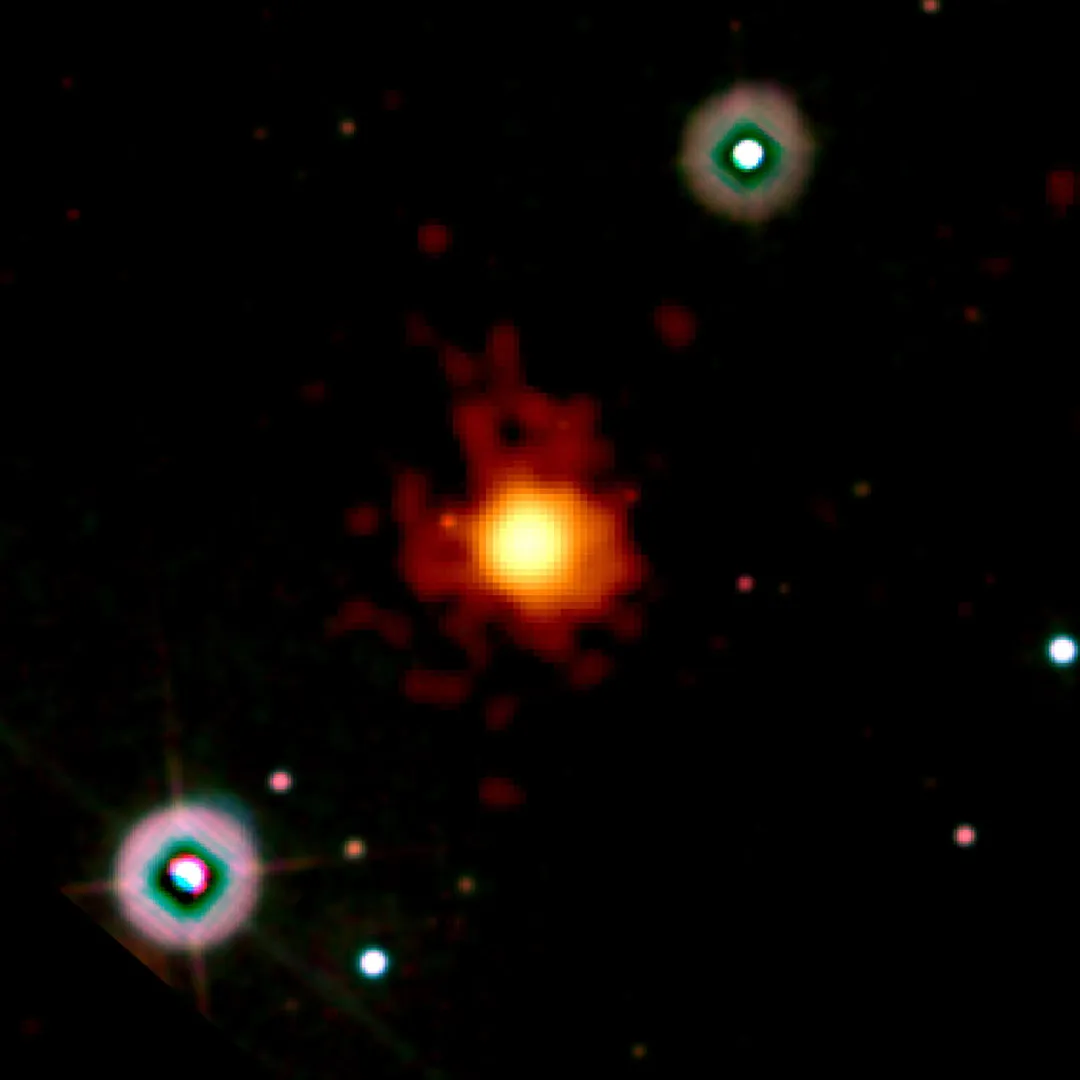
It is a gamma-ray burst (GRB), the brightest explosions in the universe. GRBs occur when some massive stars collapse and form black holes and eject jets of gas.
The burst, named GRB 090423 after the date of its discovery, which occurred this past Thursday, was originally observed by NASA's Swift satellite.
Around the world, astronomers began observing that region of the sky to study the afterglow. Some of the first observations were made at Mauna Kea, with the United Kingdom Infrared Telescope and the Gemini North telescope.
Other telescopes later measured the spectrum, revealing that the burst occurred 13.035 billion years ago. "It's the most distant gamma-ray burst, and the most distant object in the universe," said Edo Berger, of the Harvard-Smithsonian Center for Astrophysics.
To calculate the distance to an object, astronomers measure how much its light has been stretched, that is, how much it has been shifted towards the red end of the spectrum. This burst has a redshift (z) of 8.2, which is greater than the previous record of 6.7.
(See: "Swift captures most distant gamma-ray burst")
Other astronomers have said they have found galaxies at even greater distances, with z=10 and z=9, but those findings are still ambiguous, according to Joshua Bloom of the University of California, Berkeley, who observed the afterglow with Gemini South in Chile.
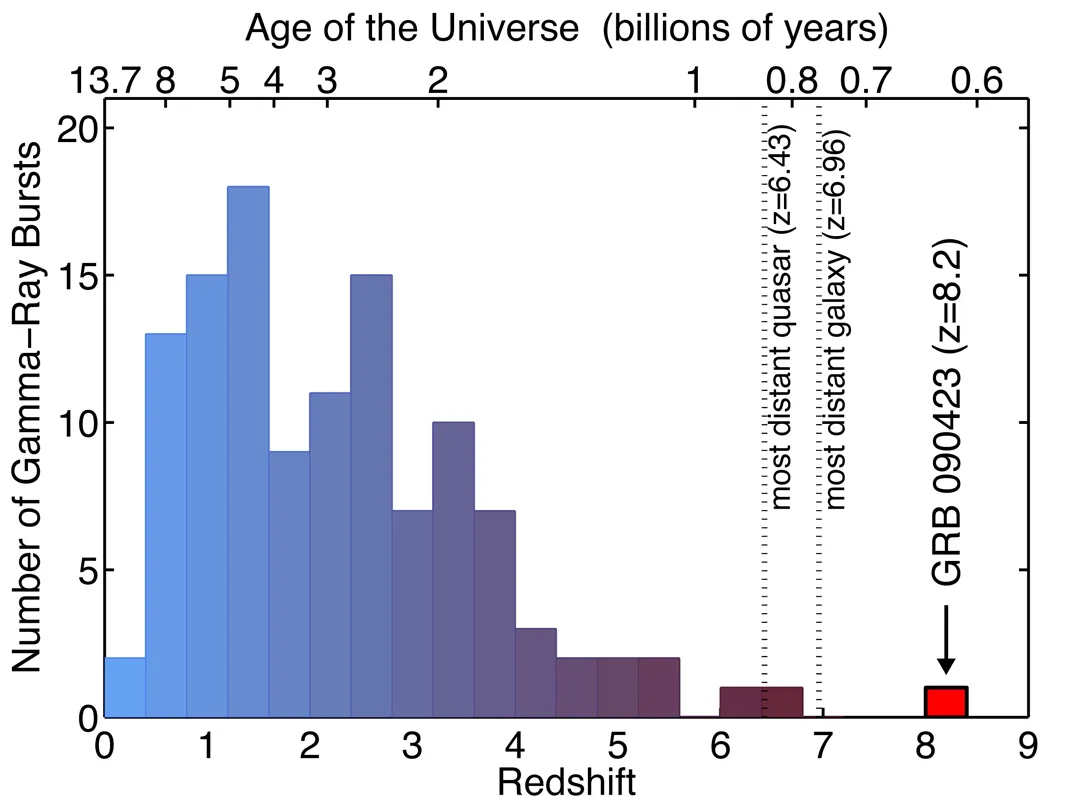
Credit: Edo Berger (Harvard-Smithsonian CfA)
The history of the universe marks that early epoch with what is called the reionization era.
"For astronomy, this is a key moment. It is the beginning of the study of the universe as it was before most of the structure we know today began to exist," Bloom told New Scientist.
According to GRBlog, Swift's Burst Alert Telescope (BAT) triggered and located GRB 090423 (trigger=350184), a 10-second gamma-ray burst of modest brightness, and calculated its position. The X-ray telescope began observing the region 72.5 seconds after the alert.
Within three hours of the event being detected, in the United Kingdom they detected an infrared source at Swift's position using UKIT. At the same time, efforts were made to obtain infrared images of the afterglow with Gemini North.
Berger hopes the discovery of the object will accelerate the development of new telescopes that can find these afterglows more efficiently.
"I think we have shown that it is a worthwhile investment because [the distant bursts] really do exist."
Sources and related links
- New Scientist: Most distant object in the universe spotted
- Sky&Telescope: The Farthest Thing Ever Seen
- GRBlog: 090423
- CfA: Farthest Known Object: New Gamma-Ray Burst Smashes Cosmic Distance Record
About the images
Data from Swift's telescopes: blue and green from ultraviolet/optical, orange and red from X-rays, combined in this image.
NASA/Swift/Stefan Immler
The diagram shows the distribution of redshifts and their corresponding age of the universe for GRBs detected by Swift. The new burst, with z=8.2, easily breaks the previous record.
Credit: Edo Berger (Harvard-Smithsonian CfA)