How did the universe begin? How did life start? Is there life beyond Earth or are we alone in the cosmos?
These were some of the questions addressed at the remarkable symposium titled "Origins," in which distinguished scientists from a wide spectrum of disciplines gathered last April.
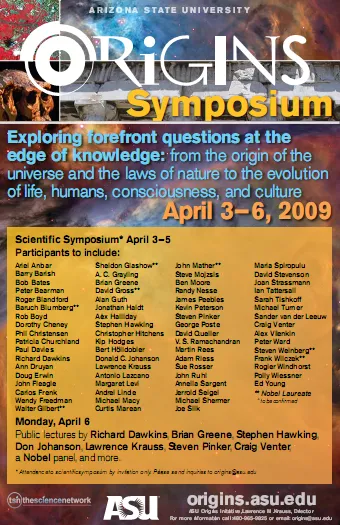
The event was the beginning of the so-called Origins Initiative, at the University of Arizona, an interdisciplinary research program led by physicist Lawrence Krauss.
Its goal was to start the initiative "with a bang," Krauss noted. "I wanted to create a symposium that would be heard around the world."
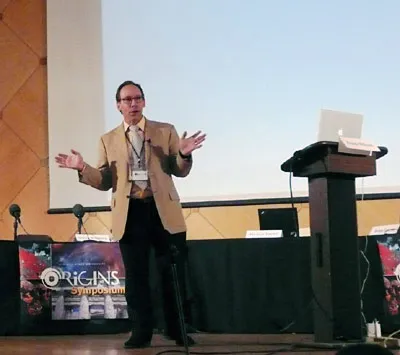
In an atmosphere that could be described as the "Woodstock of Science," some of the best-known researchers explored topics such as the big bang, string theory, human origins, evolution, and astrobiology.
Familiar names participated, such as Brian Greene, Steven Weinberg, Richard Dawkins, Paul Davies, Craig Venter, and Steven Pinker.
The four-day event included a full day of public lectures at the University of Arizona.
Beyond Earth
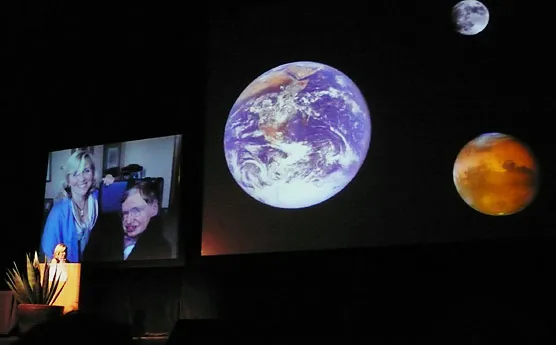
The last speaker at the public event was supposed to be Stephen Hawking, but a chest infection kept him in the hospital. His daughter, Lucy Hawking, delivered his presentation, showing her father's slides and playing a pre-recorded narration. In the talk, titled "Why Go into Space?," Hawking said that although robotic space missions have proven incredibly successful, they cannot achieve the excitement of human spaceflight. Furthermore, he said that the long-term survival of humanity depends on our colonization of other worlds.
The possibilities of alien life
Half a century of SETI radio searches have not detected extraterrestrial life, but the searches have been so sparse that not having obtained results really means nothing.
The issue brings to light how probable or improbable it is for life to begin on a suitable planet. But it also directs attention to how likely it is for primitive life to evolve into beings capable of building spaceships or radio transmitters.
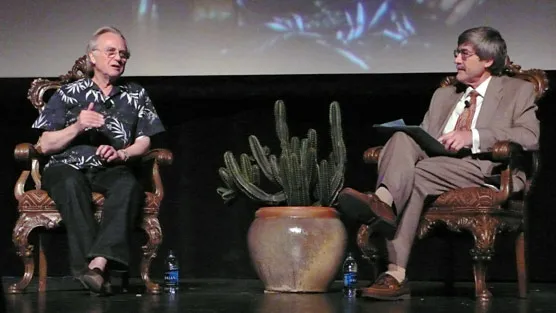
A number of presenters at the symposium alluded to the fact that the thinking, speaking, and tool-using abilities of Homo sapiens are the result of a large number of evolutionary accidents. This perhaps would not happen again if we were to rerun our planetary history.
Biologists tend to be skeptical about the possibility of extraterrestrial radio builders. Astronomers, who deal with cosmic immensities, tend to be bold on the matter. But not always. "It was Darwin who showed how matter and energy can turn into complexity and produce a machine capable of internalizing the universe," noted biologist Richard Dawkins. Given the existence of simple organisms, he continued, the eventual emergence of complexity seems almost guaranteed.
But the leap from complexity to intelligence could be a cosmic fluke. Dawkins pointed out that while eyes arose about 40 times in our planetary history, symbolic language did so only once.
"Human symbolic consciousness, which is the underpinning of our cognitive singularity, is a very recent acquisition in the human lineage," said Ian Tattersall of the American Museum of Natural History. "And, more importantly, it is not a simple extrapolation of the trends that preceded it."
This implies that, even if life itself were common in the universe, creatures that use symbols like us could be quite unusual.
The multiverse
Why does the universe have the conditions that allow life to arise? Physicists and cosmologists have pointed out that the laws of physics, particularly the physical constants, seem to be remarkably the right ones to allow the existence of any kind of complex matter. The nature of atoms and molecules, the strength of the known forces, the properties of stars and galaxies, everything seems to be set up in the appropriate way.
If some of the fundamental constants (which seem to be arbitrary) had values just slightly different, life as we know it could not exist.
The book "Just Six Numbers," by Martin Rees, develops precisely these concepts.
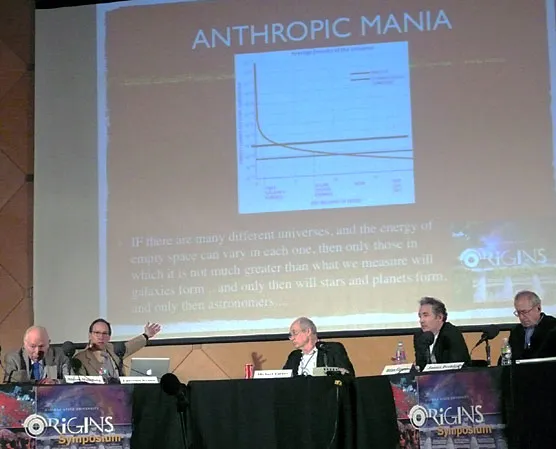
This has led to supporting anthropic arguments and the concept of the multiverse. The idea of multiple universes would allow us to understand our singularity in a broader context. If other universes existed, or regions within the same universe but where conditions were different, it could be understood that these fine values we enjoy have made our existence possible. In the other regions, those constants would be different and there we could not exist.
The idea of a broader universe, a multiverse, has been gaining ground in recent decades. The concept of an inflationary universe, which states that after the big bang a subatomic region of the universe expanded exponentially, could allow us to think of different spaces in the universe. In some, expansion would have occurred and in others not. String theory also seems to allow unseen regions of space-time that could be considered separate universes.
"If there is a multiverse—regions in which different parts have different values for the constants, like the strength of dark energy—then the anthropic principle becomes common sense," said Nobel laureate Steven Weinberg of the University of Texas.
Strings
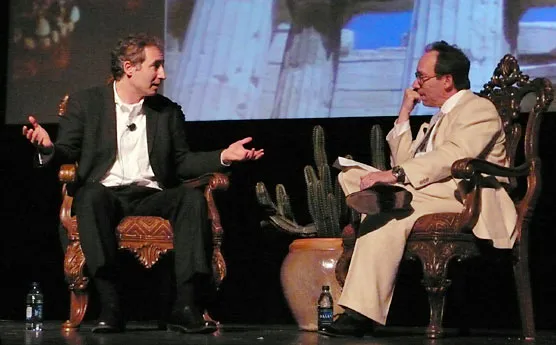
String theory had its moment when Krauss and Brian Greene of Columbia University sat down to talk. String theory attempts to unite quantum theory and general relativity by postulating that all fundamental particles are tiny strings of energy, rather than points. Differences in these strings generate vibrations that account for all the properties of fundamental particles. However, after several decades of research, Greene—author of the book and documentary "The Elegant Universe"—admitted that the theory still has to make a falsifiable prediction. That is, to develop an experiment that allows distinguishing this theory from other ideas, to support it, finally, for which, until then, it should be called the "string hypothesis."
Is this idea going through a stagnation? According to Greene, no. He pointed out that "we are in a period where we are reevaluating and trying to take all the things that have been discovered and find how to organize them better so that we can gain a deeper understanding. If string theory is wrong, I would like to know it right now...because I am not in the game to prove a particular theory right or wrong. I am in the game because I hope to be part of a generation that takes us a step forward, no matter what step that is."
Sources and related links
- Life, the Universe, and Everything: A Conference Looks to Ultimate Origins by Dan Falk
- Videos of the conferences at Origins
- Videos of Origins Initiative at TheScienceNetwork
- The future of cosmology
About the images
Symposium poster
Credit for all photographs: Dan Falk