The technique called astrometry was attempted 50 years ago to search for planets outside our solar system and now, thanks to it, a Jupiter-like planet has been detected.
At the same time, scientists are developing new methods to search for oceans on exoplanets.
Astrometry is a technique that involves measuring the precise movements of a star in the sky since if a planet orbits it, it will generate a particular motion in it. But the method requires very precise measurements over long periods of time.
A team of two astronomers from NASA JPL have mounted an instrument on a telescope at Palomar Observatory for 12 years. After careful and intermittent observations of 30 stars, the team has identified a new exoplanet around one of them, providing the first discovery of an exoplanet around another star using this technique.
"This method is optimal for finding solar system configurations like ours that could host other Earths," says astronomer Steven Pravdo of JPL, author of the study to be published in Astrophysical Journal.
"We found a Jupiter-type planet in a relative location where our Jupiter is found, only around a much smaller star. It is possible that this star also has inner rocky planets. And since more than seven out of ten stars are as small as this one, it could mean that planets are more common than thought."
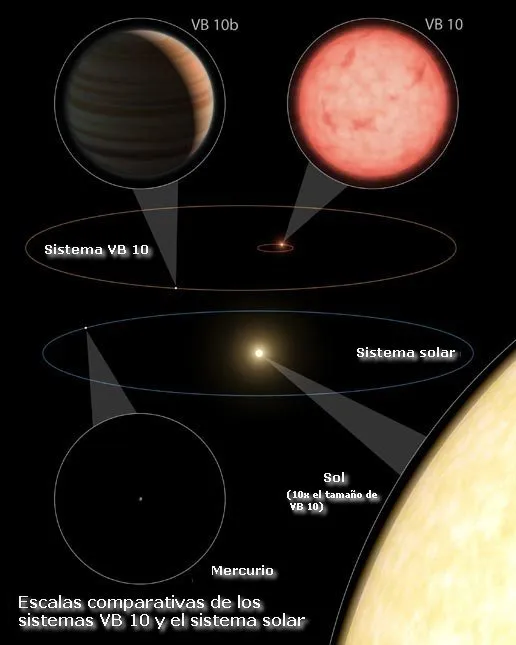
The new exoplanet, called VB 10b, is about 20 light-years away. It is a gas giant, with a mass six times that of Jupiter and orbits far enough away to be categorized as a "cold Jupiter," similar to ours.
The star around which it orbits, VB 10, is small, an M dwarf, with one-twelfth the mass of our sun, barely enough to fuse atoms in its core and shine. For years, VB 10 was known for being one of the smallest stars known. Now it will be the smallest one that also hosts a planet.
Given the size of the star, its planetary system would be a miniature version of ours. For example, VB 10b, although considered a cold Jupiter, is located at a distance from its star similar to that of Mercury from the Sun. Any rocky planet would lie closer.
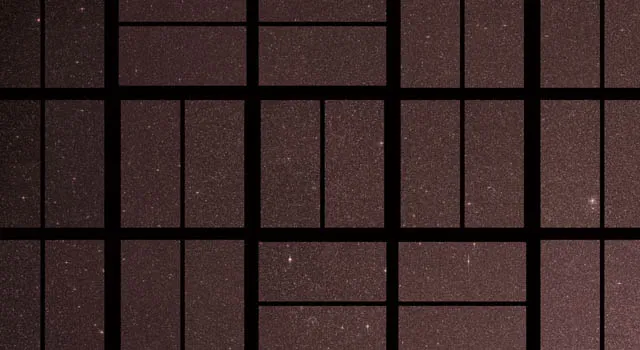
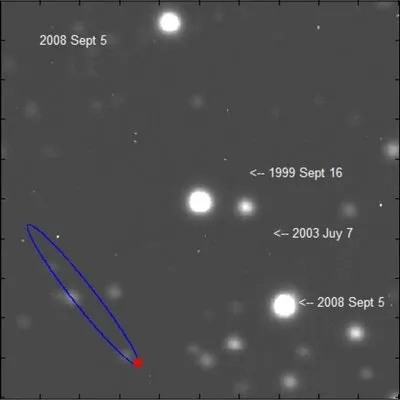
Two to six times a year, over the past 12 years, Pravdo and Stuart Shaklan, co-author of the study, attached their instrument (Stellar Planet Survey) to the famous Hale telescope at Palomar to search for planets. The instrument, which has a 16 Megapixel CCD, can detect small changes in the positions of stars. The planet VB 10b, for example, causes its star to move a small fraction of a degree.
Other techniques used to detect exoplanets that are more widely used are the radial velocity method and the transit method. The first technique also involves measuring changes in the position of stars, but measures the Doppler changes in starlight caused by its motion toward and away from us. As an object approaches, its light tends to blue and as it moves away, it tends to red. Those are the changes that technique detects. The transit method looks for variations in light caused by the passage of planets blocking starlight. The Kepler mission uses the transit method, for example.
Searching for oceans on other worlds
There are already several methods for searching for water on exoplanets. One is spectroscopy, which can reveal the characteristic absorption wavelengths of water molecules and has already been used successfully on giant planets.
Others involve searching for the appearance of clouds or the glint of light from a reflective surface, although this technique has been used for other liquids like methane on Saturn's moon Titan.
Now, Nick Cowan of the University of Washington and others, including the EPOXI mission team, have designed a complementary method that should boost the chances of finding exoplanets with oceans.
The researchers developed their method using data from the Deep Impact probe, launched in 2005 to study the composition of a comet orbiting the sun. Since the mission completed its primary objective, it has continued on an extended mission called EPOXI to study another comet as well as distant exoplanets.
During this extended mission, Cowan and colleagues used the telescope on Deep Impact to examine our planet from tens of millions of kilometers away, as if it were an exoplanet.
The overall color of Earth is gray, with some blue due to Rayleigh scattering. However, the researchers found that when the sky is clear, without clouds, the average color changes with Earth's rotation: when continents are in view, the color shifts toward the red side of the spectrum; when the sea is in view, the color shifts more toward blue. Those color changes should be able to reveal oceans on real exoplanets, the researchers think.
The scientists indicate that the method does not require high resolution, just a few different filters would be enough, but it requires short exposures, according to Cowan. However, to see oceans on Earth-sized exoplanets several light-years away, large telescopes are needed, like the proposed ATLAST, and they will also need to have a coronagraph device to block the light from the star that hosts the planet.
For 2017, the "New Worlds" observatory is also planned, which will combine a 4-meter telescope with a large coronagraph specifically for exoplanet detection.
The research will appear in the August edition of The Astrophysical Journal.
Sources and related links
- Planet-Hunting Method Succeeds: Jupiter-like Planet Found Orbiting One Of Smallest Stars
- Planet-Hunting Method Succeeds at Last
- Alien Maps of an Ocean-Bearing World
N.B. Cowan et al.
arXiv:0905.3742v1 - New method to seek life on exoplanets by Jon Cartwright
About the images
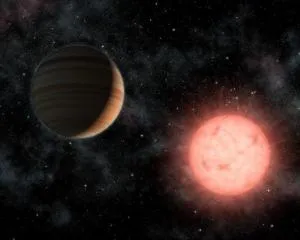
Artist's conception of VB10
Credit: NASA/JPL-Caltech)
The diagram compares our solar system (bottom) with the VB 10 system.
The bodies in this diagram are shown in circles of the same relative scale.
Image of VB 10 moving in the sky over a nine-year period. On the JPL site there is a movie about it.
Credit: NASA/JPL-Caltech/Palomar