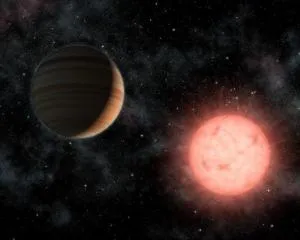
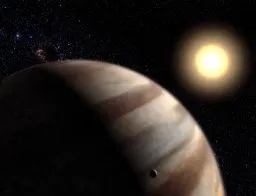
It is an exoplanet in the Gliese 581 system, which has twice the mass of Earth. The team of astronomers also refined the orbit of the planet Gliese 581d, discovered in 2007, placing it within the habitable zone, where liquid water can exist. The incredible discoveries are the result of more than four years of observations.
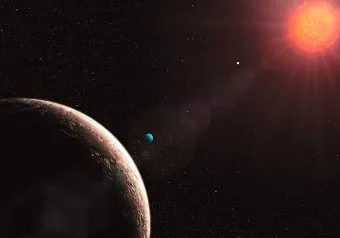
"The holy grail of current exoplanet research is the detection of a rocky planet like Earth in the habitable zone—a region around the star with the right conditions for water to be liquid on the planet's surface," said Michael Mayor, of the Geneva Observatory, who led the study.
The planet Gliese 581 e orbits its star—located 20.5 light-years away in the constellation Libra—in just 3.15 days. "With only 1.9 Earth masses, it is the least massive exoplanet ever detected and is, very likely, a rocky planet," said co-author Xavier Bonfils of the Grenoble Observatory.
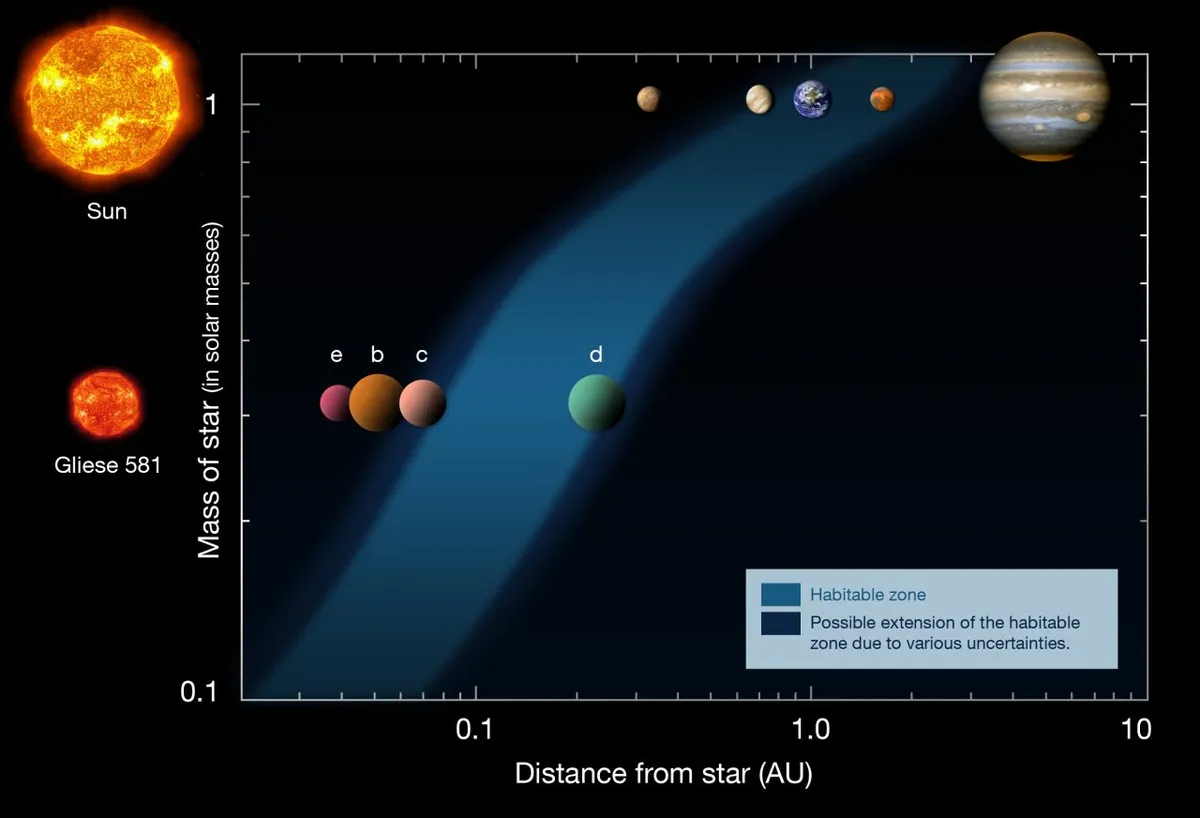
Being so close to its star implies that it is not in the habitable zone. But another planet in this system does seem to be. From previous observations, obtained as in this case with the HARPS spectrograph at ESO's La Silla Observatory and announced two years ago, this star hosts a Neptune-sized planet and two super-Earths. We reported that here in the note "Gliese 581: A planet could be habitable". With the discovery of Gliese 518e, the planetary system now has four planets, with masses of 1.9 (planet e), 16 (planet b), 5 (planet c) and 7 (planet d) Earth masses. The farthest one, Gliese 581 d, orbits the star in 66.8 days and is probably too massive to be only rocky. It is speculated that it is an icy planet that migrated closer to its star. The new observations revealed that this planet is in the habitable zone, where liquid water can exist. According to team member Stephane Udry, "it could even be covered by a large and deep ocean."
Planets exert a gravitational pull as they orbit their stars, causing them to "wobble." That movement can be detected with current technology. Red dwarf stars like Gliese 581 are potentially fruitful hunting grounds for low-mass exoplanets in the habitable zone. These cool stars are relatively faint and their habitable zone lies closer, where the gravitational pull of a planet is more pronounced. Even so, detecting these faint signals is a real challenge and the discovery of Gliese 581 e, as well as the refinement of the orbit of Gliese 581 d, were made possible thanks to the precision and stability of ESO's HARPS instrument.
"It's amazing to see how far we have come since we discovered the first exoplanet around a normal star in 1995—the one orbiting 51 Pegasi," said Mayor. "The mass of Gliese 518 e is 80 times less than that of 51 Pegasi b. That is tremendous progress in just 14 years," he explained.
But astronomers believe they can do even better. "With similar observing conditions, a planet like Earth located in the middle of the habitable zone of a red dwarf could be detectable," said Bonfils. The hunt continues.
The discovery was announced at the JENAM conference during European Astronomy and Space Science Week taking place in the United Kingdom. The results were submitted to Astronomy & Astrophysics.
Sources and related links
- Lightest exoplanet yet discovered
Press release through which more images and animations can be accessed - The HARPS search for southern extra-solar planets: XVIII. An Earth-mass planet in the GJ 581 planetary system
Mayor et al., 2009
Preprint in pdf
About the images
Illustration of Gliese 581 e. ESO.
Diagram:
Illustration based on a diagram by Franck Selsis, Univ. of Bordeaux.