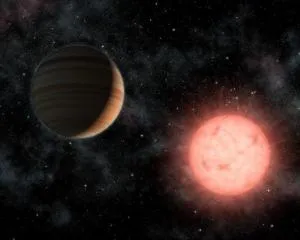
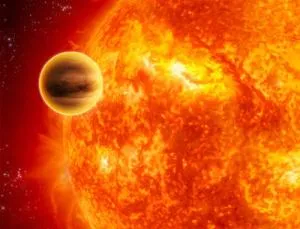
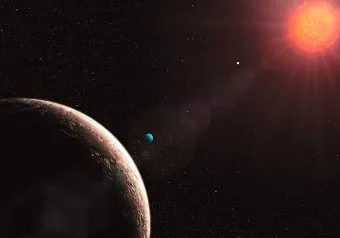
Astronomers found protoplanetary disks, around three young stars, that have central holes, zones "cleaned" of material, perhaps due to the existence of protoplanets.
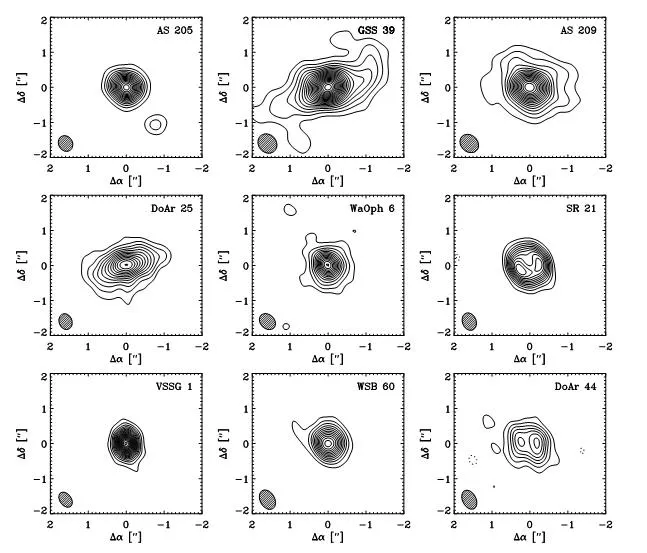
It is not the first time that observations suggest the existence of holes or voids in the disks of gas and dust around newborn stars. In this case, it was presumed that one of the three disks studied should have a void thanks to observations from the Spitzer Space Telescope. But the evidence was indirect, since what had been measured was the absence of short-wavelength radiation that should be emitted by the warm dust near the star.
In a new study, Sean Andrews (from the Harvard-Smithsonian Center for Astrophysics) and colleagues, provide an image of that void. The team used the Sub-Millimeter Array interferometer on Mauna Kea to form images with a resolution of 0.3 arcseconds, enough to show holes with a radius of 40 astronomical units at the distance at which the stars are located, about 400 light-years, in the constellation Ophiuchus. This is the closest active star-forming region to Earth.
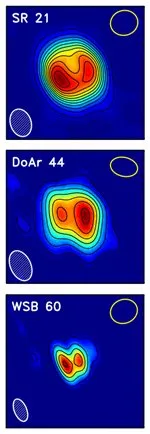
The researchers studied nine disks and found that three host large central cavities. The disks are larger than our solar system and the central holes are at least the size of Neptune's orbit. "You need something with the mass of Jupiter to clean that out," Andrews indicated.
In fact, the missing matter could be a giant planet or several, perhaps a swarm of rocks, or even a stellar companion. It could well be a brown dwarf, difficult to observe, for example.
Finding a fully formed planet in a disk a few million years old would be big news. Theorists assume that the planet formation process, which involves collisions and accretion, takes about 10 million years to turn dust and rocks into planets and clean out a protoplanetary disk. Finding large cavities or gaps in material would imply the possible existence of planets in formation. On the other hand, gravitational instabilities in the disk could act more quickly, forming a companion like a brown dwarf.
Of the nine disks, the three with holes appear to be precisely the oldest.
The importance of the study lies in expanding our knowledge about protoplanetary structures, their spatial distribution and other characteristics, which allow us to better understand the mechanisms of planet and star formation.
The material around a disk, in about 10 million years, should be dispersed into the interstellar medium or incorporated into large bodies of an incipient planetary system. Throughout that time, the force of gravity forces a spatial redistribution of the material and the dust grains settle into the midplane of the disk and aggregate to build larger bodies. If the process continues, those bodies can dynamically influence the remaining material of the disk through accretion and the creation of large cavities. This entire mechanism is influenced by the spatial distribution of mass, the density of the structure, of the material disk. Hence the researchers want to investigate large disks around nearby stars.
The disks studied in this case are AS 205, in the outer northern part of the Ophiuchus clouds is a hierarchical triple system composed of a K5 star (AS 205 A) and a binary (AS 205 B) which are K7/M0 type stars (see Note below); GSS 39, is a heavy and reddish M0 star; AS 209 is a young K5 star; DoAr 25 is another K5; WaOph6 is a K6 star; VSSG 1 is an M0 star in the L1688 cloud; SR 21 is a G3 star; WSB 60 is a cool M4; DoAr44 is a young K3. Of the disks of these nine stars, three appear to host central cavities, associated with possible planet formation. These are SR 21; WSB 60 and DoAr 44.
Note: Stars are classified according to their spectral type. From the largest types to the class of smallest stars the classification is; O, B, A, F, G, K, M. The stars of the studied disks are K or M stars, that is, the smallest and least luminous. Our Sun is a G-type star. Within each type, subdivisions are made, assigning them numbers. Thus, we have K5, K6, M0, etc.
Sources and related links
- Sky&Telescope: Planetary Preemies? by Johannes Hirn
- Protoplanetary Disk Structures in Ophiuchus
Sean M. Andrews, D. J. Wilner, A. M. Hughes, Chunhua Qi, C. P. Dullemond
arXiv:0906.0730v1
In print for Astrophysical Journal
About the images
SMA images of the nine disks. Note the disk around AS 205B (in the first panel), as well as the cavities detected in three disks (SR 21; WSB 60 and DoAr 44.)
Credit: Sean Andrews et al.
Images of the three planetary disks by SMA. Each disk is accompanied by an ellipse at the top right showing the size of Neptune's orbit, for comparison. The ellipses at the bottom left show the image resolution.
Credit: Sean Andrews et al.