An international team of radio astronomers discovered the secret explosion of a massive star, a new supernova, in the nearby galaxy M82. Despite being the closest supernova discovered in the last five years, the explosion is exclusively detectable at radio wavelengths due to the dense gas and dust around the exploded star. Without this blockage of other wavelengths, the explosion would have been visible even with amateur telescopes.
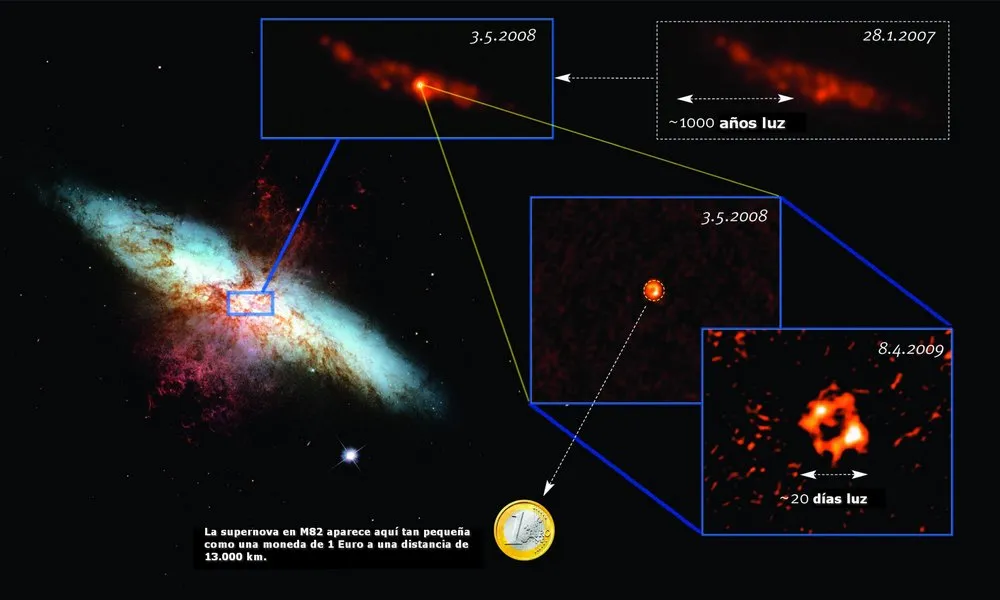
M82 is an irregular galaxy in a nearby group located 12 million light-years from Earth. Although smaller than the Milky Way, it hosts vigorous star formation in its innermost region, where more stars are born than in our entire galaxy. M82 is sometimes called an "exploding" or "starburst" galaxy because it appears torn apart in optical and infrared images as a result of numerous supernovae from massive stars.
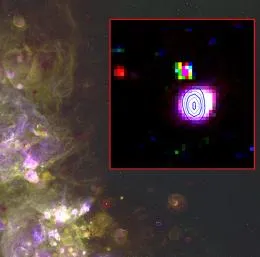
The new discovery was made in April 2009 when Dr. Andreas Brunthaler, from the Max Planck Institute for Radio Astronomy (MPIfR), examined data taken the day before with the NRAO's VLA. "Then I looked at older data we took from March to May of last year, and there it was too, outshining the entire galaxy!" the scientist indicated. Observations taken before 2008 showed no pronounced emissions in either radio or X-rays at the position of the supernova, designated SN 2008iz.
On the other hand, observations of M82 taken last year with optical telescopes searching for new supernovae showed no signs of this explosion. Furthermore, the supernova is hidden in X-ray and ultraviolet images. The supernova exploded near the center of the galaxy in a very dense interstellar environment. That is why the bright outburst remains covered under enormous clouds of gas and dust that only radio waves can penetrate.
Radio emissions can only be detected from the core collapse of a massive star that produces a black hole or a neutron star. It occurs when the shock wave from the explosion propagates into dense material around the star, usually material that was ejected by the massive progenitor star before exploding.
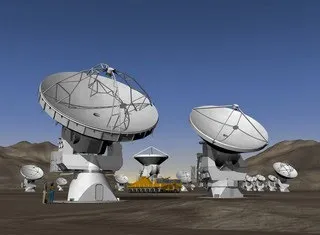
By combining data from ten telescopes of the VLBA, the VLA, the Green Bank telescope, and the Effelsberg telescope in Germany, using the VLBI technique, the team was able to produce images that show a ring-like structure expanding at over 40 million kilometers per hour or 4% of the speed of light, typical of supernovae. "By extrapolating this expansion back in time, we can estimate the explosion date. Our current data indicate that the star exploded in late January or early February 2008," explained Brunthaler.
The asymmetric appearance of the supernova in the images also indicates that the explosion was highly asymmetric or that the surrounding material was distributed irregularly. "Using the ultra-sharp vision of VLBI we can follow the expansion of the supernova into the dense interstellar medium of M82 over the coming years and gain insight into it and the explosion itself," commented Prof. Karl Menten of MPIfR.
Discoveries like this will be routine with the new generation of radio telescopes, such as the Low Frequency Array (LOFAR), currently under construction in Europe, the Allen Telescope Array (ATA) in the United States, or the planned Square Kilometer Array (SKA).
Sources and related links
- An exploding star in an "exploding" galaxy
- Discovery of a bright radio transient in M82: a new radio supernova?
A. Brunthaler, K.M. Menten, M.J. Reid, C. Henkel, G.C. Bower, H. Falcke
Astronomy & Astrophysics, 2009, Vol. 499, L17 (May 28).
DOI=10.1051/0004-6361/200912327
About the images
The left image, taken with the Hubble Space Telescope shows the body of the galaxy in blue and the hydrogen from the central region in red. The VLA image (top left) clearly shows the supernova (SN 2008iz), taken in May 2008. The high-resolution VLBI images (bottom right) show an expanding bubble on the scale of a few light-days.
Graphics: Milde Science Communication, HST Image: /NASA, ESA, and The Hubble Heritage Team (STScI/AURA); Radio Images: A. Brunthaler, MPIfR. (Click image for higher resolution).