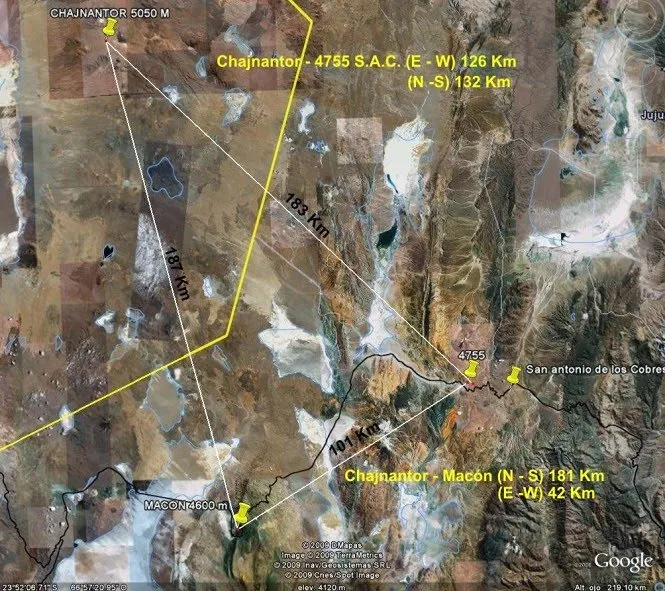
The possibility of installing two radio telescopes for millimeter and submillimeter wavelengths, on the Argentine side of the Atacama desert 180-210 km from ALMA, and at altitudes greater than 4,700 meters has been discussed among astronomers from Argentina and Brazil.
This is indicated by the astronomers in the sixth issue of Estrela D'Alba, the newspaper of the XVII General Assembly of the International Astronomical Union.
Support for this idea was ratified in September 2008 by the 51st Annual Meeting of the Asociación Argentina de Astronomía. In Brazil it is being studied as one of the possible key objectives of the recently approved Instituto Nacional de Astrofísica by the Conselho Nacional de Desenvolvimento Científico e Tecnológico (CNPq). The science and technology authorities in Argentina reported that, in the context of regional integration, funds would be available for original projects in basic sciences.
The initial investment of US$20 million for LLAMA would allow scientists from Argentina and Brazil to develop a millimeter and submillimeter antenna, as well as integration into global experiments with Very Long Baseline Interferometry (VLBI) networks. Of particular interest would be the already existing radio telescopes in Chile APEX and ASTE and in the long term with elements of the ALMA array. Soil testing has been carried out for three years at Macón (4,600 meters, 180 km SE of ALMA) with equipment provided by UNAM (Mexico) and more tests were initiated at another location.
A proposal for a deeper study of this project will be sent in December 2009.
The article is signed by the Argentine and Brazilian astronomers Félix Mirabel, Marcelo Arnal, Ricardo Morras, Gustavo Romero, J. Lepine, Z. Abraham, E.M. de Gouveira Dal Pino.
Latin American Project
It alludes to the 51st Meeting of the AAA. There, indeed, the Argentine astronomers Mirabel (at ESO), Arnal, Morras and Romero (IAR/FCAG-UNLP) presented the "Latin American Astronomy Project in Argentina", in whose summary one can read:
The possibility of installing a radio telescope for millimeter and submillimeter waves 180 kilometers from ALMA at 4600 meters in Argentina has been discussed with colleagues from several Latin American countries at the Regional Meeting of the International Astronomical Union that took place in Venezuela from October 22 to 26, 2007 and with members of the Instituto Argentino de Radioastronomía. Furthermore, this idea was very well received by the highest authorities of Science and Technology of Argentina: by the Minister of Science and Technology Dr. Barañao and by the President of the Consejo Nacional de Ciencia y Técnica Dr. Charreaux, who informed me that there are sources of funding for original projects in basic sciences with components of technological transfer, in contexts of regional integration. To promote the project outlined here, the Ministry of Science and Technology of Argentina has offered the possibility of sponsoring a first meeting of representatives from interested countries.
The LLAMA project

In the Scientific Program on the website of the General Assembly in Rio de Janeiro one can access a report on LLAMA.
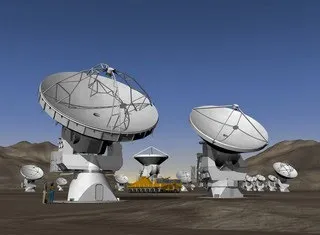
It is the Long Latin American Millimeter Array. The need for a millimeter array in South America is given because the central countries (Europe, North America, Japan/Taiwan) are supporting the construction of ALMA (Atacama Large Millimeter Array), one of the largest astronomical projects on the surface of the planet. It will consist of 64 antennas of 12 meters for millimeter and submillimeter observations, distributed over an area of approximately 20 km at an altitude of 5,000 meters in Chajnator, Atacama Desert, Chile, a few kilometers from the borders with Bolivia and Argentina. The investment foreseen there is 1.4 billion dollars until 2012.
In this context, the installation of one or two antennas at more than 4,600 meters in the Provinces of Salta and/or Jujuy, Argentina, would be an opportunity for the South American countries that are not involved in ALMA to take the initiative in a cutting-edge scientific project.
A millimeter/submillimeter radio telescope at high altitude in northwestern Argentina could be used in every area of astronomy: studies of the Sun, the solar system, stellar evolution, the interstellar medium, extragalactic astronomy.
As part of an interferometer associated with ALMA, ASTE (Atacama Submillimeter Telescope Experiment) or APEX (Atacama Pathfinder Experiment), for compact bright sources, it would allow a high angular resolution that could be used to study the environments of supermassive black holes, solar activity, magnetospheres, the intergalactic medium, exoplanets and disks and more.
The technology to carry out such a project will also generate technological transfer in communications, materials science, electronics and other applications.
Political context
Considering the recent investments in astronomical facilities in the Southern Hemisphere, an increase in the level of participation of South American countries would be desirable.
The AUGER project in the province of Mendoza, Argentina, has shown the capacity of Latin American countries to play a leading role in global scientific-technical projects.
In addition to these aspects, the project can enhance multi-wavelength astronomy in South America. As Jay Gallager, Editor in chief of Astronomical Journal, remarked, "A VLBI array including ALMA will clearly open a new and exciting approach to multi-wavelength astronomy to the world community. Given its location...it can add tremendous scientific value and allow the South American community to leave its scientific mark".
Antennas at more than 4,600 meters altitude and 150-200 km SE of ALMA, ASTE and APEX, would be the first step to develop an interferometer for VLBI associated with ALMA, with antennas distributed in the Andes. Furthermore, it is known that Argentina, Brazil, Mexico, Chile (and Colombia in the future) are developing scientific-technical groups in radio astronomy and their integration into global millimeter and submillimeter projects would be desirable.
Budgetary context
The following alternatives exist for the first antenna:
a) Use one of the ALMA prototype antennas, built by TALES-ALESIA and VERTEX, currently in the state of New Mexico. Refurbishment and transport would cost ~US$1.5 million, plus installation costs. However, it is not clear if the appropriate documentation and parts for these prototypes are available.
Buy an additional 12-meter antenna like those of ALMA. Construction, transport, and installation per antenna is US$6 million.
b) VLBI and receivers:
The equipment for VLBI costs US$1 million, plus the receivers for autonomous use US$3 million.
The total cost of the option to buy an ALMA antenna would be around US$10 million.
Annual operating costs are to be determined, but APEX's costs are about US$2 million per year.
The extra salary for 20 engineers would be about US$10,000 per year. For ten years that's US$2 million.
Conclusion
The project offers the following advantages:
- Take the initiative in a global project that core countries would not start before 2015. This would give countries in the region the possibility to participate in an extended version of the ALMA project, and thus strengthen their intellectual and technological roles in the growing South American astronomy.
- An initial investment of US$10 million would allow partial integration within a global project that involves an investment of US$1.4 billion.
- It is a unique, original scientific-technological project, in the sense that it will not repeat already achieved objectives.
- It will allow testing and correcting scientific-technological integration, step by step, and progressively, given that this project, in the future, will require the installation of antennas in other South American countries.
- It is an ideal context for training human resources in materials engineering and microwave technology, with applications in telecommunications, natural resource surveying, microelectronics, and business management, at a national and regional level.
The report is signed by the astronomers:
Félix Mirabel
Marcelo Arnal (Argentine Institute of Radio Astronomy)
Ricardo Morras (Argentine Institute of Radio Astronomy)
Gustavo Romero (Argentine Institute of Radio Astronomy)
Jacques Lepine (IAG-Universidade de São Paulo. Brazil)
Elisabete M. de Gouveira Dal Pino (IAG-Universidade de São Paulo. Brazil)
Zulema Abraham (IAG-Universidade de São Paulo. Brazil)
Sources and related links
- A window of opportunity for South American Astronomy
Félix Mirabel, Marcelo Arnal, Ricardo Morras, Gustavo Romero, J. Lepine, Z. Abraham, E.M. de Gouveira Dal Pino.
Estrela D'Alba, Number 6, August 10, page 4 - Long Latin American Millimetric Array - LLAMA Project
XXVII IAU General Assembly, August 2009, Rio de Janeiro - Latin American Astronomy Project in Argentina
51st Annual Meeting of the Asociación Argentina de Astronomía, OAFA San Juan 2008,
Oral Presentation 13: "Instrumentation."
Félix Mirabel, Marcelo Arnal, Ricardo Morras, Gustavo Romero
About the images
- Simulation representing the antennas of the ALMA radio astronomy observatory, as it will look once the observatory is complete. (C) ESO
- LLAMA logo
- Location map