A team of astronomers has detected the effects of the magnetic field of the bright star Vega.
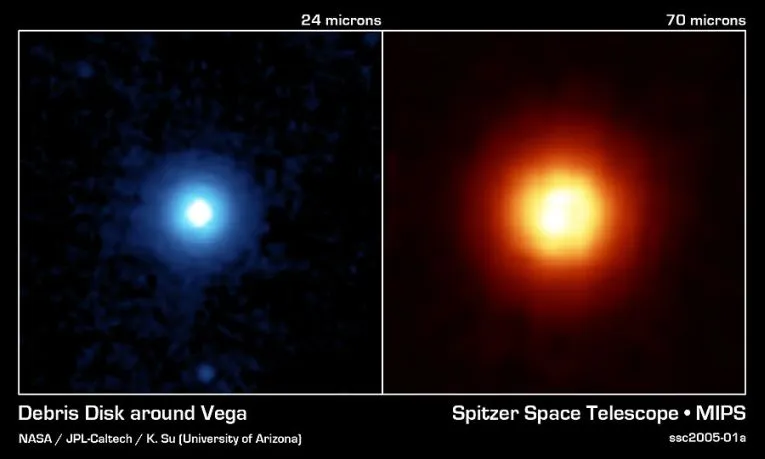
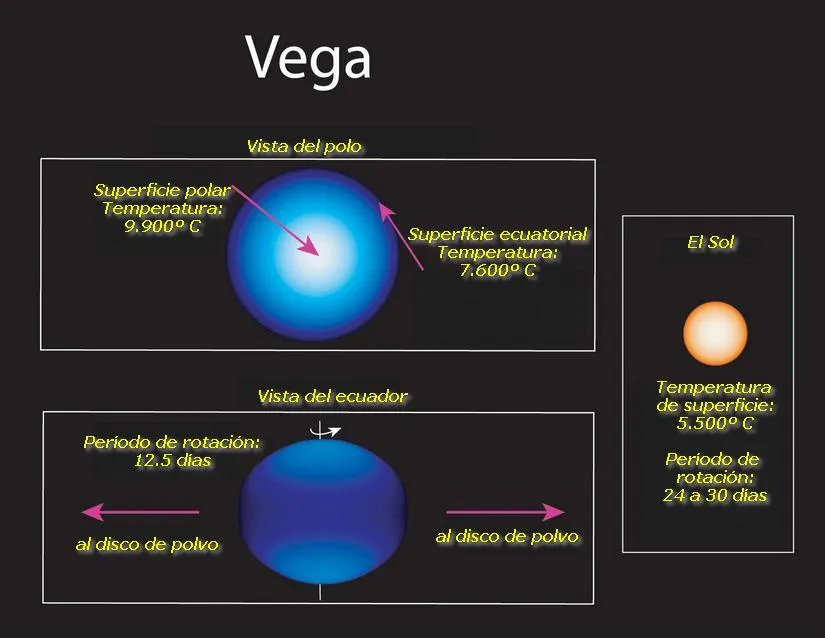
At only 25 light-years from Earth, in the constellation Lyra, Vega is the fifth brightest star in the sky. It is twice as massive as our Sun and only one-tenth the age of our star. It is a very studied star, due to its brightness and proximity, but it continues to reveal new aspects. Vega, a type A star, rotates in less than a day, while the rotation period of our Sun is 27 days. The intense centrifugal force induced by its rapid rotation flattens its poles and generates temperature variations of more than a thousand degrees Celsius between the polar regions (warmer) and the equator of its surface. It is also surrounded by a dust disk, in which inhomogeneities suggest the presence of planets.
This time, astronomers analyzed the polarized light emitted by Vega and detected a weak magnetic field on its surface. The team used the NARVAL instrument on the Bernard-Lyot telescope at the Pic du Midi Observatory in France. The detection itself is not a surprise since it is known that the movements of charged particles can generate magnetic fields and thus the magnetic fields of the Sun and Earth are produced. However, for stars more massive than ours, theoretical models cannot predict the intensity and structure of magnetic fields. After several failed attempts in past decades, a dedicated observation campaign and the sensitivity of the instrument used paid off.
The strength of Vega's magnetic field is about 50 micro-Tesla (0.5 Gauss), close to the average of Earth's magnetic field. The result restricts theoretical models about the origin of magnetic fields in massive stars. The observation also suggests that magnetic fields exist even if they have not been detected in other stars similar to Vega.
Sources and related links
- Astronomy & Astrophysics (press release): Magnetic field on bright star Vega
- First evidence of a magnetic field on Vega. Towards a new class of magnetic A-type stars
F. Lignières, P. Petit, T. Böhm, and M. Aurière
To be published in: Astronomy & Astrophysics, 2009, vol. 500-3
About the images
Vega versus the Sun
Credit: J. Aufdenberg and NOAO/AURA/NSF
The dust disk around Vega and the star
Credit: NASA/JPL Caltech/K.Su (University of Arizona)