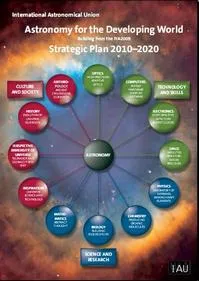
A 2006 study by Professor John Hearnshaw, from the University of Canterbury, on how support for astronomy in countries depends on their economy.

Is there any relationship between a country's wealth and the development of its astronomy?
I think the answer we will quickly get is that there is a relationship. It is clear that a certain infrastructure is necessary to enable teaching and research at the university level. Studying astronomy (I repeat, at the university level, as a professional career) and not having the necessary instruments to carry out research does not seem viable.
And, very likely, this happens with many other careers that depend on technological infrastructures.
But, instead of assuming, let's do the math. This is what Professor John Hearnshaw proposed in 2006, as he recounts on the blog Cosmic Diary.
The idea is simple, but it is not easy or straightforward to establish how to measure an index of astronomical vitality in a country.
The simplest and crudest measurement is the number of members of the International Astronomical Union (IAU) from the countries. The IAU is recognized as the main organization for professional astronomers.
But that approach has its pitfalls: although membership is free, some countries encourage more astronomers to join the IAU than others. Many professional astronomers never join, despite which the number of IAU members per million inhabitants is a kind of index of astronomical activity.
Another index can be the number of papers whose authors reside in each country. A paper is a scientific article submitted to a specialized journal, generally with the arbitration or peer review system. Here there are two major problems: How to count papers where the authors come from several countries and how to count the papers themselves, given that the ADS database sometimes omits the author's affiliation data?
Despite these problems, interesting facts emerge when the author used these indexes and correlated the results with the GNP/capita, the Gross National Product, which is a widely used measure of the economic activity of countries. It is defined as the value of all goods and services produced by the citizens of a country (residents and non-residents). Foreigners working in the country are excluded and nationals working abroad are included.
First, the author introduces us to some demographic data. In 2006 there were 197 independent countries in the world, 85 of which had individual IAU members residing in them. There were about 8,970 members. 62 of the countries adhered to the IAU and, in fact, 76 percent of the total world population resides in countries that are IAU members. This statistic arises because almost all large-population countries are IAU members (all except Pakistan and Bangladesh, with populations over 100 million are national members of the IAU). The 112 countries without astronomers (actually, without IAU members) were "minor" countries, with less population, since all together they totaled less than one billion people, compared to a world population of 6.5 billion.
Then, Hearnshaw collected data on individual IAU members, population per country and GNP/capita, all for the year 2006. The IAU site provided him with the first parameter, while the Photius site provided him with the population and GNP data.
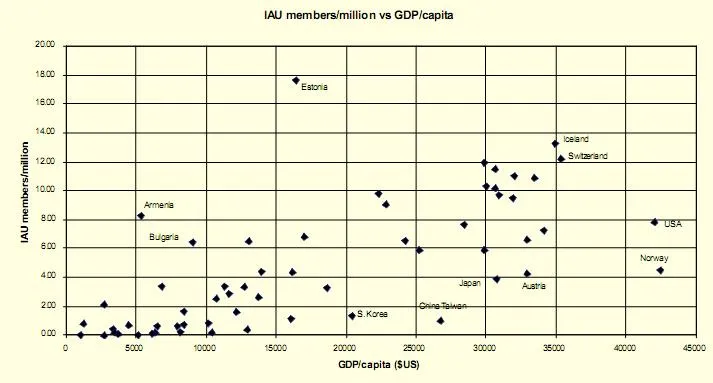
Chart 1 shows the number of IAU members per million population against GNP/capita for the 62 IAU member countries in 2006. The notable points are:
-IAU members/million are mainly in the range of 0 to 13;
-As expected, there is a strong correlation between IAU members/million and GNP/capita;
-Estonia has the most astronomers per million with a rate of 17.7, according to Hearnshaw an anomaly that arose after the separation from the Soviet Union rather than a special educational issue of the government;
-Several "healthy" countries have strikingly few astronomers, especially Norway, Austria, Japan, Taiwan and South Korea.
When, according to the author, 23 countries that are not IAU members but with professional astronomers (who are members) are added, it doesn't change things much, except for the fact that countries like the United Arab Emirates and Singapore have few astronomers in relation to a high level of GNP, with only one IAU member in each case.
In fact, these 23 countries have from 0 to 3 individual members per million.
What can we learn from the number of astronomical papers from IAU member countries? Is it also related to the economy? The author says he was able to use the affiliation fields of ADS to count the papers published between 1976 and 2005 inclusive. For multi-author papers, if all are from the same country, the paper was counted once; but if all N authors come from N countries, the paper was counted N times. Then he found N per IAU astronomer. This index is a measure of the astronomer's productivity, despite the fact that a significant number of astronomers are not individual IAU members.
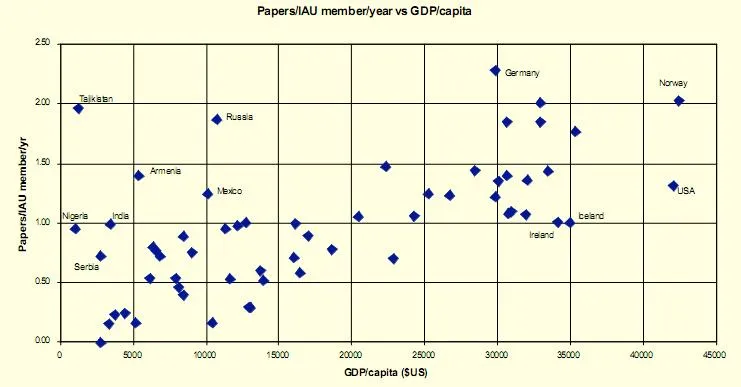
Chart 2 shows papers per IAU astronomer per year (averaged over the 30-year period) against GNP/capita for the 62 IAU member countries in 2006. Once again, there is a strong correlation. The stronger economies also have the most productive astronomers. Perhaps the interesting points are the anomalous ones. Thus, Russia, Germany and Norway have the most productive astronomers. Germany is at the top of the list with about 2.3 papers/IAU member/year.
Tajikistan, with 2 papers from IAU members annually is also high, but it does not seem reliable since it arises from only 6 astronomer members. The author points out to us that Norway, with fewer astronomers than other countries, nevertheless has high productivity.
Astronomers in Ireland, Iceland and the U.S. appear somewhat less productive in relation to their economy, below the main trend.
Once again, the 23 non-member countries but with individual astronomers who are members can be added and we find that those astronomers generally have low productivity, with 0.5 paper per astronomer per year.
Hearnshaw says there are messages we can learn from these correlations, despite the many necessary precautions.
One is that if we want to promote astronomy around the world, the best way is to have strong economies. Astronomy is unlikely to flourish in countries where the economy is weak. Unfortunately, most governments see astronomy as expensive, not as a national priority and, moreover, politicians are generally blind to the educational benefits of promoting astronomical science in their universities.
Perhaps the implications of climatological/geographical variables deserve another study. It is clear that doing astronomy in the Canary Islands is not the same as in Madrid; in San Juan as in Buenos Aires, in the Atacama Desert as in Santiago de Chile. Therefore, if a country does not have areas where astronomical observation is viable, or has few areas compared to other countries with more available surface area, it will tend to downplay, and thus fund less, that activity which depends heavily on appropriate observing conditions.
Astronomy in Latin America
The previous work was presented at the IAU Special Session 5, between August 14 and 25, 2006. The session developed the theme of astronomy in developing countries ("Astronomy for the Developing World").
On that occasion, Hugo Levato, Complejo Astronómico El Leoncito, San Juan, Argentina, presented a paper on formal education in Latin America. There he summarized university educational programs in different countries and differentiated three groups: with well-developed careers, countries that need efforts to consolidate incipient careers, and a third group that would need great efforts to develop formal education in astronomy.
The first group includes Argentina, Brazil, Chile and Mexico, with more than 500 professionals in astronomy and astrophysics working in their institutions.
The second group, which needs to consolidate its programs, is made up of Uruguay, Venezuela, Colombia, Honduras.
The third group, which requires a great effort to develop formal education in astronomy, is composed of Cuba, Trinidad Tobago, Dominican Republic, Haiti, Bolivia, Peru, Ecuador and Paraguay.
Does the economic strength of these countries influence the development of their university careers in astronomy and astrophysics?
Again, as in the previous study, Levato used GNP per capita, the Photius rankings and the IAU data. He also says he used the quality of life index from www.economist.com.
The results do not seem to differ from the general picture presented earlier, with a strong relationship between GNP and IAU members.
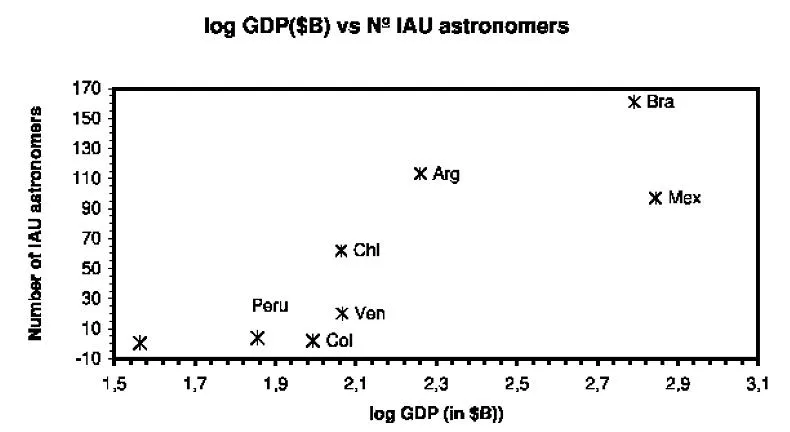
Figure 1 shows the relationship between the number of IAU members and GNP
From this it can be concluded that Mexico will probably require more astronomer members of the IAU according to its GNP level.
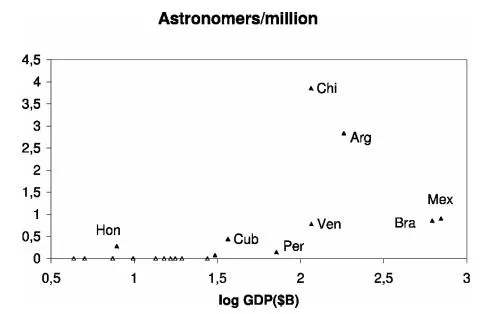
Figure 2 shows the number of IAU astronomers per million inhabitants against the logarithm of GNP in billions of US dollars
When population is taken into account, it can be seen in figure 2 that Chile and Argentina have more astronomers per million inhabitants than the general trend or that Mexico and Brazil should increase their number of IAU members.
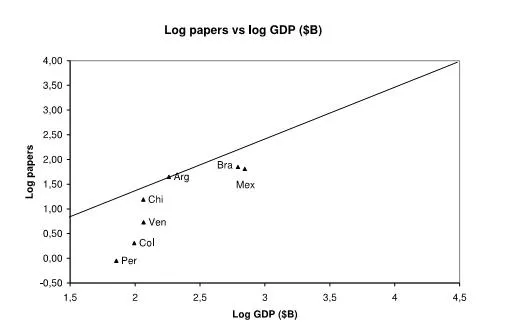
Figure 3 shows the logarithm of the number of papers against the log of GNP
Again there is a strong trend in the number of papers. Peru, Colombia and Venezuela should increase their papers to follow the trend according to their GNP.
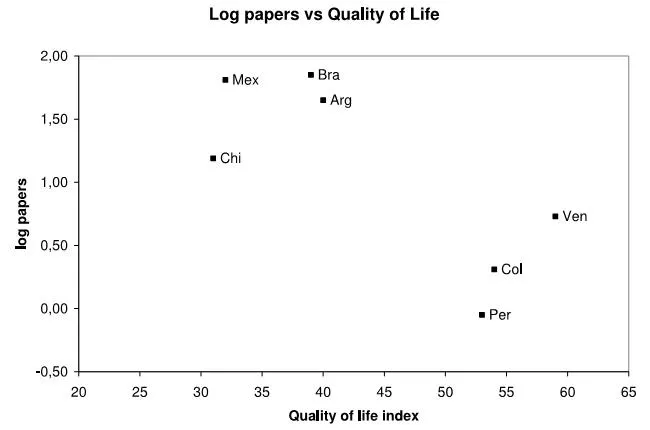
Figure 4 shows the log of the number of papers against the quality of life index.
Quality of life seems to be related to the number of papers according to this last graph.
Who says money doesn't buy happiness? Well, I'm not saying it does, but it helps, it helps...
Sources and related links
- How does a country’s support for astronomy depend on its economy?
John Hearnshaw, Cosmic diary
http://cosmicdiary.org/blogs/john_hearnshaw/?p=428 - Astronomy for the Developing World
XXVIth General Assembly of the International Astronomical Union
Prague, Czech Republic, 14-25 August 2006 - A survey of published astronomical outputs of countries from 1976 to 2005 and the dependence of output on population, number of IAU members and gross domestic product
Proceedings of the International Astronomical Union (2006), 2 : 9-20
John Hearnshaw, Cambridge University Press
DOI:10.1017/S1743921307006618 - Formal education in Astronomy in Latin America
Proceedings of the International Astronomical Union (2006), 2 : 27-30
Hugo Levato, Cambridge University Press
DOI:10.1017/S1743921307006643
About the images
- A Galileo dollar
Credit: Gerardo Blanco with Inkscape. The Galileo image is from the Astronomy Picture of the Day 8/30/1996
http://apod.nasa.gov/apod/ap960830.html - Graph 1 and Graph 2
Credit: John Hearnshaw - Figures 1-4
Credit Hugo Levato