No, it's not a time machine. It's a software tool that allows you to visualize a lunar eclipse through computer-generated images, almost indistinguishable from photographs.
Lunar eclipses have been well documented throughout human history. The rare and beautiful phenomenon, which occurs when the Moon passes through Earth's shadow and appears to change shape, color, or disappear from the dark sky completely, captivated the attention of poets, leaders, the curious, and scientists alike.
Researchers at Rensselaer Polytechnic Institute developed a new method to use computer graphics to simulate and present an accurate visualization of a lunar eclipse. The model uses the celestial geometry of the sun, Earth, and Moon along with data from our planet's atmosphere, as well as the peculiar optical properties of the Moon, to create images of lunar eclipses.
These images, virtually indistinguishable from real photographs, offer the possibility to look at past eclipses or spy on what future ones will be like. The model can also be configured according to the geographic location from which it is observed.
"Our models could help with research on the historical phenomenon and could be of interest to artists," noted Barbara Cutler, a professor at Rensselaer who supervised the study. The work was presented at the Graphics Interface 2009 conference.
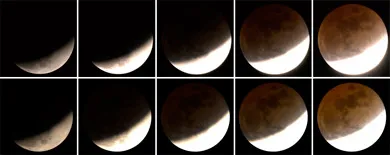
For the study, Theodore C. Yapo and Cutler compared digital photographs of the total lunar eclipse of last February 21, 2008, with computer models of the same eclipse. The result is that the rendered images are almost indistinguishable from the photographs, as they indicate.
An example is the images above. The first row are images from the eclipse of February 21, 2008. The second row, however, are not photographs, but images rendered by the team at Rensselaer Polytechnic Institute.
Sources and related links
- Rendering Lunar Eclipses
Report by Yapo and Cutler with images, pdf and video. - Moon Magic: Researchers Develop New Tool To Visualize Past, Future Lunar Eclipses
About the images
Credit: Rensselaer Polytechnic Institute.