Researchers have found new ways to determine cosmic distances: A recent work involves the use of long-duration Cepheid variables. On the other hand, the distance of a galaxy was determined by measuring the disk of material orbiting the central black hole of a galaxy.

The first method comes from researchers at Ohio University, and involves the use of long-period Cepheid variable stars, usually overlooked by astronomers.
Cepheid variables are stars that vary their brightness, that "pulsate," and have been used as reference points to measure distances in the nearby universe. However, beyond 100 million light-years from Earth, their signal is lost among other stars. Jonathan Bird, from Ohio, revealed that a rare class of Cepheid, brighter and pulsating more slowly, can potentially be used as distance measurement parameters up to three times farther than other Cepheids.
Astronomers usually combine the different existing methods to perform distance measurements. We recently commented here on the awarding of the 2009 Gruber Prize in Cosmology to the researchers who determined the Hubble constant, the rate at which the universe expands, and for which they combined measurements of Cepheids and Type Ia Supernovae.
Krzystof Stanek, a professor at Ohio, applied a direct measurement in 2006 used the emerging light from a binary system in galaxy M33 to measure the distance to that galaxy for the first time: it is located 3 million light-years from Earth.
This new technique using the so-called "ultra-long period Cepheids" (ULP Cepheids) is different. It is an indirect method, but this initial study suggests that the method could work for galaxies much farther away than M33.
Since researchers do not take this type of variable into account, there are few in astronomical records. From the existing literature, the team discovered 18 ULPs, located in nearby galaxies where distances are well known. They found they could use these ULPs to determine distances with a 10/20 percent error.
Astronomers use Cepheid variables because their brightness varies regularly, but ULPs do not behave the same way, as they are much larger and brighter. For example, the 18 ULPs used in this study have masses between 12-20 solar masses.
Do these ULP Cepheids evolve the same way as classical ones? A classical Cepheid will become hotter and cooler during its lifetime. In between, the outer layers become unstable, which causes the change in brightness. It is thought that ULPs go through this period of instability only once and only go from being hot to being cool.
However, the authors of the study discovered that the ULP Cepheid called HV829 in the Small Magellanic Cloud does the opposite. For years, the star pulsated every 87.6 days and now does so every 84.4 days. Two other measurements found in the scientific literature confirm that the period shortened, implying that the star itself is shrinking and becoming hotter.
Astronomers conclude that these Cepheids could help not only to measure the universe, but also help astronomers understand how massive stars evolve.
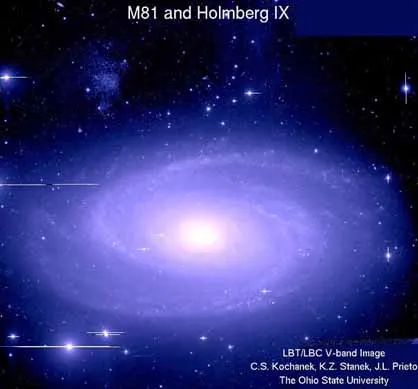
Since reporting the results in Astrophysical Journal, Ohio astronomers began using the LBT in Arizona and according to Stanek found some good candidates in M81, but those results have not been confirmed.
Cosmology with water vapor megamasers
Meanwhile, radio astronomers measured the distance to galaxy UGC 3789. James Braatz of NRAO and colleagues used the VLBA and the Robert C. Byrd Green Bank Telescope along with the Effelsberg telescope in Germany. It was established that the galaxy is located 160 million light-years from Earth. To do so, they measured the size of the disk of material orbiting the galaxy's central black hole. Water molecules in the disk act as masers to amplify, or strengthen, radio waves in the same way that lasers amplify light waves.
The observation is a key element of an effort to measure the expansion rate of the universe (the Hubble constant) with great precision and thus narrow down the possible explanations for dark energy, a force thought to be causing the expansion rate of the universe to increase. The project is called The Megamaser Cosmology Project.
The work is better than a previous one with the VLBA performed in 1999 in which the distance to galaxy NGC 4258, at 23 million light-years, was measured. This new measurement of UGC 3789 is better because the speed at which NGC 4258 is moving away from the Milky Way can be influenced by local effects. "UGC 3789 is far enough away that the speed at which it is moving away from the Milky Way is more indicative of the expansion of the universe," explained Elizabeth Humphreys of CfA.
Team member Cheng-Yu Kuo, from the University of Virginia, also presented an image of the disk in NGC 6323, a galaxy even more distant than UGC 3789.
The work was presented at the meeting of the American Astronomical Society in Pasadena.
Sources and related links
- To 300 million light years, and beyond -- a new way to measure cosmic distances
- Using Ultra Long Period Cepheids to Extend the Cosmic Distance Ladder to 100 Mpc and Beyond
Jonathan C. Bird, K. Z. Stanek, and José L. Prieto
ApJ 695 No 2 (April 20, 2009) 874-882
DOI: 10.1088/0004-637X/695/2/874 - Radio Telescopes Extend Astronomy's Best "Yardstick," Provide Vital Tool for Unraveling Dark Energy Mystery
- The Megamaser Cosmology Project (MCP)
- The Megamaser Cosmology Project. I. Very Long Baseline Interferometric Observations of UGC 3789
Reid, M. J.; Braatz, J. A.; Condon, J. J.; Greenhill, L. J.; Henkel, C.; Lo, K. Y.
ApJ 695 287-291
DOI:10.1088/0004-637X/695/1/287
About the images
Lights
Stock.xchng
M81
Visible light UGC 3789
CREDIT: STScI