Gamma-ray bursts are the most powerful explosions in the universe. However, some of these GRBs, as they are known by their English acronym, are not seen in visible light. It was thought, until now, that they must be very distant to be seen at optical wavelengths, but a new analysis suggests they simply detonate in cocoons of dust that block their light.
It is thought that GRBs are produced when massive stars collapse to form black holes, ejecting jets of gas at speeds close to that of light.
Despite being very bright explosions, some GRBs are "dark". It was thought they originated in massive stars that reached the end of their lives when the universe was very young, almost 13 billion years ago. As space has expanded greatly since then, it was thought the visible light from these distant explosions would have shifted to the red part of the spectrum.
Now, a new study indicates that these dark bursts occur closer to home, but are blocked by dust.
"We think we have solved most of the mystery of what makes them dark," commented Daniel Perley of the University of California, Berkeley, at the meeting of the American Astronomical Society on Monday.
Using the telescope at Palomar Observatory, he and his colleagues found that 14 of 29 GRBs that had been discovered by the Swift satellite were dark.
Subsequent observations with the twin 10-meter Keck telescopes in Hawaii, however, suggested that some of them were not entirely dark.
Three of the fourteen had diffuse afterglows and the remaining eleven had positions in the sky that seemed to match well-known galaxies. This suggests that none of the bursts came from regions of the universe more than 12.9 billion light-years away, where visible light would be shifted to longer wavelengths.
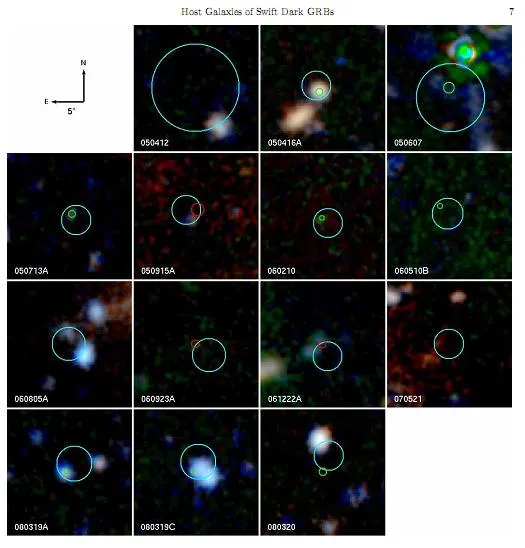
Most of these dark bursts appear to originate in galaxies that are not particularly red, a sign of very widespread dust. "The host galaxies we see seem relatively normal," noted Perley. Which suggests that the dust within them is "distributed irregularly," he explained.
As stars form in dusty regions of space, there could be unseen reservoirs of star formation scattered throughout the universe.
The team hopes to continue its work with a more detailed study of the host galaxies to better understand how the light from these bursts is blocked.
It is worth clarifying that, nevertheless, GRBs can occur in the very distant universe, as was recently discovered.
(See: "Detectan el objeto más distante del universo").
But the team estimates that those bursts are only between 0.2 and 0.7 percent of all GRBs.
Sources and related links
- New Scientist: Astronomers solve mystery of 'dark' cosmic bursts by Rachel Courtland
- The Host Galaxies of Swift Dark Gamma-Ray Bursts: Observational Constraints on Highly Obscured and Very High-Redshift GRBs
Perley, D. A et al.
arXiv:0905.0001v1 - NASA:Keck Study Sheds New Light on 'Dark' Gamma-ray Bursts
About the images
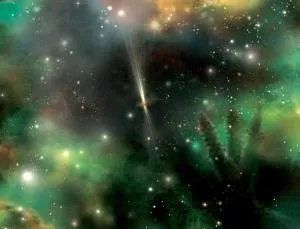
Dense knots of dust in normal galaxies block the light from a GRB (center). The dust absorbs most of the visible light but not X-rays and gamma rays.
Illustration. Credit:NASA/Swift/Aurore Simonnet
Figure 1 from the report.
Credit: Perley, D. A et al.
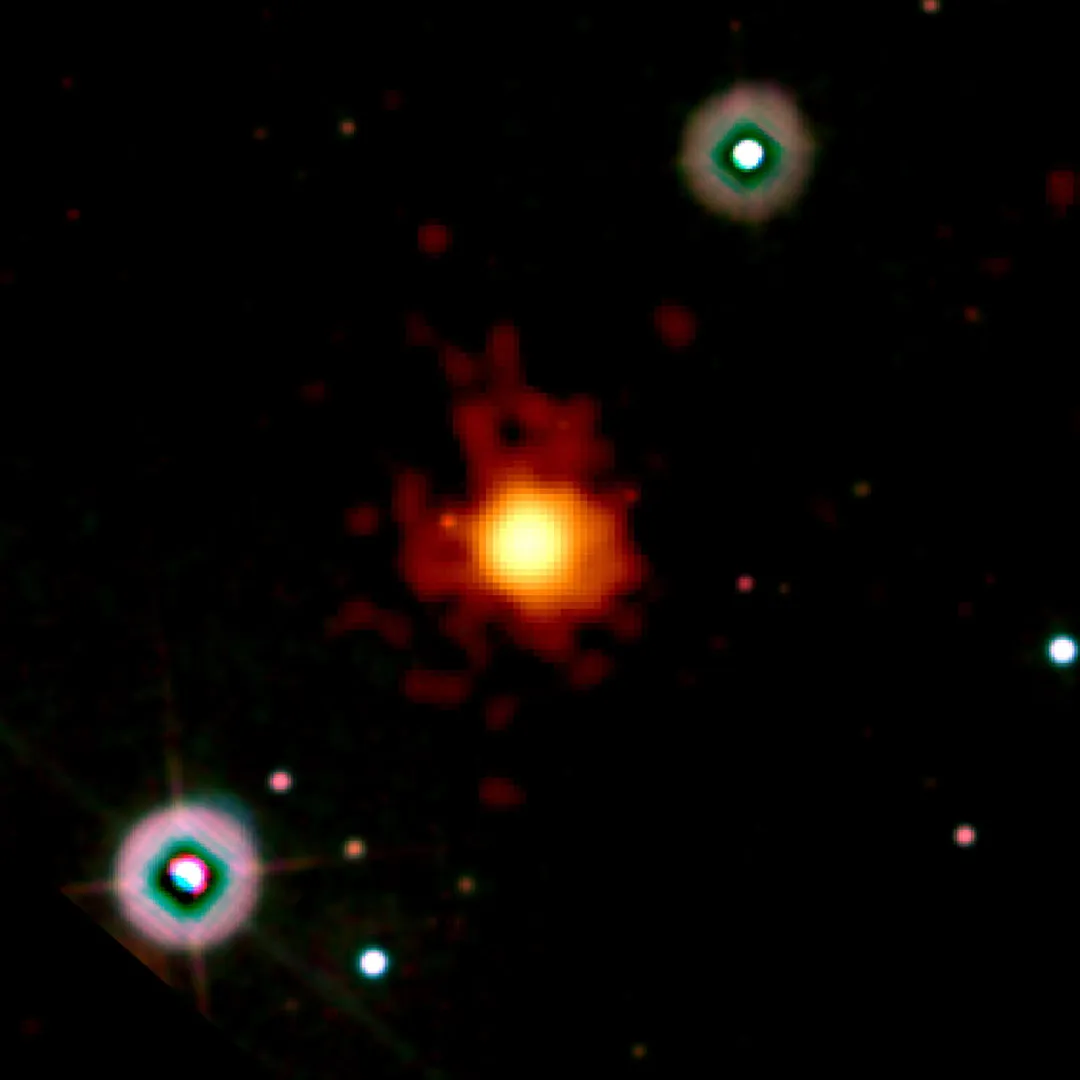
It is a false-color mosaic of the 14 dark GRBs in the host fields (galaxies).
The X-ray positions are blue, the optical in green and the infrared in red.