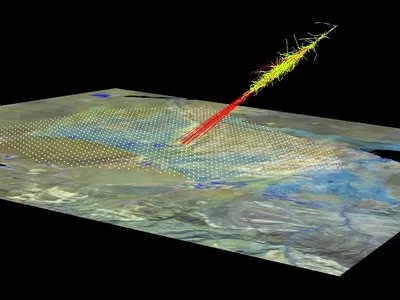
During the Apollo flights, astronauts reported seeing strange flashes of light, even with their eyes closed. Since then it has been known that the cause was so-called cosmic rays, extremely energetic particles that reach Earth from outside the solar system and are constantly bombarding our atmosphere. They can even cause failures in electronic components.
Galactic cosmic rays come from sources within our Milky Way galaxy, and consist mainly of protons moving at a speed close to that of light. These protons have been accelerated to energies far superior even to those that the Large Hadron Collider at CERN will be able to achieve.
"It has long been thought that the super-accelerators that produce these cosmic rays in the Milky Way are the expanding shells created by exploded stars, but our observations reveal the smoking gun that proves it," says Eveline Helder, from the Astronomical Institute Utrecht in the Netherlands, author of the study.
"One could even say that we have now confirmed the caliber of the weapon used to accelerate cosmic rays to their tremendous energies," added collaborator Jacco Vink.
For the first time, Helder, Vink and colleagues have been able to make a measurement that resolves a long-standing astronomical dilemma about whether stellar explosions produce enough accelerated particles to explain the number of cosmic rays hitting our atmosphere. The team's study indicates that they do.
"When a star explodes in what we call a supernova, a large part of the explosion's energy is used to accelerate some particles to very high energies. The energy that is used for particle acceleration is at the expense of heating the gas, which is therefore cooler than theory predicts."
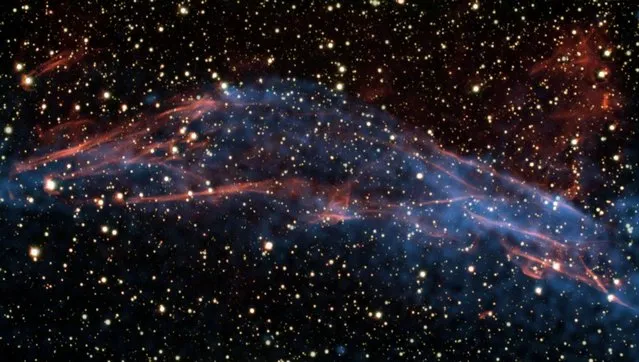
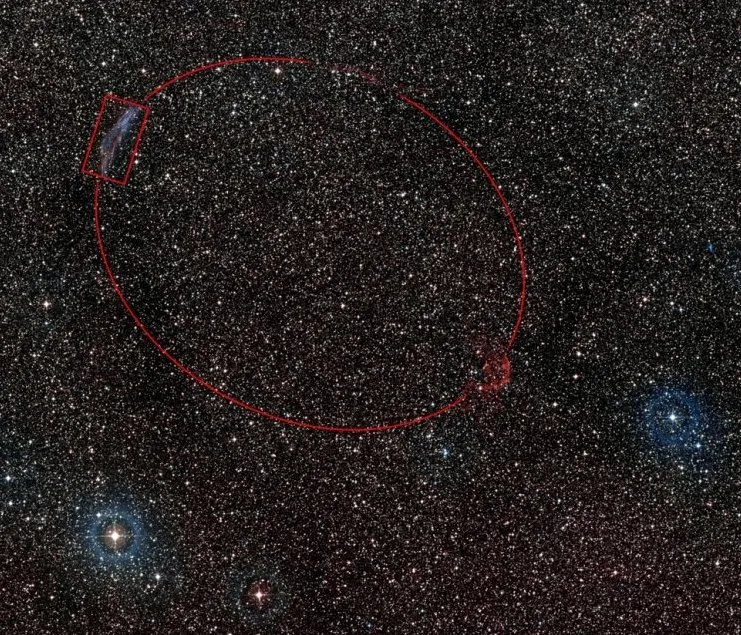
The researchers observed the supernova remnant RCW 86, whose star exploded in the year 185 A.D. The remnant is located 8,200 light-years away in the constellation Circinus and is probably the oldest record of a star explosion.
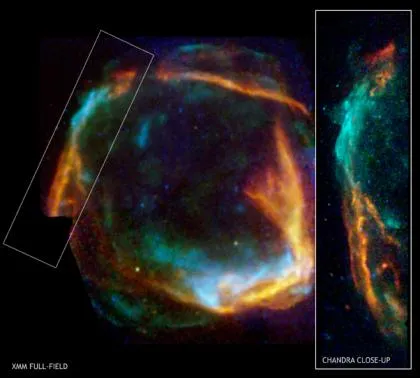
Using ESO's VLT, the team measured the temperature of the gas just behind the shock wave created by the stellar explosion. They also measured the speed of the shock wave, using images taken by the Chandra X-ray Observatory three years ago. They found that it moves between 10 and 30 million kilometers per hour (6000 +/- 2800 km/s), between 1 and 3 percent of the speed of light.
The temperature of the gas is about 30 million degrees Celsius (2.3 keV). That seems like a lot compared to daily life, but less than expected given the speed of the shock wave. This should have heated the gas to at least 500 million degrees (42 keV), which implies that this lack of temperature is due to the acceleration of cosmic rays.
"The missing energy is what accelerates the cosmic rays," concluded Vink.
Sources and related links
- Milky Way's super-efficient particle accelerators caught in the act
- Measuring the cosmic ray acceleration efficiency of a supernova remnant
E. A. Helder et al.
Published Online June 25, 2009 Science Express
DOI: 10.1126/science.1173383
arXiv:0906.4553v1
About the images
RCW 86: Image of part of a supernova remnant whose explosion was recorded in 185 A.D.
Credit: ESO/E. Helder & NASA/Chandra
Image of RCW 86 by Chandra
Credit: Chandra: NASA/CXC/Univ. of Utrecht/J.Vink et al. XMM-Newton: ESA/Univ. of Utrecht/J.Vink et al.
Field of RCW86: The wide-field image contains the area where the research team confirmed that cosmic rays from our galaxy are very efficiently accelerated in supernova remnants. The red line guides the eye to several regions where the remnants of stellar explosions are more visible. The square area contains data from the VLT and Chandra. This region, called RCW 86, is centered on the position where the star exploded in 185 A.D.
Credit: ESO and Digitized Sky Survey 2. Acknowledgement: Davide De Martin