For decades, scientists have thought that the highest-energy cosmic rays -up to trillions of electronvolts- were almost exclusively protons. But data from the Pierre Auger Observatory, in the province of Mendoza, Argentina, may be indicating another story.
The Pierre Auger Observatory is the world's largest facility dedicated to the study of ultra-high-energy cosmic rays. At a conference held in Poland (International Cosmic Ray Conference, July 7-15), the observatory's scientists are presenting (in the talk "New results from the Pierre Auger Observatory", by Paul Sommers of Pennsylvania State University) data that makes one think about the possibility that some of the super-fast "cosmic bullets" are, in truth, iron nuclei.
"It would be a surprise for many people if some of these particles were iron", said Hank Glass, an Auger collaborator at Fermilab. While scientists can imagine mechanisms that could accelerate protons to a speed close to that of light, they have no idea, on the other hand, how ultra-high-energy iron nuclei could originate.
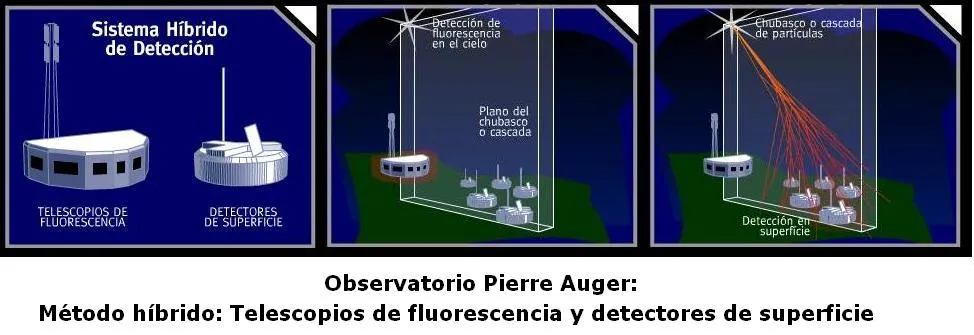
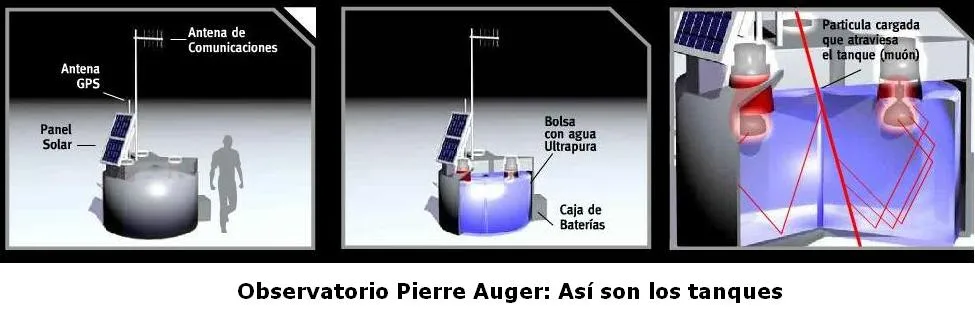
The scientists in Malargüe combine two methods to investigate these mysterious extragalactic invaders. A set of 1,600 water tanks scattered across 3,000 square kilometers of Mendoza soil acts as a giant particle detector, tracking the showers of secondary particles that ultra-high-energy cosmic rays generate and that collide with the air molecules in our atmosphere. And a set of fluorescence telescopes detects the faint ultraviolet glow of those secondary particles interacting with atmospheric nitrogen. By combining both sources, scientists can determine the energy, trajectory, and perhaps identify the primary particles.
A revealing piece of data is the altitude at which cosmic rays interact. Based on particle accelerator data, theorists developed models of the interactions of various particles in Earth's atmosphere. Protons, with their small mass, should penetrate quite deeply before starting the shower. Heavier nuclei, like iron, should generate showers farther from the Earth's surface.
At Auger, scientists measure the maximum of cosmic ray showers -the height at which most secondary particles are produced. The average of this maximum is farther from the planet's surface than predictions indicate for rays of only protons, but closer than expected if they were only iron. One might think of intermediate-mass nuclei, like carbon, but since those nuclei are less tightly bound than iron they should break apart with the photons of the cosmic microwave background radiation before reaching Earth. A more plausible explanation is that what Auger detects is a mixture of iron and protons.
However, there is no consensus on this explanation. In part because the models rest on many extrapolations from particle accelerator data.
"At this point, the data have generated more questions than answers. All we can do is keep collecting more data and see if a more coherent picture evolves", commented Glass.

Meanwhile, Glass expects a whirlwind of papers from the conference proposing origins for these highest-energy rays. Creating a correct model is a difficult task. Scientists suspect that ultra-high-energy protons originate in the accretion disks of supermassive black holes, but those disks contain mainly hydrogen and helium.
We reported on this in an article from late 2007, when the observatory's researchers published their first data in Science:
"They link the highest-energy cosmic rays with violent black holes".
Iron appears in supernova explosions, but scientists do not believe those events have enough energy to generate nuclei at the energies detected by Auger.
"In science, it's always better to show the data you have and let people talk about it, instead of just sitting on it", said Glass.
Sources and related links
- Page of the Argentine Pierre Auger Collaboration
- Symmetry Breaking:Another cosmic-ray puzzle: Are iron nuclei bombarding Earth? by Rachel Carr
- Cosmus:Animations and downloads from the Pierre Auger Observatory Here are animations, videos and programs related to cosmic rays and Pierre Auger to download!
- Radio detection of cosmic rays in the Pierre Auger Observatory
T. Huege (Forschungszentrum Karlsruhe, IK), for the Pierre Auger Collaboration
arXiv:0906.4970v1 - Investigation of Hadronic Interactions at Ultra-High Energies with the Pierre Auger Observatory
Ralf Ulrich, for the Pierre Auger Collaboration
arXiv:0906.4691v1 - Studies of Cosmic Ray Composition and Air Shower Structure with the Pierre Auger Observatory
The Pierre Auger Collaboration
arXiv:0906.2319v1 - All articles from the Pierre Auger Collaboration on Arxiv
- A cosmic ray detector in high school
About the images
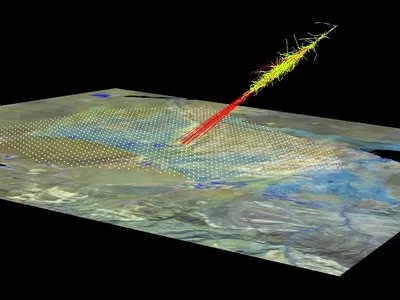
The first image shows a shower created when a proton with energy of 1019eV hits the atmosphere. (Color codes: muons in red, photons in yellow, electrons/positrons in purple). The image was used in Astronomy magazine, September 2005, "Cosmic Rays radiate Radio Waves" by Liz Kruesi.
Credit: Cosmus at University of Chicago: Randy Landsberg, Dinoj Surendran, and Mark SubbaRao
Map:Size of the Pierre Auger Observatory
The map shows the boundaries of the surface array of the Pierre Auger Observatory in Malargüe, Argentina. To get a better idea of its size, this tool allows you to draw the boundaries of Auger anywhere on Earth, thanks to Google maps.
Credit: Obs. Pierre Auger
Images:This is what the tanks and Hybrid Method look like
Screenshots from the animations on the observatory's website
Credit: Obs. Pierre Auger