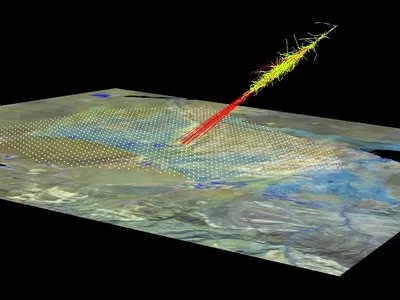
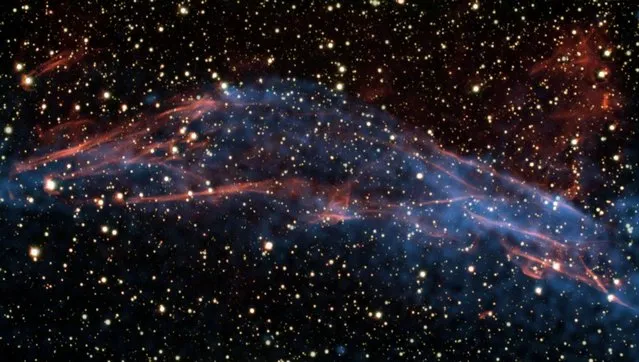
Tree growth seems to follow a cosmic pattern: they grow faster when higher levels of cosmic radiation arrive from space, a new study claims.
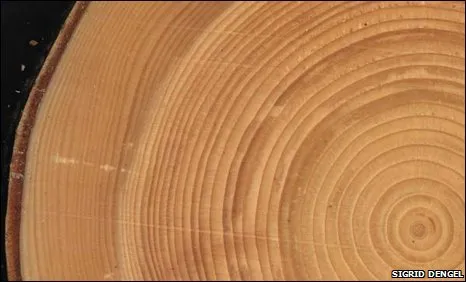
The British researchers made the discovery by studying the growth of rings in spruce trees and how they varied during the last half of the century, as they indicate in their article published online in a specialized journal.
The goal of Sigrid Dengel, a researcher at the Institute of Atmospheric and Environmental Sciences at the University of Edinburgh, was to study "the climatological factors that influence forest growth."
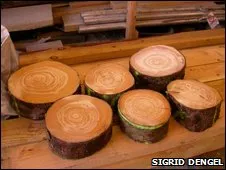
For this, she and her colleagues Mr. Dominik Aeby and John Grace obtained slices of spruce or spruce trunks.
The trunks had recently been cut from the Dumfriesshire forest, Scotland. They had been planted in 1953 and cut down in 2006. The researchers froze the trunks to prevent the wood from shrinking, scanned them, and used software to count the number and width of the rings.
As expected, as they got older, they showed a decline in growth. However, during a number of years, the trees also grew particularly slowly. Those years are related to periods when a relatively low level of cosmic rays reached the Earth's surface.
When the intensity of cosmic rays reaching Earth increased, the trees' growth rate was faster.
The effect is not large, but it is statistically significant. Furthermore, this relationship between growth and cosmic rays is stronger than with other climatological factors such as variations in temperature or precipitation levels over the years.
Cosmic rays are energetic particles, mainly protons, as well as electrons and the nucleus of helium atoms that travel through space before reaching the planet's atmosphere.
Cosmic ray levels decrease and increase with solar activity, which follows eleven-year cycles.
Every 11 years, approximately, the Sun becomes more active, producing a peak in sunspots that carry magnetic fields that block and slow down the path of energetic particles.
When the researchers analyzed the data, they found that tree growth was greater during periods of low solar activity. And growth slowed during four periods of high activity of our star, which occurred between 1965 and 2005.
"We have tried to relate the size of the rings, that is, the growth rate, with climatological factors such as temperature. We also thought it would be interesting to look for patterns related to solar activity, as some people had suggested previously," explained Dengel.
Despite having found that the growth rate seems to match the fluctuations in solar activity, the researchers have no idea how the mechanism occurs.
But they propose two hypotheses: the first is that cosmic rays ionize gases in the atmosphere, creating molecules around which clouds condense, and thus increasing cloud cover. This mechanism is debated among scientists and the evidence is weak. But, if it occurs, an increase in clouds and haze would diffuse the amount of solar radiation reaching the trees.
As diffuse radiation penetrates forests better than direct light, it would increase the amount of radiation that plants capture and increase tree photosynthesis. This would boost growth.
Or there is some direct effect hitherto unknown, but experiments in space have shown that cosmic rays can have positive impacts on biological materials.
The conclusions are not sufficient and more work on the topic will be necessary. Dengel's colleagues seem both skeptical and enthusiastic about the study. The researchers now want to extend the investigation to better understand the mechanism.
If this relationship between cosmic rays and tree growth were correct, it could help solve another enigma about the tree growth cycle in North America. It is suggested that the amount of aerosols we humans emit into the atmosphere can impact tree growth by causing a "global dimming", an effect that occurs when the levels of light reaching Earth decrease.
"If it is true that the mechanism is about rays intensifying diffuse radiation, it would mean that "global dimming" and the opposite effect "global brightening" would have a large effect on tree growth and thus on carbon dioxide absorption," explained Dengel.
Sources and related links
- BBC: Cosmic pattern to UK tree growth, by Matt Walker
- A relationship between galactic cosmic radiation and tree rings
New Phytologist, Volume 184 Number 3 (November 2009) (p 545-551)
Sigrid Dengel, Dominik Aeby, John Grace
DOI: 10.1111/j.1469-8137.2009.03026.x
About the images
- The images belong to S. Dengel