Beneath South Dakota, the world's deepest scientific laboratory is being built, in search of dark matter.
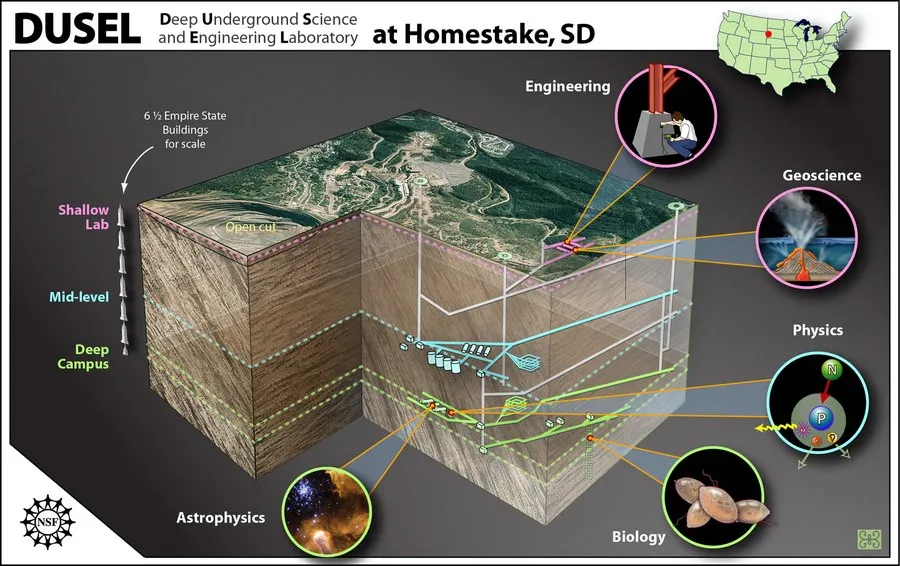
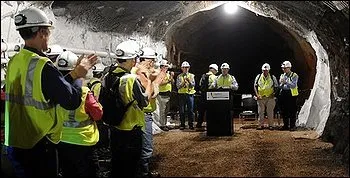
The site is an old gold mine, called Homestake, whose depth exceeds 2,400 meters (8,000 feet). Some geology and hydrology experiments are already being carried out at more than 1,400 meters (4,850 feet) deep and they hope to build two laboratories even further down, with funds awaiting approval from the U.S. Congress.
The place is ideal for experiments in search of dark matter since it is protected from cosmic rays that could interfere with the tests and produce "false positives". That is, with the experiments located in such deep places, there will be less "noise" in the results, which would otherwise be "contaminated" by cosmic rays.
A part of the mine is named the Davis Cavern, in honor of Ray Davis Jr., who in the 1960s used the place to demonstrate the existence of solar neutrinos. Davis and his colleague Bahcall shared the 2002 Nobel Prize in Physics for their work.
Before building the laboratories, the work teams must stabilize the tunnels and install new infrastructure.
The first dark matter experiment will be the Large Underground Xenon, or LUX experiment, a project to detect weakly interacting particles.
Dark matter, which accounts for a quarter of the matter in the Universe, does not emit light or radiation, but is detectable by its gravitational effects. However, it is still not known what kind of matter this is, which together with an also unknown repulsive force form the dark side of the universe. Several proposals have been made in this regard, for example, MACHOs and WIMPs. MACHO is the name given to some astronomical bodies that could explain the presence of dark matter in galactic halos. They are Massive Compact Halo Objects. They could take the form of black holes, neutron stars, brown dwarfs. On the other hand, WIMPs are another hypothetical class of massive matter that would interact through the weak force and gravity.
Synergy
The initiative is supported, among other arguments, by the synergy it will generate between different disciplines of research and technical application. Engineering, astrophysics, biology and geology will be able to develop research in each area in an interdisciplinary way. Furthermore, the technical requirements necessary for the construction of the deepest laboratory will imply new knowledge in excavation techniques, among others.
The place is also required by biologists in search of "extremophiles", organisms that live in extreme conditions. In addition, geologists can investigate the properties of rocks, minerals and groundwater.
The South Dakota Science and Technology Authority (SDSTA) is reopening the Homestake mine under the name Sanford Underground Laboratory. But they also want to demonstrate the feasibility of a larger and deeper laboratory: the Deep Underground Science and Engineering Lab (DUSEL).
Lawrence Berkeley Laboratory leads a team of scientists and engineers designing DUSEL at Homestake, which must be approved by the U.S. National Science Foundation.
The elusive dark particles will be attempted to be detected in large tanks of liquid xenon, a cold substance three times heavier than water. Construction is expected to begin next year and be completed by 2016, with an initial estimated cost of $550 million.
Sources and related links
- Washington Post: Work begins on world's deepest underground lab by Dirk Lammers
- Welcome to Underground Science
- Deep Underground Science and Engineering Lab (DUSEL)
About the images
South Dakota Governor Mike Rounds, at the podium, on June 22, 2009, at the future site of the Sanford Underground Science and Engineering Laboratory. The event took place at the 4,850-foot level (about 1,400 meters) of the old Homestake mine.
Credit: AP Photo/Steve McEnroe
Illustration of the Deep Underground Science and Engineering Lab (DUSEL) at Homestake
Credit: Zina Deretsky, National Science Foundation