The 1st OAAA will take place in Bolivia, on the shores of Lake Titikaka, La Paz department, from June 19 to 23, 2009, coinciding with the Winter Solstice in the Southern Hemisphere. An Argentine, from the province of Santa Fe, will participate.
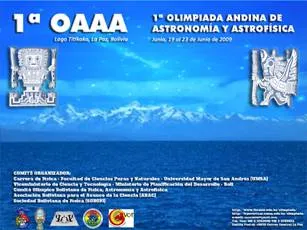
The 1st Andean Astronomy and Astrophysics Olympiad (1st OAAA) arises from the need to give an urgent response to the challenge of: How to encourage the youth of the Andean countries: Argentina, Chile, Colombia, Ecuador, Peru, Venezuela and Bolivia to study Astronomy and Astrophysics?
The competition is based on the minimum content of the
INTERNATIONAL OLYMPIAD ON ASTRONOMY AND ASTROPHYSICS
Objectives:
As declared on the Olympiad's site, the general goals are:
To give an urgent response to the challenge of how to encourage the youth of the Andean community of nations to study Astronomy and Astrophysics?, in order to generate greater scientific and technological capacities as a contribution to the cultural, economic and social development of the region as a whole.
SPECIFIC OBJECTIVES:
- To contribute to the improvement of learning and teaching of Astronomy and Astrophysics.
- To stimulate the creativity and interest of students in Astronomy and Astrophysics.
- To awaken scientific and technical vocations.
- To contribute directly to the permanent training and updating of knowledge of teachers at both the secondary and primary levels.
- Holding Regional Olympiads in each member country of the CAN.
- Preparation of specialized publications on the teaching of Astronomy and Astrophysics.
- To promote and encourage Astronomy and Astrophysics in schools in rural and urban areas of the CAN.
- To continuously improve the level of teaching of Astronomy and Astrophysics.
- To work jointly with the Ministry of Education of each country regarding the solution of problems related to education.
To form a "Foundation: Scientific Olympiad of the CAN" where members are: Scientific Institutions, Independent Professionals, Members of the Private Sector, the Government through its direct officials, Universities, NGOs, etc. To cover the economic part demanded by the organization of the Olympiads and ensure that they are held periodically every year. - To participate continuously in the INTERNATIONAL OLYMPIAD ON ASTRONOMY AND ASTROPHYSICS (IOAA).
- To give Seminars to teachers in the area about: New teaching methodologies.
The competition will consist of two tests, one theoretical and one experimental. The time for each will be a maximum of four hours and they will be held on two different days.
Argentine representative
Agustín Di Paolo, a 6th-year student of the Mechanical Electrical specialty at the Escuela Industrial Superior (EIS), dependent on the Facultad de Ingeniería Química of the Universidad Nacional del Litoral, will participate in the competition.

"I was selected because of my score in last year's olympiads and because I meet the other requirements requested by the organizers," explained Di Paolo and added that participating in this event will be a huge challenge since high school and technical programs do not include too much content on astronomy and astrophysics.
Regarding how the training will be, the young man indicated that preparation begins in a few days. "I have to go three days, every other week, to the Facultad de Matemática, Astronomía y Física of the Universidad Nacional de Córdoba (FAMAF UNC) where they are going to train me to participate. For me, this astronomy thing is very new. I had been in the Physics olympiads in previous years, but I hadn't dealt with such specific topics of astronomy and astrophysics," explained the student.
Regarding the contents that will be covered in the olympiad, he indicated: "They evaluate the handling of instruments, telescopes, photometers and some software. I've been looking at the topics and they are quite varied, there are even some I don't know. They test you on some basic physics, mechanics, quantum physics and solar study. There are also astronomical theories like the Big Bang and topics related to stars, galaxies and several other things."
"I have to go three days, every other week, to the Facultad de Matemática, Astronomía y Física of the Universidad Nacional de Córdoba (FAMAF UNC) where they are going to train me to participate. For me, this astronomy thing is very new. I had been in the Physics olympiads in previous years, but I hadn't dealt with such specific topics of astronomy and astrophysics," explained the student.
To learn more:
http://fcpnvirtual.umsa.bo/oaaa/index.html
Sources and related links
- El Litoral: A man from Santa Fe will compete in Astronomy in Bolivia
- UNL: A student from the Industrial school will represent the country
- 1st Andean Astronomy and Astrophysics Olympiad (1st OAAA)
About the images
Agustín Di Paolo. Photo: Amancio Alem