Astronomers think a supernova seen in 2005 could be a new type of cosmic explosion.
The supernova SN 2005E was an explosion in galaxy NGC 1032, 100 million light-years away. A team of researchers led by Hagai Perets of the Weizmann Institute believes the event does not seem to match either of the two processes known to originate supernovae.
The explosive death of stars, supernovae, are generally explained by two physical processes. Young massive stars (more than 8 solar masses) whose cores collapse under their own gravity, releasing radiation that expels their outer layers and appear as type Ib/c and type II supernovae. They generally occur in regions where massive stars are forming. Type Ia result from the thermonuclear explosions of older objects, white dwarfs, which steal material from a companion star until reaching a critical point. Even the least luminous Type Ia supernovae eject around 1 solar mass of carbon/oxygen when they explode. However, the team says it has found a supernova in the halo of an isolated nearby galaxy, NGC 1032. The lack of any trace of recent star formation near the supernova's location and the very low ejected mass detected (around 0.3 solar masses) seem to indicate it is not a stellar core collapse. Nor are carbon or oxygen products found, but the material ejection from SN 2005E appears to be dominated by helium, which would imply it is not a Type Ia supernova either.
They conclude, therefore, that they are facing a new type of stellar explosion, which arises from a low-mass object and is an old stellar system. The ejection contains between 5 and 10 times more calcium than observed in any type of supernova and probably a very significant amount of titanium.
The supernova was discovered on January 13, 2005 shortly after it occurred, on December 24, 2004. Spectroscopic data indicated strong helium and calcium lines, suggesting it would belong to the group of type Ib supernovae. The event's position is 22.9 kiloparsecs (74,600 light-years) from the center and 11.3 kpc (36,000 light-years) above the disk of its galaxy, which is located at 34 Mpc (110 million light-years).
NGC 1032 is an isolated galaxy, with no signs of interaction, with the closest satellite galaxy found more than 120 kpc away. Observations of the explosion site, sensitive to ultraviolet light from young hot stars and emission lines from ionized hydrogen gas, placed strict limits on any nearby star formation activity. Furthermore, radio signals, expected from a stellar core collapse, have not been observed. The remote position of SN 2005E in the outskirts (the halo) of the galaxy and the isolation of NGC 1032, as well as the S0 classification of the galaxy, whose star formation rate is very low, in addition to the limits imposed by the aforementioned observations on local star formation, point to the progenitor being from an old stellar population.
The spectrum analysis of SN 2005E indicates it is similar to Type Ib supernovae. A considerable amount of calcium is also detected in the ejection (0.06 solar masses) which is much greater than in other supernovae.
The data then indicate that the progenitor comes from an old environment and that little mass was ejected, which would not match the collapse of massive stars, which would rule out them being type II. The low ejected mass and spectral analysis also seem to rule out it being a Type Ia supernova.
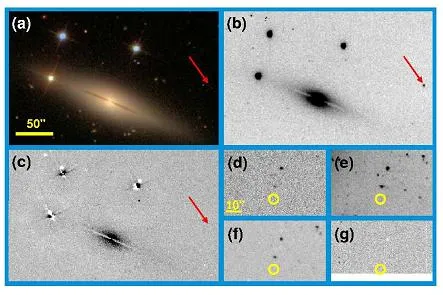
Other calcium-rich type Ib/c SN similar to SN 2005E have been observed. According to the authors, the rate of calcium-rich type Ib/c SN can be estimated, since SN 2005E was discovered as part of the Lick Observatory Supernova Search (LOSS). That study has high sensitivity within 60 Mpc for SN Ia and fainter calcium-rich objects. The researchers estimate the rate of calcium-rich SN at 7% (+/- 5%) of the total SN Ia rate.
The authors say they performed various nucleosynthesis simulations to investigate possible conditions that could have led to the analysis results obtained from SN 2005E. They found that large amounts of calcium and a low mass of nickel and iron elements can be strongly produced from initial conditions dominated by helium.
Calcium-rich supernovae were theoretically predicted as arising from burning helium-rich material on a white dwarf. But those models predict more luminous supernovae than SN 2005E. Other models have also been suggested in the literature that might produce less luminous supernovae.
It is possible, then, that SN 2005E began as a white dwarf, stealing helium from a helium-rich companion and that this gas accumulated in a dense layer before exploding.
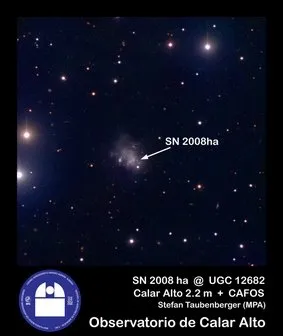
An explosion that could be similar to this is that of supernova SN 2008ha.
The finding may have implications regarding resolving two anomalies. In the central bulge of our galaxy, astronomers see evidence of a large number of positrons - the antimatter counterparts of electrons. If this new type of supernova produces a large amount of titanium-44, a radioactive isotope that emits positrons. Furthermore, titanium-44 decays into calcium-44, an isotope that accounts for 2 percent of the calcium in our solar system, whose origin has been difficult to discern.
Other possibilities, which the authors discuss in their report, is that the progenitor was a hypervelocity star, which could explain its location in the outskirts of the galaxy, instead of being in a star-forming region. The study's authors, however, do not believe this scenario is possible.
Sources and related links
- NewScientist: Quirky supernova could be something new by Stephen Battersby
- A new type of stellar explosion
H. B. Perets et al.
arXiv:0906.2003v1
Submitted to Nature - SN 2008ha: An Extremely Low Luminosity and Extremely Low Energy Supernova
Ryan J. Foley et al.
arXiv:0902.2794v2
About the images
Illustration.
Nob3L / stock.xchng
Figure: The environment of SN 2005E.
(a) NGC 1032, the galaxy hosting SN 2005E, observed by SDSS, before the explosion.
(b) SN 2005E on January 13, 2005. The SN is marked with an arrow. Note the remote location with respect to the galaxy.
(c) An image of NGC 1032 in the light of the H-alpha emission line, in which no recent star formation source is observed.
(d) Close-up of the location of SN 2005E before the explosion, by SDSS. No source was seen at the supernova location, marked with a circle.
(e-f) Deeper photometry of the SN location.
Credit: Hagai Perets et al.