I will begin this entry by thanking, first of all, Gerardo, who considered, in his own words, “pertinent,…, to reciprocate in a reciprocal manner,” my invitation to participate in “Tu Blog en mi Blog”, a space where the authors themselves present their blogs: characteristics, history, anecdotes, audience and everything they wish to tell us.
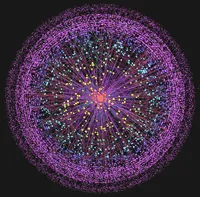
But in reality, the one I wish to thank deeply today for this possibility of sharing my reflections with you, is HER...
I discovered her in the year 2000 and from that moment on she changed my life, my work, my way of communicating, of teaching and of learning: the Great Network of Networks.
Since we met, she became part of a very important aspect of my “pedagogical life,” as she allowed me to discover a range of possibilities, and among them, Telecollaborative or Telematic Projects, which use telecommunications for their development and enable the exchange between students and educators from geographically distant institutions.
Collaborative Projects, in general, are an extremely rich tool to motivate students, give them the possibility to get involved in their learning in a different way and feel that they are the true protagonists.
According to John Dewey, "learning is more effective when it starts from experience and is student-oriented. It becomes more meaningful when it happens in the context of the real world, the student can connect it with their own world and it is then that they appropriate what they learn"
The capacity for world exploration and responsible work within a group are the fundamental pillars for the development of the skills and abilities that a collaborative project requires.
Regarding their strengths, to mention just a few of them:
• Greater motivation and commitment.
• Research becomes a fundamental stage, since one must first DISCOVER in order to later TRANSMIT.
• One learns for ONESELF and also for the OTHER, which implies collaborative learning.
• Greater development of creativity, in teachers to adapt the methodology to the curriculum and in students to achieve the proposed objectives in the best way.
• Enables real and meaningful knowledge.
• Fosters the creation of true learning communities.
In these projects, students, within a study framework, process information until they transform it into something meaningful for their learning. They learn to think differently, to make decisions and to relate to other people.
The practice in the classroom ceases to be centered on the teacher, and the student participates actively. Usually, contents from different areas are used and integrated and it is related to the real world.
For Guillermo Covarrubias Guerrero, "Creating new and motivating learning environments is a task that teachers and students must try to procure daily. Learning communities gain more strength every day, collaborative work is considered indispensable in the work of the school and of the entire society".
For my part, I began working with this pedagogical modality in the year 2002, initially as a participating teacher in some telecollaborative projects of the TELAR Network (Todos En LA Red), an educational telematic network open to all schools that promotes the pedagogical use of new information and communication technologies, through work in national and international collaborative projects.
This Network is part of the Global iEARN Network (International Education and Resource Network), in which educational institutions from 110 countries participate.
Starting in the year 2003 I began to develop and facilitate my own telecollaborative projects: “Tour por el Mundo”, “TELAR va a la Escuela, “En clave de FE” and “Caja TELAR Virtual”.
If you wish to learn about them and other telematic projects, I invite you to visit the TELAR Network and my blog “Aprendiendo Telecolaborativamente”, designed with the main purpose of introducing teachers and future educators to this different way of teaching and involving students in their own learning.
It has been a pleasure to share this space with you and an excellent opportunity to bring you this pedagogical modality that can be applied to different areas and educational levels.
And if you are an educator... DON'T DEPRIVE YOURSELF of living a different educational experience together with your students.
Once again, thank you Gerardo, for such a pleasant invitation.
Cristina