On June 17, the launch of two NASA spacecraft, LRO and LCROSS, is scheduled, whose objective is to detect and confirm the presence of water on our satellite. For that, they will crash into the moon, producing two large dust clouds.
The identification of water is very important for the future of human activities on the Moon. LCROSS will perform two large impacts to find out if ice exists beneath the surface. The ejected material will be studied to determine if water exists as vapor or ice, hydrocarbons, or other materials.
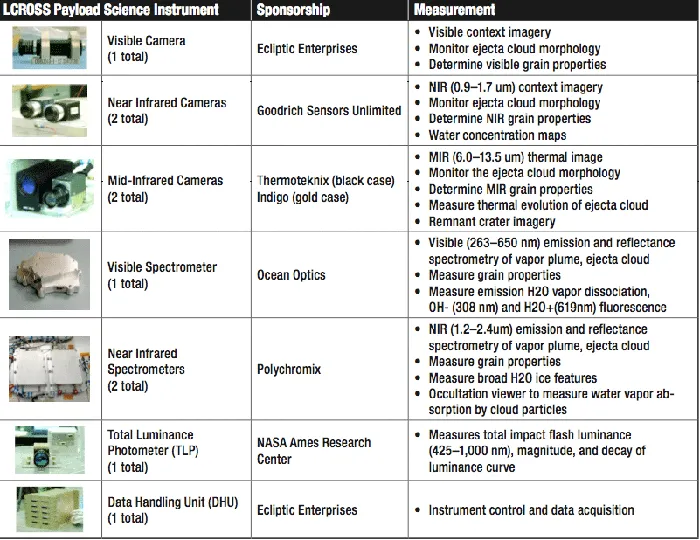
The payload consists of nine instruments, in different wavelengths: four infrared cameras and one visible, three spectrometers (one in the visible and two in infrared) and a photometer. A data collection unit will take the information from each instrument and transmit it to mission control.
The two main components are the Shepherding spacecraft that guides the rocket to the selected site on the Moon which has a high probability of having water and the rocket's upper stage, Centaur. These two components together with LRO will be launched together and one hour after launch LRO will separate. The Shepherding spacecraft will guide the Centaur rocket through multiple Earth orbits, each of 38 days. Then the rocket separates from the spacecraft and will impact the Moon at twice the speed of a bullet, causing an impact that will generate a large cloud of debris and dust.
We can imagine this impact as throwing an SUV-type truck at over 9,000 km/h onto the Moon. The impact will cause a crater one third the size of a soccer stadium: about 20 meters in diameter and 3 meters deep, approximately.
The amount of ejected dust could fill 10 buses and will reach up to almost 50 km in height!
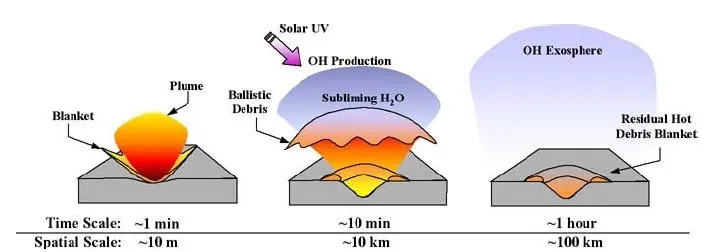
While this is happening, the spacecraft containing the instruments on board will take images of the descent and the impact. Four minutes later, the spacecraft will follow almost the same path as the rocket to analyze the cloud with its instruments. Shepherding will transmit the data to Earth before its impactful finale. The spacecraft will also crash into the Moon generating another cloud that could be seen from Earth with amateur telescopes.
The Moon's craters and the LCROSS crater
LCROSS will generate an impact crater between 20 and 25 meters in diameter. Through a telescope, one of the most striking lunar craters is Copernicus, with its 93 kilometers in diameter. But there are many others larger: Iridium Basin or Crisium Basin of 1200 and 600 kilometers respectively. The largest is Aitken, with 2500 kilometers. Compared to this, the LCROSS crater sounds very small. And it is.
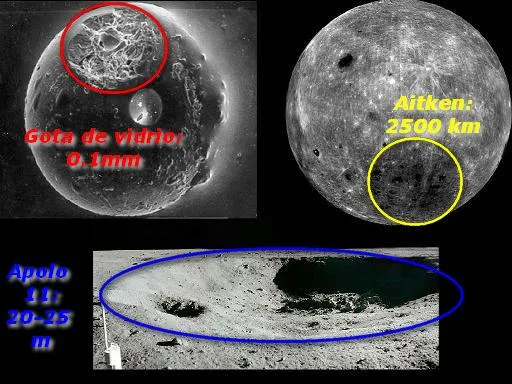
But our view of the crater depends on what we compare it to. The crater near the Apollo 11 landing site (East Crater) has a size similar to that of LCROSS. But even these, which seem small compared to the previous ones, are extremely large if we compare them with the smallest ones found.
For example, a glass droplet of 0.25 millimeters was found that formed from the heat and pressure created by one of the lunar craters. While on the Moon's surface, this glass droplet was hit by a tiny micro-meteorite, which left an impact of only 0.1 millimeters in diameter.
Lunar craters come in a great variety of sizes. The one LCROSS will leave will be 250 thousand times larger than the 0.1 mm one and 100 thousand times smaller than Aitken.
In the image we can see the comparison between the micro-meteorite on the glass speck, the Apollo 11 landing site and the Aitken crater.
The Moon's cartographer
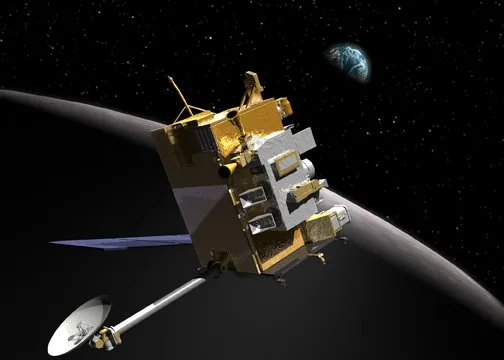
LRO is the Lunar Reconnaissance Orbiter that will try to find landing sites, characterize the radiation environment and demonstrate new technologies.
The spacecraft will be in a low polar orbit (50 km) on a one-year mission, transmitting data on temperatures, high-resolution images and the ultraviolet albedo of the Moon.
The LRO payload consists of six instruments and a technology demonstration:
- Cosmic Ray Telescope for the effects of radiation: This instrument is called CRaTER and will characterize the radiation environment and determine its potential biological impact.
- DLRE:Diviner Lunar Radiometer Experiment: will provide thermal measurements with detailed information on surface and sub-surface temperatures (identifying potential ice deposits) and hazardous sites.
- LAMP:Lyman Alpha Mapping Project: will map the entire surface in the far ultraviolet, will search for surface ice in the polar regions.
- LEND:Lunar Exploration Neutron Detector: Will create maps of the hydrogen distribution and provide information on the ambient radiation.
- LOLA:Lunar Orbiter Laser Altimeter: will generate a 3D map of the moon and perform ground measurements.
- LROC:Lunar Reconnaissance Orbiter Camera: will send high-resolution black and white images of the surface, the poles and also in color and ultraviolet.
- Mini-RF Technology Demonstration
The primary objective will be to search for subsurface water ice deposits. It will also take high-resolution images of the permanently shadowed regions.
Sources and related links
About the images
Credit: NASA Ames Center. LCROSS/LRO