Guest post
Engineer Pablo González tells us about the international CANSAT project and particularly how this initiative is developing in our country.
I met Pablo through this blog, a few years ago now. Every time Pablo carries out CANSAT activities he invites me and so far I have never been able to attend. I had as a pending task to write something about it, since rocketry within reach of one's pocket and the knowledge of high school students I think is a fruitful, enriching and exciting task. I suggested to Pablo that he write an article to publish here and he kindly agreed. What follows, then, is the exclusive authorship of Pablo González, whom I publicly thank for his commitment to scientific outreach and rocketry in this case. I invite readers to visit his website Astroeduc.com.ar.
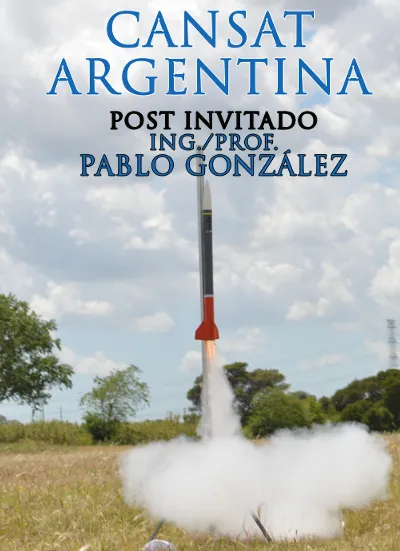
CANSAT ARGENTINA
By Eng. Pablo González
The CANSAT project in Argentina attempts to reproduce on a scale the entire process by which a satellite is designed, built, tested, launched and operated. This methodology has its origin in the United States of America, where a teacher and a group of enthusiasts proposed to elevate a payload whose size did not exceed that of a soda can (hence the term CAN = can, SAT = satellite). It was a huge success all over the world, to the point that it became an annual university competition and was backed by the main space agencies (NASA, ESA, JAXA, etc.).
In our country, the Asociación de Cohetería Experimental y Modelista de Argentina adopted the model for high school and in 2004 we launched the first test. The Comisión Nacional de Actividades Espaciales became interested in the program and carried out a very successful pilot test. Currently, the CANSAT Argentina program continues in some schools in the city of Buenos Aires and the surrounding area.
Our experience
As an engineer, I currently work in the Grupo de Tecnología Aeroespacial at UTN. But my passion has always been teaching, and as a member of ACEMA I set out to bring this project to the schools where I teach.
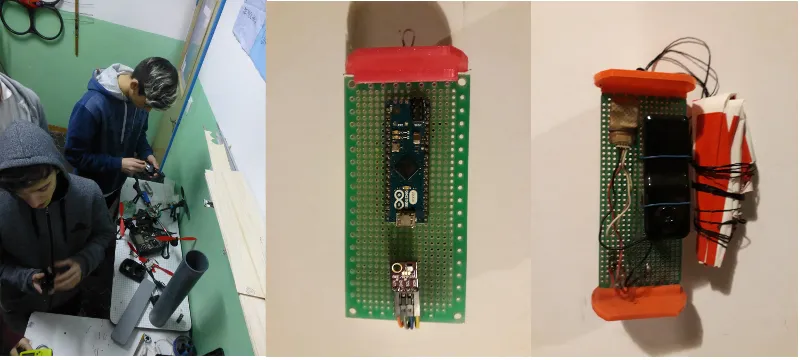
For this year, the missions were two. One of the femto-satellites, so called because they weigh less than 100 grams, would carry an altimeter-thermometer and a video camera and should have an autonomous descent after exceeding 100 meters in height aboard a rocket. This limit seems low, but only logistical reasons prevent us from going higher: a small object is lost from sight at that height and with some wind it can fall very far. The other satellite would travel aboard and return with the rocket, performing a record of pressure, humidity and temperature from a sensor connected to a micro Arduino.
The kids worked all the first part of the school year and divided their efforts into dedicated groups: programming, space segment, logistics and documentation. Applying the same methodology used in the space environment implies following a series of steps and a type of organization that stems from a series of standards, adapted for education. This adaptation is an arduous task, almost as arduous as getting teenagers to carry it out... even so, in December we were ready to start the launch campaign. This event is, by far, what takes up most of the budget, since the costs we handle are really low: assembling a Cansat and a rocket does not exceed $1000, equivalent today to 50 US dollars.
The final day
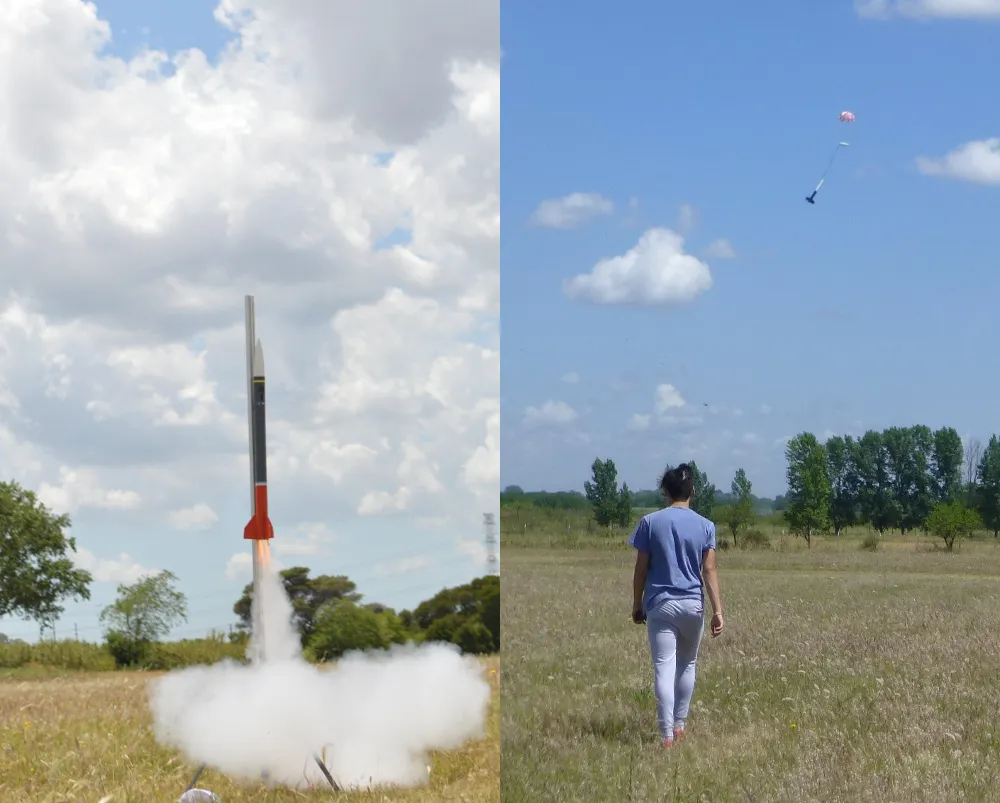
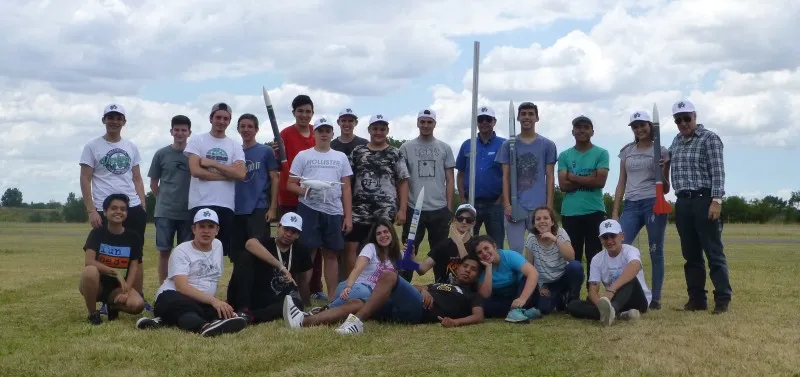
On Wednesday, December 6, 2017, we carried out our thirteenth launch campaign at the Agrupación Aeromodelista Pucará, in the town of González Catán. We were accompanied by the president of ACEMA, Guillermo Descalzo, mentor of the program in Argentina. After deploying the equipment, a calibration shot (a launch without payload of a small rocket) was carried out to establish the definitive place to mount the launch pad. This is done to verify the systems and foresee the landing site. At this point it is good to clarify that all takeoffs are vertical and descents are practiced with recovery systems, generally parachutes.
The first launch was carried out at 12:30 h. A failure in one of the engines caused the flight to be erratic and the satellite did not deploy, not exceeding 50 meters in altitude, well below our “Kármán line” of 100 meters. Let us remember that the Kármán line is the boundary of the atmosphere with outer space, which the International Astronautical Federation set at 100 km. The second launch was successful, with a payload that worked perfectly, exceeding 150 meters at its apogee. The day ended with a lunch made on the Association's grill.
Results and some conclusions
After recovering the payloads, the data was downloaded to obtain a profile of some atmospheric parameters of the flight location. As can be seen, the scientific and technological objectives are in line with the level of schooling, not constituting an end in themselves. The most important thing is to carry out the educational process that involves applying a work methodology similar to that carried out in the aerospace industry. Teamwork, meeting objectives, responsibility in tasks and above all the joy of discovering that what is learned in class can have a direct application in reality, are stimulus enough to keep trying every year.
Guest Post: Prof. Pablo González
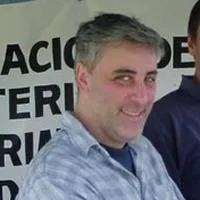
Pablo Martín González is a Mechanical Engineer (UTN) and physics teacher at ORT schools and the Instituto San Felipe Neri, and Co-Director of GTA (Grupo de Tecnología Aeroespacial) at Universidad Tecnológica Nacional, where he also teaches mechanical design.
He is Director of the Grupo Astronómico Omega Centauro (GAOC), founding partner of ACEMA, First professor and principal investigator of the CanSat Program.
Sources and related links
- CANSAT on Wikipedia
https://es.wikipedia.org/wiki/Cansat - Page of the Asociación de Cohetería Experimental y Modelista de Argentina
http://www.acema.com.ar - Author's page about his teaching activities
http://www.astroeduc.com.ar
About the images
The images belong to Pablo M. González. Astroeduc.com.ar