Four centuries after Galileo pointed his homemade instrument at the skies, the largest and most technologically advanced telescope will make its formal debut.
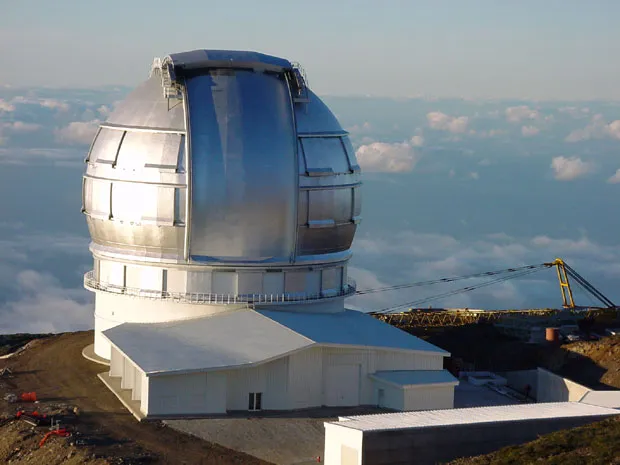
It is the Gran Telescopio Canarias (GTC), which with its 10.4-meter mirror diameter, the largest light-collecting area of any other, will be inaugurated on July 24 in the Canary Islands, Spain.
At 2,400 meters above sea level, on a mountain on the island of La Palma, at the Roque de los Muchachos Observatory, it is a Spanish initiative, led by the Instituto de Astrofísica de Canarias with the participation of Mexico and the United States.
This great scientific infrastructure has a primary mirror composed of 36 hexagonal vitroceramic elements, each 1.9 meters in diagonal, which when coupled together form a surface equivalent to that of a single circular mirror 10.4 m in diameter.
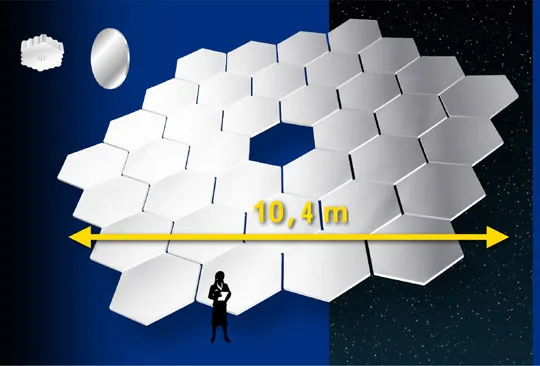
By eliminating the gaps that circles cannot occupy, the hexagon is also an ideal shape for saving space. Precisely, like the hexagonal cells of a honeycomb, the GTC has no space to waste and much material to save, but with the difference that it is not trying to store honey, but to collect light. But if there is one function in nature that the hexagon knows how to do, it is to pave spaces, with special success when it comes to spherical surfaces, like a turtle's shell or a pine cone's bark. Therefore, thanks to the hexagon, the GTC's primary mirror has been given a perfect concave hyperbolic surface that, like an open container, collects and concentrates all the light and sends it to the rest of the mirrors, secondary and tertiary, responsible for conducting the starlight to the desired foci for study.
To learn more: How the primary mirror works
The instruments
The GTC has two scientific instruments: OSIRIS (multi-object camera and spectrograph in the visible) and CanariCam (camera and spectrograph, with polarimetry and coronagraphy capabilities, in the thermal infrared).
The next common-use scientific instrument is being built for the GTC: a multi-object spectrograph in the near-infrared called EMIR.
Another second-generation instrument, under development by the University of Florida, is CIRCE: an infrared camera that will also work in the near-infrared range (1 - 2.5 µm) and will give the GTC imaging capability in the near IR before the arrival of EMIR.
FRIDA is another instrument for the GTC in the development phase. FRIDA, which will work with the GTC's Adaptive Optics system, will have the capability to take images in broadband and narrowband, in addition to performing integral field spectroscopy in the spectral range of 0.9 - 2.5 µm. Its development is led by the Universidad Nacional de México UNAM.
Additionally, it has been proposed that the next scientific instrument to be developed for the GTC be a high-resolution spectrograph for the visible range. Some of the institutions that form the GTC's scientific community have shown interest in participating in the development of this instrument.
Multiple proposals for interesting scientific instruments to be installed on the GTC as visitor instruments are being received. These proposals are being studied by the corresponding committees.
CanariCam is a camera that works in the mid-infrared range with possibilities for imaging, spectroscopy, coronagraphy, and polarimetry. CanariCam will work in the thermal infrared between ~7.5 and 25 microns.
First light and the first data
On July 13, 2007, the first sky observations with the GTC were made.
A video of the event can be viewed at:
http://info.telefonica.es/gtcprimeraluz/
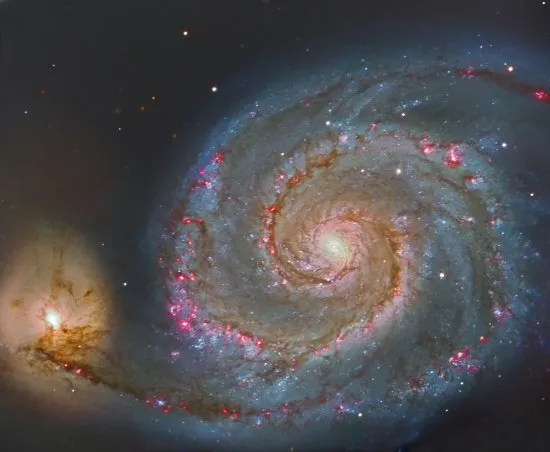
The GTC has delivered its first scientific data to about half a dozen observing programs, with proposals ranging from the study of planets beyond the Solar System to the search for primordial galaxies. The use of the telescope by the astronomical community began in March 2009, and it will be next July 24 when its official inauguration takes place by Their Majesties the King and Queen of Spain.
The first researchers to receive data from the telescope have been Pilar Ruiz, from the University of Barcelona; Alberto Javier Castro-Tirado, from the Instituto de Astrofísica de Andalucía; Víctor Béjar, from the Instituto de Astrofísica de Canarias; Miguel Chávez, from the Instituto Nacional de Astrofísica, Óptica y Electrónica of Mexico, and Eric Ford, from the University of Florida.
Among the first observations of the GTC there is something for almost every taste. One of the observing programs is that of Víctor Béjar, a researcher at the Instituto de Astrofísica de Canarias. "With the GTC we hope to have clues about how brown dwarfs are born and, in general, about what the star formation processes are." His project directed the telescope towards a very young region in the constellation of Scorpius, located 472 light-years from Earth, in search of T-type dwarfs whose spectrum contained features of methane. "These objects are very cold and very faint in the optical range, and that's why we needed a large telescope like the GTC," explains Béjar.
The inauguration
The event will be presided over by Their Majesties the King and Queen of Spain and will be attended by the Minister of Science and Innovation of Spain, Cristina Garmendia, and the President of the Government of the Canary Islands, Paulino Rivero, as well as representatives of the participating institutions from Mexico and the United States in the telescope, among others.
In addition, the presence of Brian May, lead guitarist of the group Queen and astronomer, is expected.
The GTC has facilitated the technological enrichment of the companies that have intervened in its construction. Now, once it has been put into operation, it constitutes a powerful tool with which to observe the Universe. With it, scientists will be able to unveil many of the secrets that still remain hidden from our knowledge.
Sources and related links
- Gran Telescopio Canarias
- The Gran Telescopio CANARIAS begins to produce its first scientific data
- Inauguration of the Gran Telescopio CANARIAS (GTC)
- GTC Digital
- 360º view of the GTC by Yvan van Hoorickx
- IAC YouTube Channel
About the images
Dome and building of the Gran Telescopio CANARIAS (GTC). General view from the east. February 2003.
CREDITS: Pedro Izquierdo, GTC
Size relationship between the primary, secondary, and tertiary mirror.
CREDITS: Gabinete IAC, SMM IAC
Image of M51, better known as the Whirlpool Galaxy. Located 23 million light-years away from Earth, this magnificent spiral was observed using the OSIRIS instrument on the GTC telescope with an exposure time of two minutes. To reach the same depth, a one-meter diameter telescope would need an exposure time of approximately four hours. The image was obtained and calibrated by the OSIRIS scientific team and processed by Daniel López (IAC).