Today ESO (the European Southern Observatory) released a new and incredible image of the sky around the Eagle Nebula, a stellar nursery where stars are excavating the enormous pillars of gas and dust.
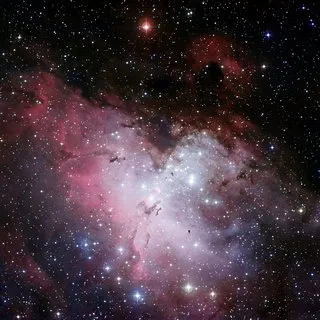
At 7,000 light-years away, in the direction of the Constellation of Serpens, the Eagle Nebula is a dazzling stellar nursery, a region of gas and dust where young stars are currently forming and where a cluster of massive, hot stars, NGC 6611, has just been born. The powerful light and strong winds from these stars are shaping pillars a light-year long, seen in the image as a silhouette against the bright background of the nebula. The nebula has a shape similar to an eagle, with the central pillars as its "claws".
The star cluster was discovered by Jean Philippe Loys de Chéseaux, in 1745-46 and later included by Charles Messier in his catalog with the number 16, and he noted that the stars were surrounded by a faint glow. The Eagle Nebula achieved iconic status in 1995 when its central pillars were recorded in the famous image obtained with the Hubble Space Telescope. In 2001, ESO's VLT telescope captured another incredible image, in the near-infrared, giving astronomers a penetrating view through the dark dust and clearly showing star formation in the pillars.
The new image, obtained with the Wide-Field Imager camera on the 2.2-meter MPG telescope of ESO at the La Silla Observatory in Chile, covers an area in the sky as large as the full Moon and is about 15 times more extensive than the previous VLT telescope image and more than 200 times larger than the famous Hubble visible-light image. The entire region around the pillars can now be seen in exquisite detail.
The "Pillars of Creation" are in the middle of the image, with the cluster of young stars, NGC 6611, at the top and to the right. The "Tower"—another pillar captured by Hubble—is in the central left part of the image.
Figures that look like fingers emerge from the vast wall of the gas and dust cloud, not unlike stalagmites rising from the floor of a cavern.
Inside the pillars, the gas is dense enough to collapse under its own weight, forming young stars. These columns of gas and dust a light-year long are being simultaneously sculpted, illuminated, and destroyed by the intense ultraviolet light from the massive stars in NGC 6611, the adjacent star cluster. Within a few million years—a blink in the universal eye—they will be gone forever.
Sources and related links
- ESO: An Eagle of Cosmic Proportions
The ESO Observatory press release contains the videos shown here, but in a variety of formats, as well as an ENORMOUS image of the nebula!
About the images
Three-color composite image mosaic of the Eagle Nebula (Messier 16), based on images obtained with the Wide-Field Imager camera on the 2.2-meter MPG/ESO telescope at the La Silla Observatory. In the center can be seen the so-called "Pillars of Creation". This wide-field infrared image shows not only the central pillars, but also several others in the same star-forming region, as well as a huge number of bright stars in front of or behind the Eagle Nebula. The star cluster seen at the top right is NGC 6611, home to the massive, hot stars that illuminate the pillars. The "Tower"—another large pillar—is in the middle left area of the image.
Credit: ESO