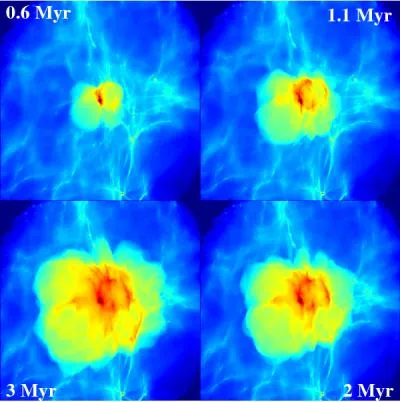
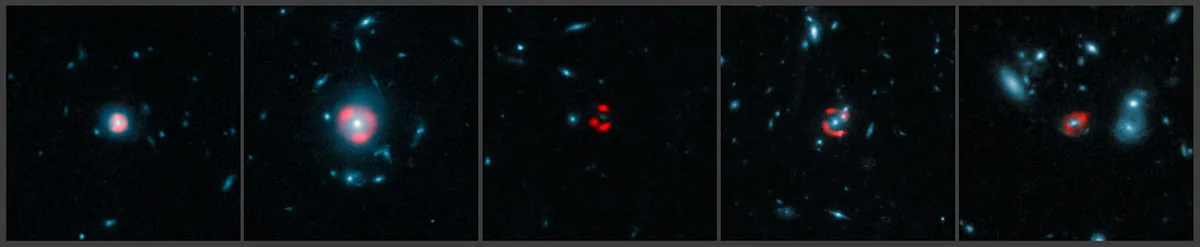
The large-scale structures of the universe and the role of the "cosmic web" and computational simulations to know how galaxies grow and evolve.
The following article is a free translation of the note published in NewScientist "How does you galaxy grow?" by E.S. Reich.
That original note is accompanied by a gallery with the different shapes of galaxies and can be found at:
http://www.newscientist.com/gallery/howdoesmygalaxygrow
Rob Simcoe looks a bit nervous as he fishes a balloon out of a tube of liquid nitrogen. "I hadn't done this demonstration before," admits the astronomer, moving the balloon over a candle flame. The balloon represents a galaxy. Heated by the candle, it should expand and explode, just as it is thought that in the early universe galaxies produced violent expulsions of gas when heated by explosive stars.
But at the last second, Simcoe gets careless. The candle makes a hole in one side of the balloon. As the smell of burnt rubber reaches the front row of the conference hall at the Massachusetts Institute of Technology, laughter spreads. Astronomers, Simcoe indicates, don't usually perform laboratory demonstrations.
They wish they could. We would love to know more about galaxies. We know there are stellar nurseries and we admit their dazzling diversity: large, small, fierce stellar factories and quieted disks, elegant spiral whirls and amorphous figures. But where does all that diversity come from? Things could be different if astronomers could test their theories in the laboratory.
And they can, increasingly. Not with balloons and candles, certainly, but with the great computing power of supercomputers. Along with ever-improving observations of the early universe, large simulations are beginning to paint a unified picture of why the universe looks the way it does. At its heart is an invisible scaffold of dark matter and cold gas on which the visible constituents of the universe are supported, a structure known as the cosmic web.
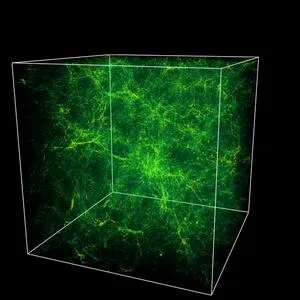
Now, simulations and observations are a duet trying to unveil the vital role of this web. It appears to be much more than a framework structure. According to the latest ideas, its filaments are, in fact, the umbilical cords that provide galaxies with the nutritious gas they need to grow.
That would be an intriguing twist in the story of the cosmic web. The concept of the web emerged in the mid-1980s as a product of an idea about galaxy formation, known as the hierarchical model, CDM (cold dark matter), proposed in 1978 by Martin Rees and Simon White of the University of Cambridge.
The model started with a universe that expanded incredibly fast after the big bang, but not regularly. Small irregularities in the distribution of matter created regions of higher density where "halos" of dark matter gathered quickly. Each of these created a deep gravitational well into which gas—mostly hydrogen—fell. The gas heated up and generated the first stars.
These clumps of matter, the seeds of future galaxies, were islands of activity in an almost empty cosmos, the nodes of the developing cosmic web. They weren't precisely static. Attracted by their mutual gravity, they began to collide and merge violently, which triggered star formation. The formation then calmed down until another merger stirred things up and created an even larger body. The varied galaxies we see today would be the result of those cycles of mergers that kept creating ever larger bodies.
This picture seemed to agree with observations of the early universe. Measurements of the cosmic microwave background radiation—an image of when the universe was 300,000 years old—confirm this idea of irregularities arising from the distribution of matter that paved the way for small density fluctuations to become the mature galaxies we observe today.
But cracks began to appear. One of the biggest showed up in 2006, when astronomer Reinhard Genzel and colleagues published observations of some of the most primitive star-forming galaxies with the VLT telescope in Chile. They used a new technique called integral field spectroscopy, which involves analyzing the color of light from small regions in the sky 20,000 times smaller than the full Moon, to reveal whether they are moving toward us or away from us. Used on distant galaxies, it can reveal something of their internal dynamics. "In terms of technology it was a tremendous advance," said Genzel.
What was discovered was strange: a galaxy so distant that the light we now receive was emitted when the universe was only 3 billion years old, less than a quarter of its current age. The galaxy was very bright. In fact, it was forming stars with a total mass of about 100 times the mass of our Sun, each year. And there were no signs of any violent collision. A central conclusion of the hierarchical model is that star formation occurs in galaxies that are merging. This galaxy, however, was a neat rotating disk and not the irregular object one might expect as the result of a merger.
(Nature, vol 442, p 786).
It wasn't the only anomaly of its kind. Between 2006 and the present, Genzel and his team collected images of dozens of more primitive galaxies that seem placid, but form stars vigorously. For these galaxies, at least, the picture of hierarchical mergers is not the whole story. So then what?
The options were limited. Observations of the cosmic background provided a clear picture of density fluctuations in the early universe that no model could ignore. The idea of dark matter halos growing and merging also seemed incontrovertible: the mysterious dark matter and its invisible gravitational hand is necessary to hold galaxies together, otherwise the force of their own rotation would tear them apart.
The only room for maneuvering lies in what happened with the gas in star formation. "The details of the gas were never as solid a foundation as the idea of merging dark matter halos," notes Simcoe.
In early 2000, Avishai Dekel and Yuval Birnboim, from the Hebrew University in Jerusalem, had built computer simulations to test alternative scenarios. Their idea was that, instead of being under the dominance of dark matter from the beginning, the gas could have accumulated quietly in the halos all along.
The initial results were promising. A stream of gas falling into a dark matter halo could be compressed and efficiently driven to the developing galactic center, where it could generate new stars. The implication was that mergers were not necessary for stars to be born.
The largest computer simulations
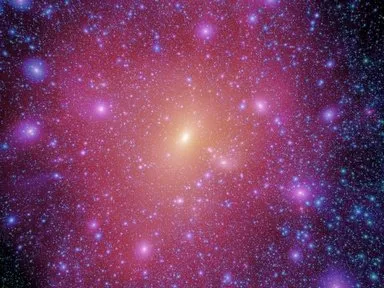
In this blog we have commented on some of the largest simulations performed to understand galactic formation: The Aquarius project and the Millennium project are two of the best examples.
See: "Computers behind the mystery of dark matter".
We also talked about BHCosmo on black holes and galactic formation.
Where did the gas come from? In 2005, Dušan Kereš, from the Harvard-Smithsonian Center for Astrophysics in Cambridge, and colleagues answered. They simulated the movement of about 2 million "particles" representing gas and dark matter in 1000 primitive galaxies. At the start, they found that gas streams seemed to form naturally, linking one galaxy with the next across the nearby void. If galaxies were the nodes of the cosmic web, these streams were its filaments - like pipes that feed on the surrounding gas that allowed galaxies to form stars uniformly and quietly over time.
In January of this year, Dekel and colleagues removed the last objection to their picture: that those filamentary flows could not provide galaxies with the gas they would need. They published the results of a supercomputer simulation involving one billion gas particles and 4 billion dark matter particles that modeled the joining of three filaments in the cosmic web. And they found that gas equivalent to 200 times the mass of the Sun could flow to the nodes each year, enough to support the observed formation rate in young galaxies. (Nature, vol 457, p 451).
Without violent mergers, less gas and energy is wasted, leaving more to form stars. So smooth is the process that sharp galaxies can form in the early history of the universe, just as Genzel and his team observed. To top it off, in April, Bruce Elemgreen of IBM, together with Frederic Bournaud of the French Atomic Energy Commission, showed how clumps of matter created by gravitational instabilities in disks fed by cold gas streams could evolve into the characteristic spiral arms of many mature galaxies like our Milky Way
(The Astrophysical Journal, vol 694, p L158).
The new picture does not completely rule out the idea of mergers. Mergers of dark matter clumps, it is thought, are important both for the formation of dark matter halos in the first place, and probably also for the formation of larger galaxies. More than 1 in 10 galaxies are massive, featureless elliptical bodies without internal features like spiral arms. Those galaxies would have formed when smaller systems that grew by accreting gas from cold streams, merged.
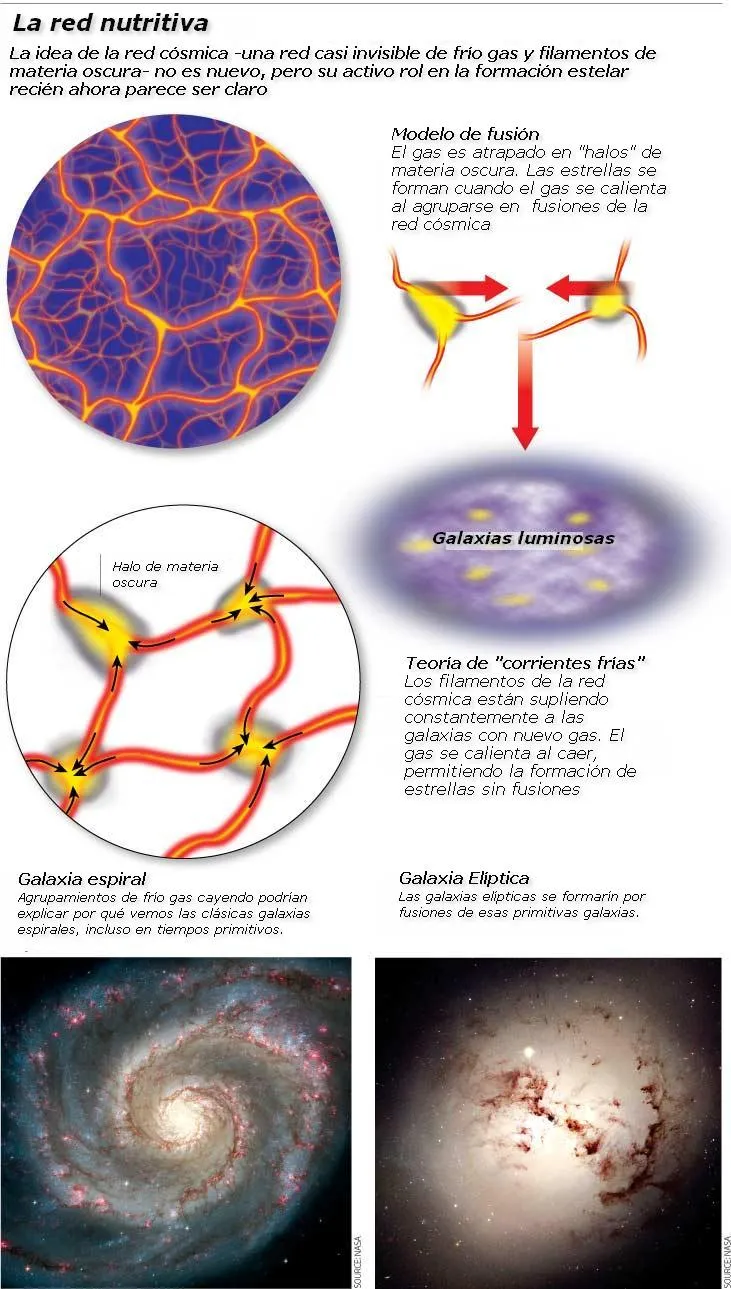
For that reason, Dekel describes the new role of the cosmic web as a generalization, rather than a refutation, of the merger picture. The material falling into galaxies along filaments is many times a smooth flow, forming disk-type galaxies, but, sometimes, includes large clumps of matter, turning the process into something resembling a merger.
According to the models, cold gas accretion could continue today. In the early universe, the filaments feeding galaxies were about 10,000 light-years in diameter, 10 times smaller than a galaxy like ours. But as the universe expanded, these filamentary pipes became wider and less defined. That makes cold accretion less efficient than it was in the distant past, decreasing the star formation rate in mature galaxies like ours. Today, cold streams are less of a deluge and more of a gentle rain of gas onto galaxies.
That is why no direct evidence of cold streams has ever been obtained in our immediate neighborhood. But there are other signs. The traces of the cold accretion process would be ultraviolet rays known as Lyman-alpha radiation, emitted when gas falls into galaxies and heats them. Unfortunately that radiation is almost completely absorbed by dust in the galaxy and in Earth's atmosphere, making nearby cold flows impossible to see from Earth.
For that reason, Genzel warns: "We must be cautious not to have a paradigm effect where everyone believes they see the same thing. No one has seen a cold gas flow yet."
Paradoxically, these flows might be easier to observe in distant galaxies. Light from distant objects is redshifted by the expansion of the universe, so the original Lyman-alpha emissions from galaxies in the early universe must have shifted to visible wavelengths that we can observe.
Abraham Loeb and Mark Kijkstra from the Harvard-Smithsonian Center think we have already seen something like this. They point to a 1998 discovery by Chuck Steidel and colleagues from the California Institute of Technology. The researchers found two enormous "bubbles" of gas emitting Lyman-alpha radiation at a time when the universe was only 2 billion years old.
Other bubbles (or "blobs") have been found in many other early galaxies. Loeb and Dijkstra think they are filaments of the cosmic web (www.arxiv.org/abs/0902.2999). But not everyone agrees. Steidel says that some "blobs" are gas clouds around quasars and that the latter would be the source of the gas, rather than the surrounding gas. The idea of cosmic web filaments is, in his opinion, "a romantic notion but I haven't seen anything that convinced me it's true," he noted.
Close-up images of young galaxies forming stars, compared with computer simulations, could indicate if we are on the right track. John Salzer from Indiana University and colleagues have recently found 15 nearby galaxies that have masses comparable to the Milky Way but seem to have started their star formation only 3 to 4 billion years ago (The Astrophysical Journal, vol 695, p L67).
If all galaxies formed through mergers, there should be evidence of violent collisions in those galaxies. If, on the other hand, galactic formation can be driven by cold streams, galaxies should look like disks with a supply of primordial hydrogen gas, a filament of the cosmic web. In that case, Salzer speculates, those galaxies began to form in a void where filaments were relatively scarce, meaning they only took shape later.
So far, Salzer's images do not have the necessary resolution to establish the internal dynamics of the galaxies.
For most astronomers, it is clear that the overall picture of galaxy formation needs revision. 'In the last 4 or 5 years the picture has changed significantly. Now people are seeing them as established in a filamentary structure that nourishes them,' commented Kereš. Reinforced by simulations, the cosmic web seems to be real and here to stay.
Sources and related links
- How does your galaxy grow?, by Eugenie Samuel Reich
- The cosmic web; by Simcoe, Robert A.; Investigación y Ciencia 340 - JANUARY 2005
- The Cosmic Web, by Rob Simcoe; January 2004 American Scientist
DOI: 10.1511/2004.1.30 This is the article in the English version of the article "The cosmic web" in Investigación y Ciencia. Here is a link to a pdf with the complete article in Spanish! - Mapping the cosmic web from its chemical composition
Sofía A. Cora;
Boletín de la Asociación Argentina de Astronomía, vol.47, p.324-335
NASA ADS - Galaxy study casts doubt on dark matter
- Analytical and numerical models of galaxy formation, Simon White
- Simulating the joint evolution of quasars, galaxies and their large-scale distribution; Volker Springel et al; astro-ph/0504097
About the images
- Image from the Aquarius simulation Aq-A-1.
- Numerical simulations show the distribution of intergalactic gas in the filaments (green) and voids (black) of the cosmic web.
Credit: R. Simcoe - The cosmic web: Image adapted into Spanish, published by NewScientist.