On July 23, 1999, the Chandra X-ray Observatory was launched aboard the space shuttle Columbia to begin a mission that was originally five years long.
With its ability to obtain high-resolution images in X-rays, Chandra has allowed astronomers to investigate phenomena as diverse as black holes, comets, and dark energy and matter. We have written a lot here about the findings made with the observatory and we tell how the universe looks in X-rays.
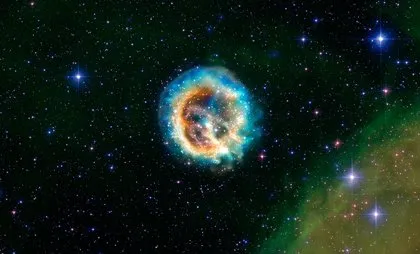
To commemorate its tenth anniversary, three new versions of classic images from the observatory will be published over the next three months. These images, the first of which is available today, provide new data and a more complete view of objects that Chandra observed in earlier stages of its mission. The image released today corresponds to the remnants of an explosive star, E0102-72.
The next image, which we will see next month, will highlight the anniversary of when the observatory first opened its eyes and collected light in its detectors. On that occasion, the majestic Cassiopeia A was recorded, on August 19, 1999.
The third image will be published during the symposium "Chandra's First Decade of Discovery," which will be held in Boston, starting September 22.
The observatory was proposed to the US space agency by Harvey Tananbaum, current director of the Chandra Center at the Smithsonian Observatory in Cambridge, and Riccardo Giacconi. Unlike Hubble, these X-ray "eyes" are in a very elliptical orbit that takes it to almost one-third the distance to the Moon and was not designed to receive servicing missions.
The image released today corresponds to a supernova remnant, 1E 0102.2-7219, or "E0102" located 190,000 light-years from Earth in the direction of the Small Magellanic Cloud. The remnant was created when a star more massive than the Sun exploded in an event that would have been visible from Earth's Southern Hemisphere a thousand years ago.
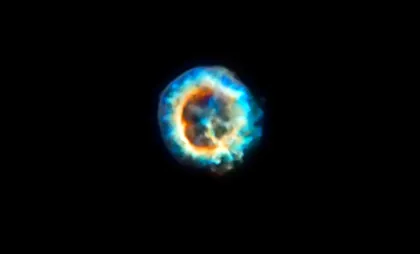
Chandra initially observed E0102 shortly after its launch. Now, new data were used to create this new image. The lower-energy X-rays are colored orange, the intermediate ones cyan, and the higher-energy ones blue. An optical image from the Hubble Space Telescope (in red, blue, and green) shows the foreground stars in the field and additional structures.
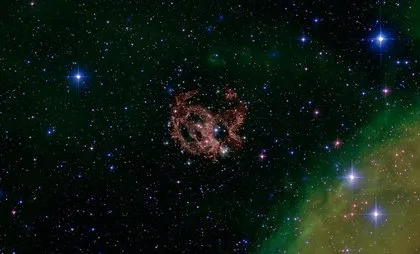
The Chandra image allows us to see the outer wave of the explosion produced by the supernova (blue) and an inner ring of cooler material (red-orange). The inner ring is probably expanding ejected material that is being heated by a shock wave. A massive star (not visible in this image) is illuminating the green clouds of gas and dust seen in the lower right region of the image. That star could have properties similar to the one that exploded to form E0102.
Spectrum analysis provides astronomers with new information about the geometry of the remnant, with implications for the nature of the explosion. The spectrum, which precisely separates X-rays from other distinct energies, shows that some of the material is moving away from Earth and some is approaching us. When the material moves away, its light is stretched toward the red part of the spectrum due to the well-known Doppler effect. Conversely, when the material approaches us, the light becomes bluer due to the same effect.
A clear separation was detected between the redshifted light and the blueshifted light, leading astronomers to think that E0102's appearance is best explained by a model in which the ejection has the shape of a cylinder viewed from the front.
The smaller red and blue cylinders represent material moving faster near the axis of the cylinder.
This model suggests that the explosion that created the remnant object could have been highly asymmetric, which is consistent with neutron stars. Another possibility is that the star exploded in a disk of material formed when material was expelled from the equator of the pre-supernova red giant star. These asymmetries have been observed in winds from lower-mass red giants that form planetary nebulae.
Sources and related links
- NASA Celebrates Chandra X-Ray Observatory's 10th Anniversary
- Adding a New Dimension to an Old Explosion
- The universe in X-rays
About the images
- Credits: X-ray (NASA/CXC/MIT/D.Dewey et al. & NASA/CXC/SAO/J.DePasquale); Optical (NASA/STScI)